

398
B. Hardy et al.
and our approach to legal review and framework will embrace the need for alignment with multiple legal contexts. We plan to interact closely with projects running
under the Innovative Medicines Initiative’s Big Data for Better Outcomes program,
which aims to facilitate the use of diverse data sources to deliver results that reflect
health outcomes of treatments that are meaningful for patients, clinicians, regulators,
researchers, and healthcare decision makers.
19.11 Preclinical Case: Regulatory Acceptance
of Workflows for Heterogeneous Knowledge
Integration
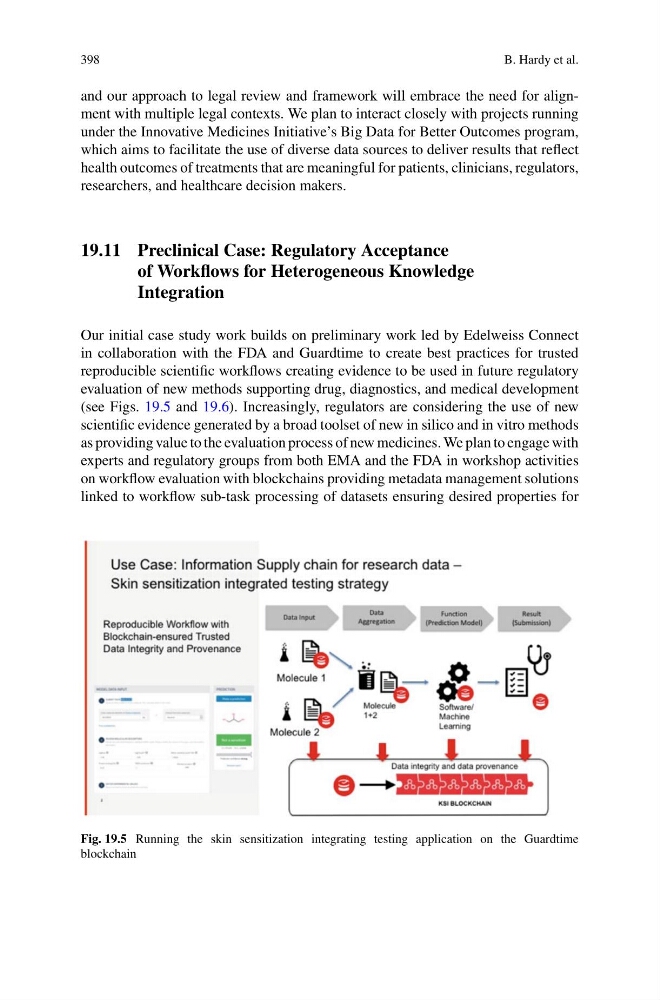
Our initial case study work builds on preliminary work led by Edelweiss Connect
in collaboration with the FDA and Guardtime to create best practices for trusted
reproducible scientific workflows creating evidence to be used in future regulatory
evaluation of new methods supporting drug, diagnostics, and medical development
(see Figs. 19.5 and 19.6). Increasingly, regulators are considering the use of new
scientific evidence generated by a broad toolset of new in silico and in vitro methods
as providing value to the evaluation process of new medicines. We plan to engage with
experts and regulatory groups from both EMA and the FDA in workshop activities
on workflow evaluation with blockchains providing metadata management solutions
linked to workflow sub-task processing of datasets ensuring desired properties for
Fig. 19.5 Running the skin sensitization integrating testing application on the Guardtime
blockchain
B. Hardy et al.
and our approach to legal review and framework will embrace the need for alignment with multiple legal contexts. We plan to interact closely with projects running
under the Innovative Medicines Initiative’s Big Data for Better Outcomes program,
which aims to facilitate the use of diverse data sources to deliver results that reflect
health outcomes of treatments that are meaningful for patients, clinicians, regulators,
researchers, and healthcare decision makers.
19.11 Preclinical Case: Regulatory Acceptance
of Workflows for Heterogeneous Knowledge
Integration
Our initial case study work builds on preliminary work led by Edelweiss Connect
in collaboration with the FDA and Guardtime to create best practices for trusted
reproducible scientific workflows creating evidence to be used in future regulatory
evaluation of new methods supporting drug, diagnostics, and medical development
(see Figs. 19.5 and 19.6). Increasingly, regulators are considering the use of new
scientific evidence generated by a broad toolset of new in silico and in vitro methods
as providing value to the evaluation process of new medicines. We plan to engage with
experts and regulatory groups from both EMA and the FDA in workshop activities
on workflow evaluation with blockchains providing metadata management solutions
linked to workflow sub-task processing of datasets ensuring desired properties for
Fig. 19.5 Running the skin sensitization integrating testing application on the Guardtime
blockchain