

372
E. Benfenati et al.
the possible reasons of effects and the factors that may be associated with the property
values, given as fragments or other parameters. The current version offers only two
models: mutagenicity (Ames test) and bioconcentration factor (BCF).
The mutagenicity model includes a list of about 800 structural alerts (SA) associated with mutagenicity. These alerts derive from different collections:
• Benigni–Bossa, as from the ToxTree software (http://toxtree.sourceforge.net/);
• From the SARpy model for mutagenicity [14];
• From the CALEIDOS project, CRS4 tool (http://www.life-caleidos.eu/pages/
project.php);
• From the list of fragments extracted by EB within the CALEIDOS project.
We notice that some fragments are associated with an increase in mutagenicity
(toxic fragments), while other fragments are associated with a decrease in this effect.
There are also fragments that are “neutral,” i.e., their presence is not related to
the effect (in the case of mutagenicity). ToxRead shows which SAs are present in
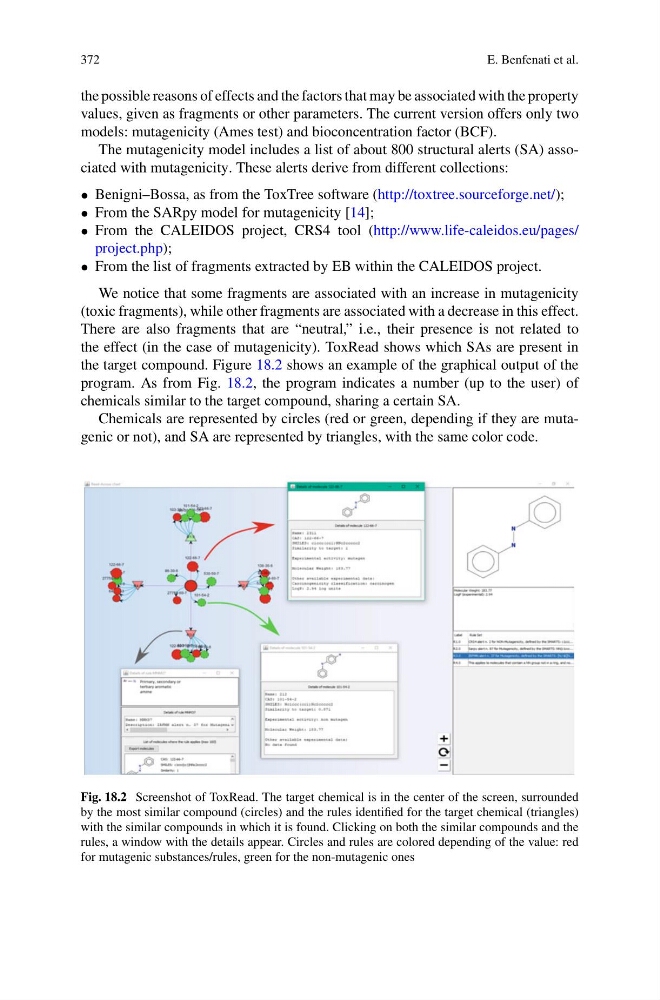
the target compound. Figure 18.2 shows an example of the graphical output of the
program. As from Fig. 18.2, the program indicates a number (up to the user) of
chemicals similar to the target compound, sharing a certain SA.
Chemicals are represented by circles (red or green, depending if they are mutagenic or not), and SA are represented by triangles, with the same color code.
Fig. 18.2 Screenshot of ToxRead. The target chemical is in the center of the screen, surrounded
by the most similar compound (circles) and the rules identified for the target chemical (triangles)
with the similar compounds in which it is found. Clicking on both the similar compounds and the
rules, a window with the details appear. Circles and rules are colored depending of the value: red
for mutagenic substances/rules, green for the non-mutagenic ones
E. Benfenati et al.
the possible reasons of effects and the factors that may be associated with the property
values, given as fragments or other parameters. The current version offers only two
models: mutagenicity (Ames test) and bioconcentration factor (BCF).
The mutagenicity model includes a list of about 800 structural alerts (SA) associated with mutagenicity. These alerts derive from different collections:
• Benigni–Bossa, as from the ToxTree software (http://toxtree.sourceforge.net/);
• From the SARpy model for mutagenicity [14];
• From the CALEIDOS project, CRS4 tool (http://www.life-caleidos.eu/pages/
project.php);
• From the list of fragments extracted by EB within the CALEIDOS project.
We notice that some fragments are associated with an increase in mutagenicity
(toxic fragments), while other fragments are associated with a decrease in this effect.
There are also fragments that are “neutral,” i.e., their presence is not related to
the effect (in the case of mutagenicity). ToxRead shows which SAs are present in
the target compound. Figure 18.2 shows an example of the graphical output of the
program. As from Fig. 18.2, the program indicates a number (up to the user) of
chemicals similar to the target compound, sharing a certain SA.
Chemicals are represented by circles (red or green, depending if they are mutagenic or not), and SA are represented by triangles, with the same color code.
Fig. 18.2 Screenshot of ToxRead. The target chemical is in the center of the screen, surrounded
by the most similar compound (circles) and the rules identified for the target chemical (triangles)
with the similar compounds in which it is found. Clicking on both the similar compounds and the
rules, a window with the details appear. Circles and rules are colored depending of the value: red
for mutagenic substances/rules, green for the non-mutagenic ones