

358
Z. Fu and J. Chen
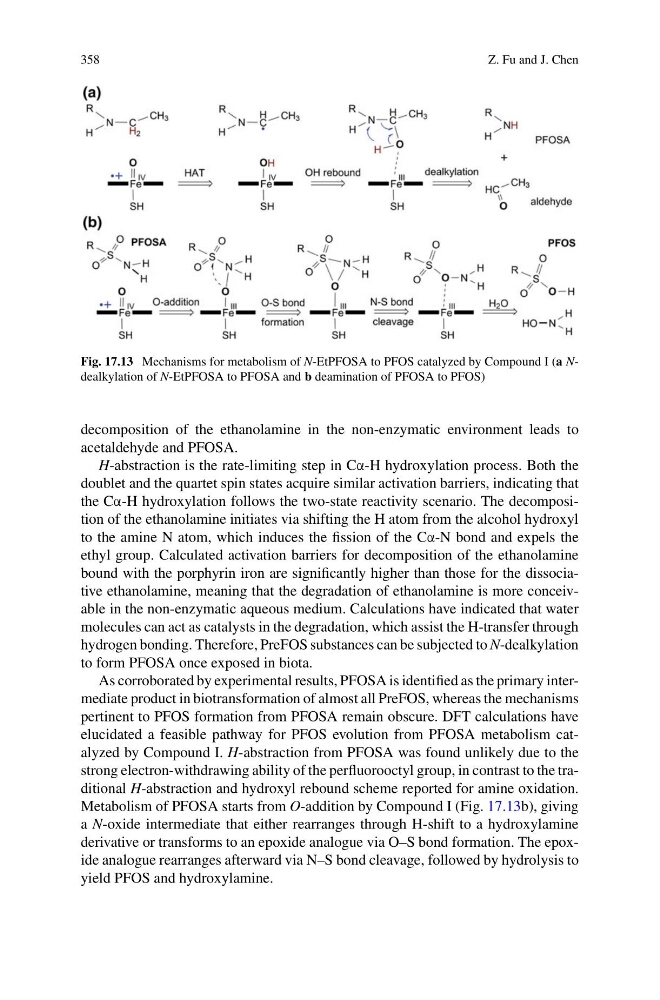
Fig. 17.13 Mechanisms for metabolism of N-EtPFOSA to PFOS catalyzed by Compound I (a Ndealkylation of N-EtPFOSA to PFOSA and b deamination of PFOSA to PFOS)
decomposition of the ethanolamine in the non-enzymatic environment leads to
acetaldehyde and PFOSA.
H-abstraction is the rate-limiting step in Cα-H hydroxylation process. Both the
doublet and the quartet spin states acquire similar activation barriers, indicating that
the Cα-H hydroxylation follows the two-state reactivity scenario. The decomposition of the ethanolamine initiates via shifting the H atom from the alcohol hydroxyl
to the amine N atom, which induces the fission of the Cα-N bond and expels the
ethyl group. Calculated activation barriers for decomposition of the ethanolamine
bound with the porphyrin iron are significantly higher than those for the dissociative ethanolamine, meaning that the degradation of ethanolamine is more conceivable in the non-enzymatic aqueous medium. Calculations have indicated that water
molecules can act as catalysts in the degradation, which assist the H-transfer through
hydrogen bonding. Therefore, PreFOS substances can be subjected to N-dealkylation
to form PFOSA once exposed in biota.
As corroborated by experimental results, PFOSA is identified as the primary intermediate product in biotransformation of almost all PreFOS, whereas the mechanisms
pertinent to PFOS formation from PFOSA remain obscure. DFT calculations have
elucidated a feasible pathway for PFOS evolution from PFOSA metabolism catalyzed by Compound I. H-abstraction from PFOSA was found unlikely due to the
strong electron-withdrawing ability of the perfluorooctyl group, in contrast to the traditional H-abstraction and hydroxyl rebound scheme reported for amine oxidation.
Metabolism of PFOSA starts from O-addition by Compound I (Fig. 17.13b), giving
a N-oxide intermediate that either rearranges through H-shift to a hydroxylamine
derivative or transforms to an epoxide analogue via O–S bond formation. The epoxide analogue rearranges afterward via N–S bond cleavage, followed by hydrolysis to
yield PFOS and hydroxylamine.
Z. Fu and J. Chen
Fig. 17.13 Mechanisms for metabolism of N-EtPFOSA to PFOS catalyzed by Compound I (a Ndealkylation of N-EtPFOSA to PFOSA and b deamination of PFOSA to PFOS)
decomposition of the ethanolamine in the non-enzymatic environment leads to
acetaldehyde and PFOSA.
H-abstraction is the rate-limiting step in Cα-H hydroxylation process. Both the
doublet and the quartet spin states acquire similar activation barriers, indicating that
the Cα-H hydroxylation follows the two-state reactivity scenario. The decomposition of the ethanolamine initiates via shifting the H atom from the alcohol hydroxyl
to the amine N atom, which induces the fission of the Cα-N bond and expels the
ethyl group. Calculated activation barriers for decomposition of the ethanolamine
bound with the porphyrin iron are significantly higher than those for the dissociative ethanolamine, meaning that the degradation of ethanolamine is more conceivable in the non-enzymatic aqueous medium. Calculations have indicated that water
molecules can act as catalysts in the degradation, which assist the H-transfer through
hydrogen bonding. Therefore, PreFOS substances can be subjected to N-dealkylation
to form PFOSA once exposed in biota.
As corroborated by experimental results, PFOSA is identified as the primary intermediate product in biotransformation of almost all PreFOS, whereas the mechanisms
pertinent to PFOS formation from PFOSA remain obscure. DFT calculations have
elucidated a feasible pathway for PFOS evolution from PFOSA metabolism catalyzed by Compound I. H-abstraction from PFOSA was found unlikely due to the
strong electron-withdrawing ability of the perfluorooctyl group, in contrast to the traditional H-abstraction and hydroxyl rebound scheme reported for amine oxidation.
Metabolism of PFOSA starts from O-addition by Compound I (Fig. 17.13b), giving
a N-oxide intermediate that either rearranges through H-shift to a hydroxylamine
derivative or transforms to an epoxide analogue via O–S bond formation. The epoxide analogue rearranges afterward via N–S bond cleavage, followed by hydrolysis to
yield PFOS and hydroxylamine.