

17 Xenobiotic Metabolism by Cytochrome P450 …
351
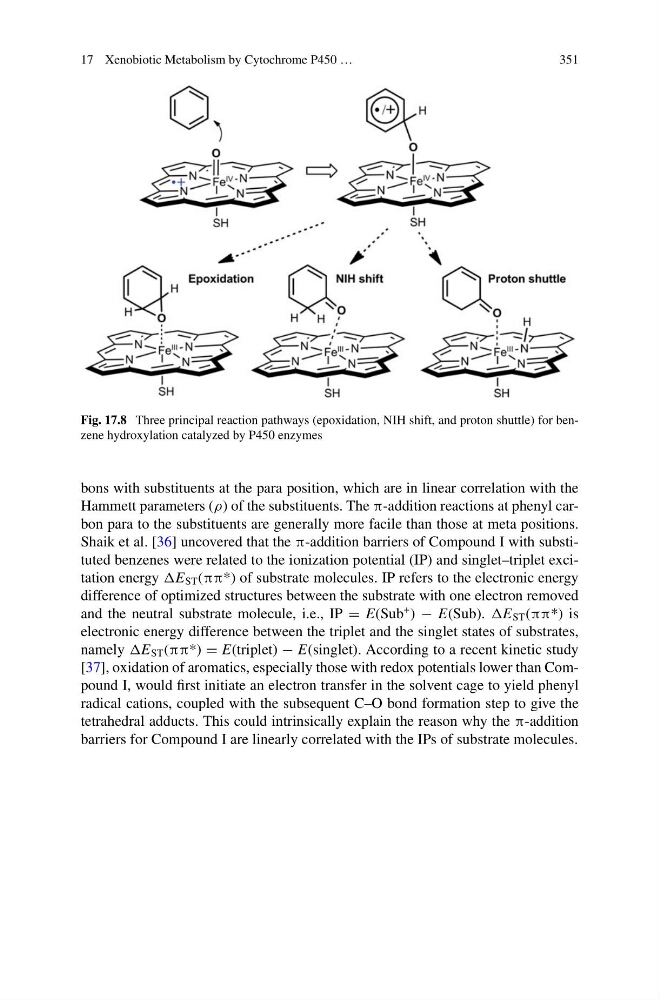
Fig. 17.8 Three principal reaction pathways (epoxidation, NIH shift, and proton shuttle) for benzene hydroxylation catalyzed by P450 enzymes
bons with substituents at the para position, which are in linear correlation with the
Hammett parameters (ρ) of the substituents. The π-addition reactions at phenyl carbon para to the substituents are generally more facile than those at meta positions.
Shaik et al. [36] uncovered that the π-addition barriers of Compound I with substituted benzenes were related to the ionization potential (IP) and singlet–triplet excitation energy E ST (ππ*) of substrate molecules. IP refers to the electronic energy
difference of optimized structures between the substrate with one electron removed
and the neutral substrate molecule, i.e., IP = E(Sub
+ ) − E(Sub). E ST (ππ*) is
electronic energy difference between the triplet and the singlet states of substrates,
namely E ST (ππ*) = E(triplet) − E(singlet). According to a recent kinetic study
[37], oxidation of aromatics, especially those with redox potentials lower than Compound I, would first initiate an electron transfer in the solvent cage to yield phenyl
radical cations, coupled with the subsequent C–O bond formation step to give the
tetrahedral adducts. This could intrinsically explain the reason why the π-addition
barriers for Compound I are linearly correlated with the IPs of substrate molecules.
351
Fig. 17.8 Three principal reaction pathways (epoxidation, NIH shift, and proton shuttle) for benzene hydroxylation catalyzed by P450 enzymes
bons with substituents at the para position, which are in linear correlation with the
Hammett parameters (ρ) of the substituents. The π-addition reactions at phenyl carbon para to the substituents are generally more facile than those at meta positions.
Shaik et al. [36] uncovered that the π-addition barriers of Compound I with substituted benzenes were related to the ionization potential (IP) and singlet–triplet excitation energy E ST (ππ*) of substrate molecules. IP refers to the electronic energy
difference of optimized structures between the substrate with one electron removed
and the neutral substrate molecule, i.e., IP = E(Sub
+ ) − E(Sub). E ST (ππ*) is
electronic energy difference between the triplet and the singlet states of substrates,
namely E ST (ππ*) = E(triplet) − E(singlet). According to a recent kinetic study
[37], oxidation of aromatics, especially those with redox potentials lower than Compound I, would first initiate an electron transfer in the solvent cage to yield phenyl
radical cations, coupled with the subsequent C–O bond formation step to give the
tetrahedral adducts. This could intrinsically explain the reason why the π-addition
barriers for Compound I are linearly correlated with the IPs of substrate molecules.