

17 Xenobiotic Metabolism by Cytochrome P450 …
349
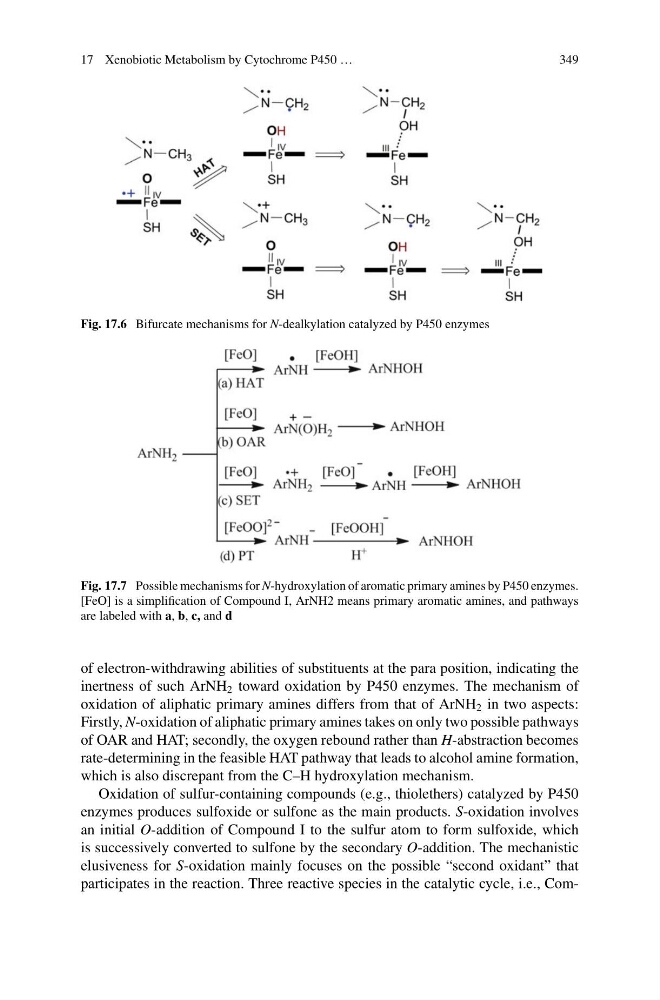
Fig. 17.6 Bifurcate mechanisms for N-dealkylation catalyzed by P450 enzymes
Fig. 17.7 Possible mechanisms for N-hydroxylation of aromatic primary amines by P450 enzymes.
[FeO] is a simplification of Compound I, ArNH2 means primary aromatic amines, and pathways
are labeled with a, b, c, and d
of electron-withdrawing abilities of substituents at the para position, indicating the
inertness of such ArNH 2 toward oxidation by P450 enzymes. The mechanism of
oxidation of aliphatic primary amines differs from that of ArNH 2 in two aspects:
Firstly, N-oxidation of aliphatic primary amines takes on only two possible pathways
of OAR and HAT; secondly, the oxygen rebound rather than H-abstraction becomes
rate-determining in the feasible HAT pathway that leads to alcohol amine formation,
which is also discrepant from the C–H hydroxylation mechanism.
Oxidation of sulfur-containing compounds (e.g., thiolethers) catalyzed by P450
enzymes produces sulfoxide or sulfone as the main products. S-oxidation involves
an initial O-addition of Compound I to the sulfur atom to form sulfoxide, which
is successively converted to sulfone by the secondary O-addition. The mechanistic
elusiveness for S-oxidation mainly focuses on the possible “second oxidant” that
participates in the reaction. Three reactive species in the catalytic cycle, i.e., Com-
349
Fig. 17.6 Bifurcate mechanisms for N-dealkylation catalyzed by P450 enzymes
Fig. 17.7 Possible mechanisms for N-hydroxylation of aromatic primary amines by P450 enzymes.
[FeO] is a simplification of Compound I, ArNH2 means primary aromatic amines, and pathways
are labeled with a, b, c, and d
of electron-withdrawing abilities of substituents at the para position, indicating the
inertness of such ArNH 2 toward oxidation by P450 enzymes. The mechanism of
oxidation of aliphatic primary amines differs from that of ArNH 2 in two aspects:
Firstly, N-oxidation of aliphatic primary amines takes on only two possible pathways
of OAR and HAT; secondly, the oxygen rebound rather than H-abstraction becomes
rate-determining in the feasible HAT pathway that leads to alcohol amine formation,
which is also discrepant from the C–H hydroxylation mechanism.
Oxidation of sulfur-containing compounds (e.g., thiolethers) catalyzed by P450
enzymes produces sulfoxide or sulfone as the main products. S-oxidation involves
an initial O-addition of Compound I to the sulfur atom to form sulfoxide, which
is successively converted to sulfone by the secondary O-addition. The mechanistic
elusiveness for S-oxidation mainly focuses on the possible “second oxidant” that
participates in the reaction. Three reactive species in the catalytic cycle, i.e., Com-