

17 Xenobiotic Metabolism by Cytochrome P450 …
347
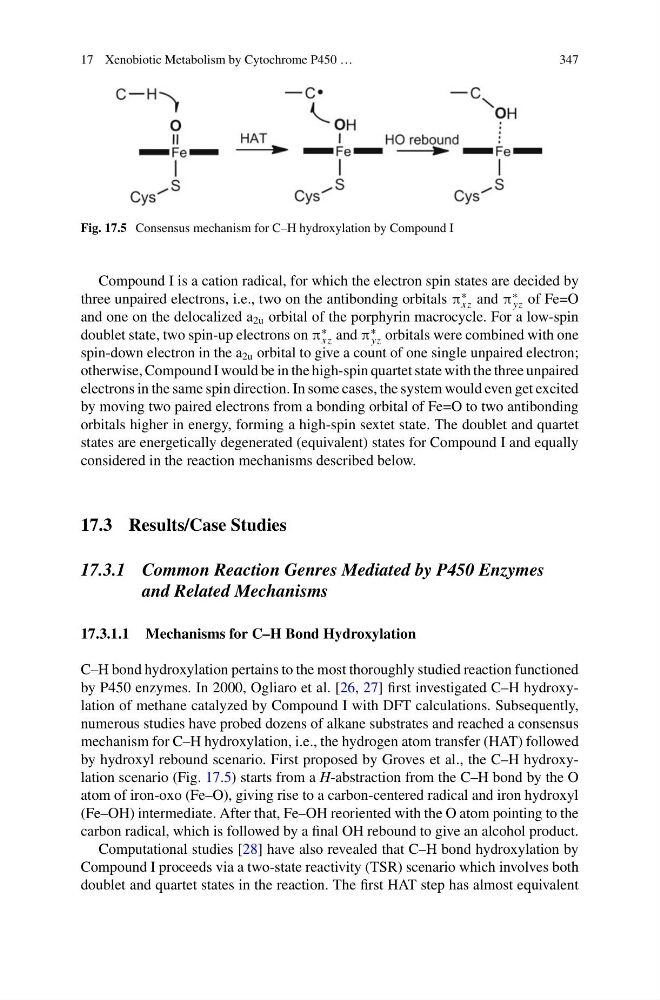
Fig. 17.5 Consensus mechanism for C–H hydroxylation by Compound I
Compound I is a cation radical, for which the electron spin states are decided by
three unpaired electrons, i.e., two on the antibonding orbitals π
∗
xz and π
∗
yz of Fe=O
and one on the delocalized a 2u orbital of the porphyrin macrocycle. For a low-spin
doublet state, two spin-up electrons on π
∗
xz and π
∗
yz orbitals were combined with one
spin-down electron in the a 2u orbital to give a count of one single unpaired electron;
otherwise, Compound I would be in the high-spin quartet state with the three unpaired
electrons in the same spin direction. In some cases, the system would even get excited
by moving two paired electrons from a bonding orbital of Fe=O to two antibonding
orbitals higher in energy, forming a high-spin sextet state. The doublet and quartet
states are energetically degenerated (equivalent) states for Compound I and equally
considered in the reaction mechanisms described below.
17.3 Results/Case Studies
17.3.1 Common Reaction Genres Mediated by P450 Enzymes
and Related Mechanisms
17.3.1.1 Mechanisms for C–H Bond Hydroxylation
C–H bond hydroxylation pertains to the most thoroughly studied reaction functioned
by P450 enzymes. In 2000, Ogliaro et al. [26, 27] first investigated C–H hydroxylation of methane catalyzed by Compound I with DFT calculations. Subsequently,
numerous studies have probed dozens of alkane substrates and reached a consensus
mechanism for C–H hydroxylation, i.e., the hydrogen atom transfer (HAT) followed
by hydroxyl rebound scenario. First proposed by Groves et al., the C–H hydroxylation scenario (Fig. 17.5) starts from a H-abstraction from the C–H bond by the O
atom of iron-oxo (Fe–O), giving rise to a carbon-centered radical and iron hydroxyl
(Fe–OH) intermediate. After that, Fe–OH reoriented with the O atom pointing to the
carbon radical, which is followed by a final OH rebound to give an alcohol product.
Computational studies [28] have also revealed that C–H bond hydroxylation by
Compound I proceeds via a two-state reactivity (TSR) scenario which involves both
doublet and quartet states in the reaction. The first HAT step has almost equivalent
347
Fig. 17.5 Consensus mechanism for C–H hydroxylation by Compound I
Compound I is a cation radical, for which the electron spin states are decided by
three unpaired electrons, i.e., two on the antibonding orbitals π
∗
xz and π
∗
yz of Fe=O
and one on the delocalized a 2u orbital of the porphyrin macrocycle. For a low-spin
doublet state, two spin-up electrons on π
∗
xz and π
∗
yz orbitals were combined with one
spin-down electron in the a 2u orbital to give a count of one single unpaired electron;
otherwise, Compound I would be in the high-spin quartet state with the three unpaired
electrons in the same spin direction. In some cases, the system would even get excited
by moving two paired electrons from a bonding orbital of Fe=O to two antibonding
orbitals higher in energy, forming a high-spin sextet state. The doublet and quartet
states are energetically degenerated (equivalent) states for Compound I and equally
considered in the reaction mechanisms described below.
17.3 Results/Case Studies
17.3.1 Common Reaction Genres Mediated by P450 Enzymes
and Related Mechanisms
17.3.1.1 Mechanisms for C–H Bond Hydroxylation
C–H bond hydroxylation pertains to the most thoroughly studied reaction functioned
by P450 enzymes. In 2000, Ogliaro et al. [26, 27] first investigated C–H hydroxylation of methane catalyzed by Compound I with DFT calculations. Subsequently,
numerous studies have probed dozens of alkane substrates and reached a consensus
mechanism for C–H hydroxylation, i.e., the hydrogen atom transfer (HAT) followed
by hydroxyl rebound scenario. First proposed by Groves et al., the C–H hydroxylation scenario (Fig. 17.5) starts from a H-abstraction from the C–H bond by the O
atom of iron-oxo (Fe–O), giving rise to a carbon-centered radical and iron hydroxyl
(Fe–OH) intermediate. After that, Fe–OH reoriented with the O atom pointing to the
carbon radical, which is followed by a final OH rebound to give an alcohol product.
Computational studies [28] have also revealed that C–H bond hydroxylation by
Compound I proceeds via a two-state reactivity (TSR) scenario which involves both
doublet and quartet states in the reaction. The first HAT step has almost equivalent