

17 Xenobiotic Metabolism by Cytochrome P450 …
345
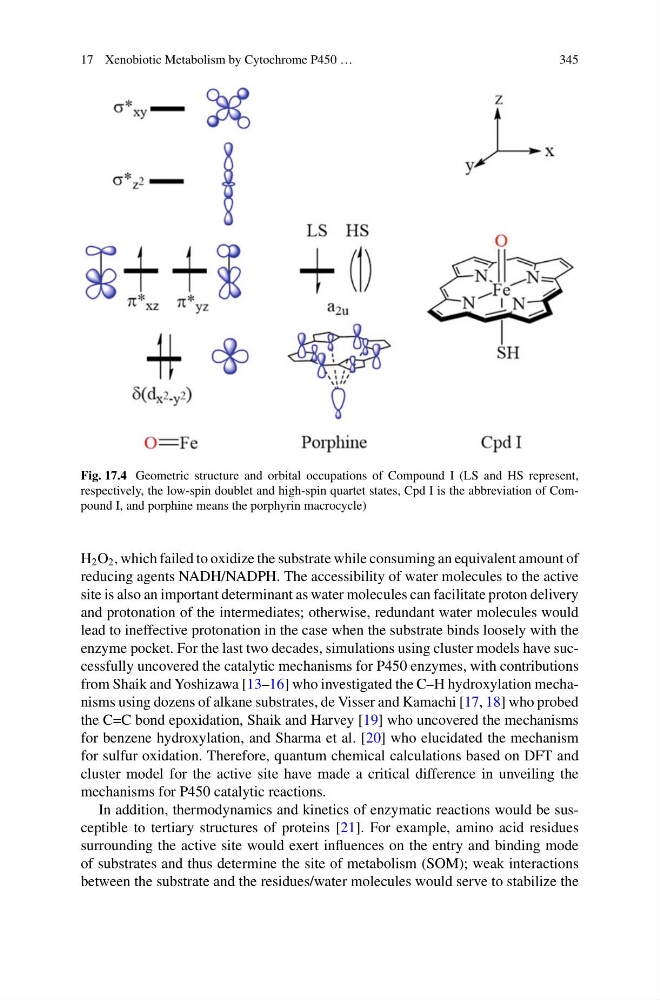
Fig. 17.4 Geometric structure and orbital occupations of Compound I (LS and HS represent,
respectively, the low-spin doublet and high-spin quartet states, Cpd I is the abbreviation of Compound I, and porphine means the porphyrin macrocycle)
H 2 O 2 , which failed to oxidize the substrate while consuming an equivalent amount of
reducing agents NADH/NADPH. The accessibility of water molecules to the active
site is also an important determinant as water molecules can facilitate proton delivery
and protonation of the intermediates; otherwise, redundant water molecules would
lead to ineffective protonation in the case when the substrate binds loosely with the
enzyme pocket. For the last two decades, simulations using cluster models have successfully uncovered the catalytic mechanisms for P450 enzymes, with contributions
from Shaik and Yoshizawa [13–16] who investigated the C–H hydroxylation mechanisms using dozens of alkane substrates, de Visser and Kamachi [17, 18] who probed
the C=C bond epoxidation, Shaik and Harvey [19] who uncovered the mechanisms
for benzene hydroxylation, and Sharma et al. [20] who elucidated the mechanism
for sulfur oxidation. Therefore, quantum chemical calculations based on DFT and
cluster model for the active site have made a critical difference in unveiling the
mechanisms for P450 catalytic reactions.
In addition, thermodynamics and kinetics of enzymatic reactions would be susceptible to tertiary structures of proteins [21]. For example, amino acid residues
surrounding the active site would exert influences on the entry and binding mode
of substrates and thus determine the site of metabolism (SOM); weak interactions
between the substrate and the residues/water molecules would serve to stabilize the
345
Fig. 17.4 Geometric structure and orbital occupations of Compound I (LS and HS represent,
respectively, the low-spin doublet and high-spin quartet states, Cpd I is the abbreviation of Compound I, and porphine means the porphyrin macrocycle)
H 2 O 2 , which failed to oxidize the substrate while consuming an equivalent amount of
reducing agents NADH/NADPH. The accessibility of water molecules to the active
site is also an important determinant as water molecules can facilitate proton delivery
and protonation of the intermediates; otherwise, redundant water molecules would
lead to ineffective protonation in the case when the substrate binds loosely with the
enzyme pocket. For the last two decades, simulations using cluster models have successfully uncovered the catalytic mechanisms for P450 enzymes, with contributions
from Shaik and Yoshizawa [13–16] who investigated the C–H hydroxylation mechanisms using dozens of alkane substrates, de Visser and Kamachi [17, 18] who probed
the C=C bond epoxidation, Shaik and Harvey [19] who uncovered the mechanisms
for benzene hydroxylation, and Sharma et al. [20] who elucidated the mechanism
for sulfur oxidation. Therefore, quantum chemical calculations based on DFT and
cluster model for the active site have made a critical difference in unveiling the
mechanisms for P450 catalytic reactions.
In addition, thermodynamics and kinetics of enzymatic reactions would be susceptible to tertiary structures of proteins [21]. For example, amino acid residues
surrounding the active site would exert influences on the entry and binding mode
of substrates and thus determine the site of metabolism (SOM); weak interactions
between the substrate and the residues/water molecules would serve to stabilize the