

17 Xenobiotic Metabolism by Cytochrome P450 …
343
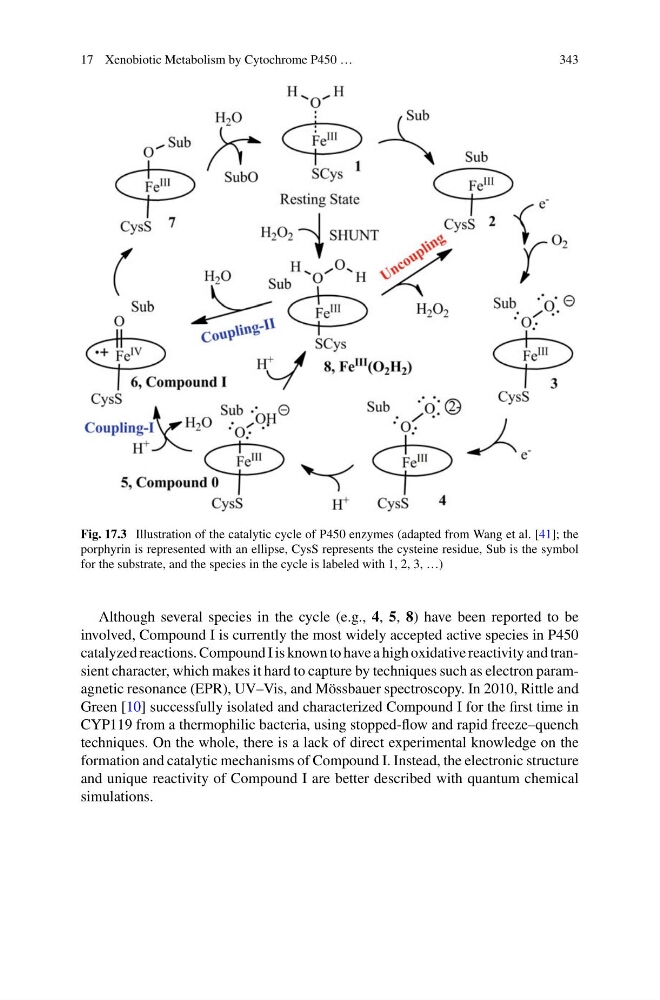
Fig. 17.3 Illustration of the catalytic cycle of P450 enzymes (adapted from Wang et al. [41]; the
porphyrin is represented with an ellipse, CysS represents the cysteine residue, Sub is the symbol
for the substrate, and the species in the cycle is labeled with 1, 2, 3, …)
Although several species in the cycle (e.g., 4, 5, 8) have been reported to be
involved, Compound I is currently the most widely accepted active species in P450
catalyzed reactions. Compound I is known to have a high oxidative reactivity and transient character, which makes it hard to capture by techniques such as electron paramagnetic resonance (EPR), UV–Vis, and Mössbauer spectroscopy. In 2010, Rittle and
Green [10] successfully isolated and characterized Compound I for the first time in
CYP119 from a thermophilic bacteria, using stopped-flow and rapid freeze–quench
techniques. On the whole, there is a lack of direct experimental knowledge on the
formation and catalytic mechanisms of Compound I. Instead, the electronic structure
and unique reactivity of Compound I are better described with quantum chemical
simulations.
343
Fig. 17.3 Illustration of the catalytic cycle of P450 enzymes (adapted from Wang et al. [41]; the
porphyrin is represented with an ellipse, CysS represents the cysteine residue, Sub is the symbol
for the substrate, and the species in the cycle is labeled with 1, 2, 3, …)
Although several species in the cycle (e.g., 4, 5, 8) have been reported to be
involved, Compound I is currently the most widely accepted active species in P450
catalyzed reactions. Compound I is known to have a high oxidative reactivity and transient character, which makes it hard to capture by techniques such as electron paramagnetic resonance (EPR), UV–Vis, and Mössbauer spectroscopy. In 2010, Rittle and
Green [10] successfully isolated and characterized Compound I for the first time in
CYP119 from a thermophilic bacteria, using stopped-flow and rapid freeze–quench
techniques. On the whole, there is a lack of direct experimental knowledge on the
formation and catalytic mechanisms of Compound I. Instead, the electronic structure
and unique reactivity of Compound I are better described with quantum chemical
simulations.