

17 Xenobiotic Metabolism by Cytochrome P450 …
341
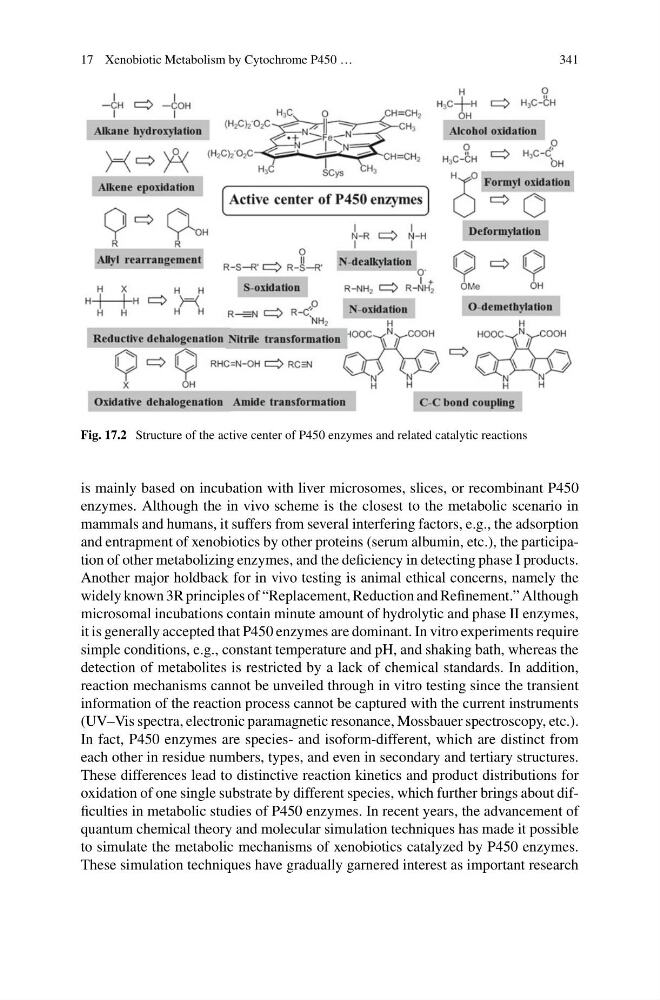
Fig. 17.2 Structure of the active center of P450 enzymes and related catalytic reactions
is mainly based on incubation with liver microsomes, slices, or recombinant P450
enzymes. Although the in vivo scheme is the closest to the metabolic scenario in
mammals and humans, it suffers from several interfering factors, e.g., the adsorption
and entrapment of xenobiotics by other proteins (serum albumin, etc.), the participation of other metabolizing enzymes, and the deficiency in detecting phase I products.
Another major holdback for in vivo testing is animal ethical concerns, namely the
widely known 3R principles of “Replacement, Reduction and Refinement.” Although
microsomal incubations contain minute amount of hydrolytic and phase II enzymes,
it is generally accepted that P450 enzymes are dominant. In vitro experiments require
simple conditions, e.g., constant temperature and pH, and shaking bath, whereas the
detection of metabolites is restricted by a lack of chemical standards. In addition,
reaction mechanisms cannot be unveiled through in vitro testing since the transient
information of the reaction process cannot be captured with the current instruments
(UV–Vis spectra, electronic paramagnetic resonance, Mossbauer spectroscopy, etc.).
In fact, P450 enzymes are species- and isoform-different, which are distinct from
each other in residue numbers, types, and even in secondary and tertiary structures.
These differences lead to distinctive reaction kinetics and product distributions for
oxidation of one single substrate by different species, which further brings about difficulties in metabolic studies of P450 enzymes. In recent years, the advancement of
quantum chemical theory and molecular simulation techniques has made it possible
to simulate the metabolic mechanisms of xenobiotics catalyzed by P450 enzymes.
These simulation techniques have gradually garnered interest as important research
341
Fig. 17.2 Structure of the active center of P450 enzymes and related catalytic reactions
is mainly based on incubation with liver microsomes, slices, or recombinant P450
enzymes. Although the in vivo scheme is the closest to the metabolic scenario in
mammals and humans, it suffers from several interfering factors, e.g., the adsorption
and entrapment of xenobiotics by other proteins (serum albumin, etc.), the participation of other metabolizing enzymes, and the deficiency in detecting phase I products.
Another major holdback for in vivo testing is animal ethical concerns, namely the
widely known 3R principles of “Replacement, Reduction and Refinement.” Although
microsomal incubations contain minute amount of hydrolytic and phase II enzymes,
it is generally accepted that P450 enzymes are dominant. In vitro experiments require
simple conditions, e.g., constant temperature and pH, and shaking bath, whereas the
detection of metabolites is restricted by a lack of chemical standards. In addition,
reaction mechanisms cannot be unveiled through in vitro testing since the transient
information of the reaction process cannot be captured with the current instruments
(UV–Vis spectra, electronic paramagnetic resonance, Mossbauer spectroscopy, etc.).
In fact, P450 enzymes are species- and isoform-different, which are distinct from
each other in residue numbers, types, and even in secondary and tertiary structures.
These differences lead to distinctive reaction kinetics and product distributions for
oxidation of one single substrate by different species, which further brings about difficulties in metabolic studies of P450 enzymes. In recent years, the advancement of
quantum chemical theory and molecular simulation techniques has made it possible
to simulate the metabolic mechanisms of xenobiotics catalyzed by P450 enzymes.
These simulation techniques have gradually garnered interest as important research