

16 Molecular Modeling Method Applications …
323
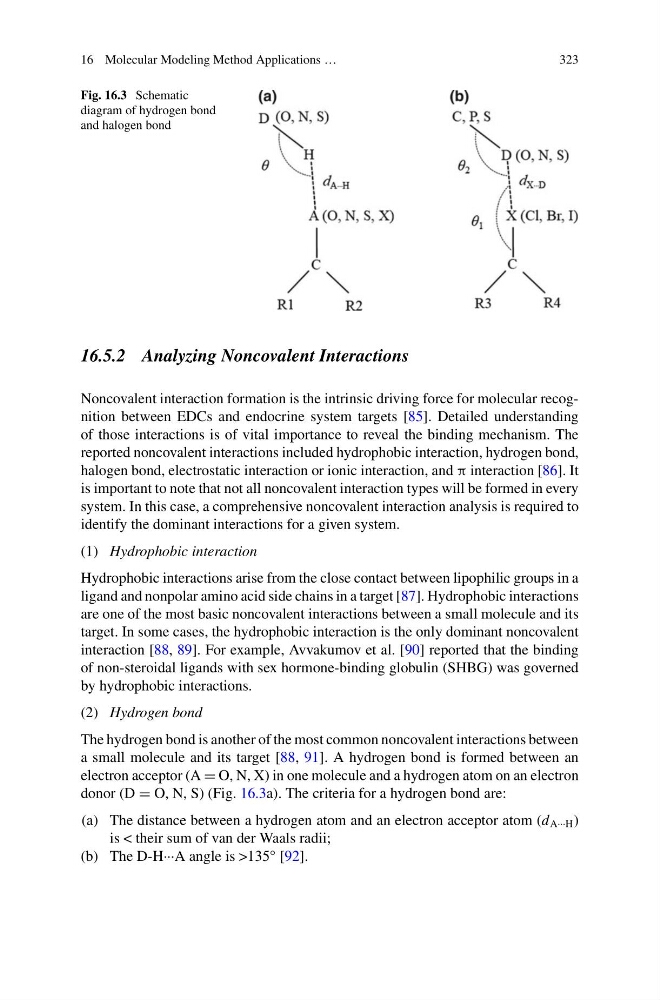
Fig. 16.3 Schematic
diagram of hydrogen bond
and halogen bond
16.5.2 Analyzing Noncovalent Interactions
Noncovalent interaction formation is the intrinsic driving force for molecular recognition between EDCs and endocrine system targets [85]. Detailed understanding
of those interactions is of vital importance to reveal the binding mechanism. The
reported noncovalent interactions included hydrophobic interaction, hydrogen bond,
halogen bond, electrostatic interaction or ionic interaction, and π interaction [86]. It
is important to note that not all noncovalent interaction types will be formed in every
system. In this case, a comprehensive noncovalent interaction analysis is required to
identify the dominant interactions for a given system.
(1) Hydrophobic interaction
Hydrophobic interactions arise from the close contact between lipophilic groups in a
ligand and nonpolar amino acid side chains in a target [87]. Hydrophobic interactions
are one of the most basic noncovalent interactions between a small molecule and its
target. In some cases, the hydrophobic interaction is the only dominant noncovalent
interaction [88, 89]. For example, Avvakumov et al. [90] reported that the binding
of non-steroidal ligands with sex hormone-binding globulin (SHBG) was governed
by hydrophobic interactions.
(2) Hydrogen bond
The hydrogen bond is another of the most common noncovalent interactions between
a small molecule and its target [88, 91]. A hydrogen bond is formed between an
electron acceptor (A = O, N, X) in one molecule and a hydrogen atom on an electron
donor (D = O, N, S) (Fig. 16.3a). The criteria for a hydrogen bond are:
(a) The distance between a hydrogen atom and an electron acceptor atom (d A···H )
is < their sum of van der Waals radii;
(b) The D-H···A angle is >135° [92].
323
Fig. 16.3 Schematic
diagram of hydrogen bond
and halogen bond
16.5.2 Analyzing Noncovalent Interactions
Noncovalent interaction formation is the intrinsic driving force for molecular recognition between EDCs and endocrine system targets [85]. Detailed understanding
of those interactions is of vital importance to reveal the binding mechanism. The
reported noncovalent interactions included hydrophobic interaction, hydrogen bond,
halogen bond, electrostatic interaction or ionic interaction, and π interaction [86]. It
is important to note that not all noncovalent interaction types will be formed in every
system. In this case, a comprehensive noncovalent interaction analysis is required to
identify the dominant interactions for a given system.
(1) Hydrophobic interaction
Hydrophobic interactions arise from the close contact between lipophilic groups in a
ligand and nonpolar amino acid side chains in a target [87]. Hydrophobic interactions
are one of the most basic noncovalent interactions between a small molecule and its
target. In some cases, the hydrophobic interaction is the only dominant noncovalent
interaction [88, 89]. For example, Avvakumov et al. [90] reported that the binding
of non-steroidal ligands with sex hormone-binding globulin (SHBG) was governed
by hydrophobic interactions.
(2) Hydrogen bond
The hydrogen bond is another of the most common noncovalent interactions between
a small molecule and its target [88, 91]. A hydrogen bond is formed between an
electron acceptor (A = O, N, X) in one molecule and a hydrogen atom on an electron
donor (D = O, N, S) (Fig. 16.3a). The criteria for a hydrogen bond are:
(a) The distance between a hydrogen atom and an electron acceptor atom (d A···H )
is < their sum of van der Waals radii;
(b) The D-H···A angle is >135° [92].