

292
R. Huang
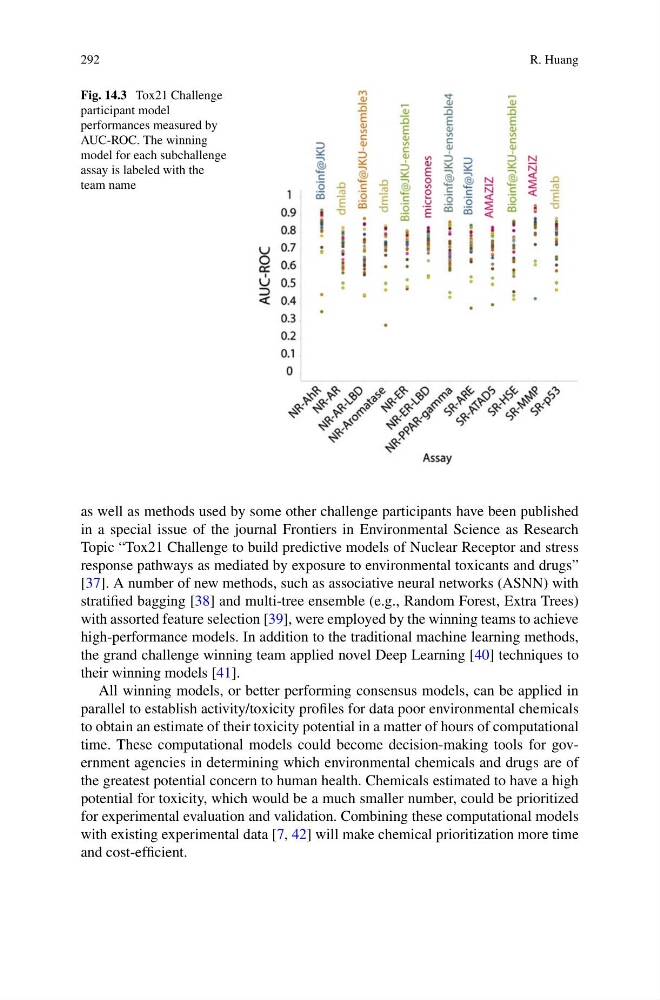
Fig. 14.3 Tox21 Challenge
participant model
performances measured by
AUC-ROC. The winning
model for each subchallenge
assay is labeled with the
team name
as well as methods used by some other challenge participants have been published
in a special issue of the journal Frontiers in Environmental Science as Research
Topic “Tox21 Challenge to build predictive models of Nuclear Receptor and stress
response pathways as mediated by exposure to environmental toxicants and drugs”
[37]. A number of new methods, such as associative neural networks (ASNN) with
stratified bagging [38] and multi-tree ensemble (e.g., Random Forest, Extra Trees)
with assorted feature selection [39], were employed by the winning teams to achieve
high-performance models. In addition to the traditional machine learning methods,
the grand challenge winning team applied novel Deep Learning [40] techniques to
their winning models [41].
All winning models, or better performing consensus models, can be applied in
parallel to establish activity/toxicity profiles for data poor environmental chemicals
to obtain an estimate of their toxicity potential in a matter of hours of computational
time. These computational models could become decision-making tools for government agencies in determining which environmental chemicals and drugs are of
the greatest potential concern to human health. Chemicals estimated to have a high
potential for toxicity, which would be a much smaller number, could be prioritized
for experimental evaluation and validation. Combining these computational models
with existing experimental data [7, 42] will make chemical prioritization more time
and cost-efficient.
R. Huang
Fig. 14.3 Tox21 Challenge
participant model
performances measured by
AUC-ROC. The winning
model for each subchallenge
assay is labeled with the
team name
as well as methods used by some other challenge participants have been published
in a special issue of the journal Frontiers in Environmental Science as Research
Topic “Tox21 Challenge to build predictive models of Nuclear Receptor and stress
response pathways as mediated by exposure to environmental toxicants and drugs”
[37]. A number of new methods, such as associative neural networks (ASNN) with
stratified bagging [38] and multi-tree ensemble (e.g., Random Forest, Extra Trees)
with assorted feature selection [39], were employed by the winning teams to achieve
high-performance models. In addition to the traditional machine learning methods,
the grand challenge winning team applied novel Deep Learning [40] techniques to
their winning models [41].
All winning models, or better performing consensus models, can be applied in
parallel to establish activity/toxicity profiles for data poor environmental chemicals
to obtain an estimate of their toxicity potential in a matter of hours of computational
time. These computational models could become decision-making tools for government agencies in determining which environmental chemicals and drugs are of
the greatest potential concern to human health. Chemicals estimated to have a high
potential for toxicity, which would be a much smaller number, could be prioritized
for experimental evaluation and validation. Combining these computational models
with existing experimental data [7, 42] will make chemical prioritization more time
and cost-efficient.