

288
R. Huang
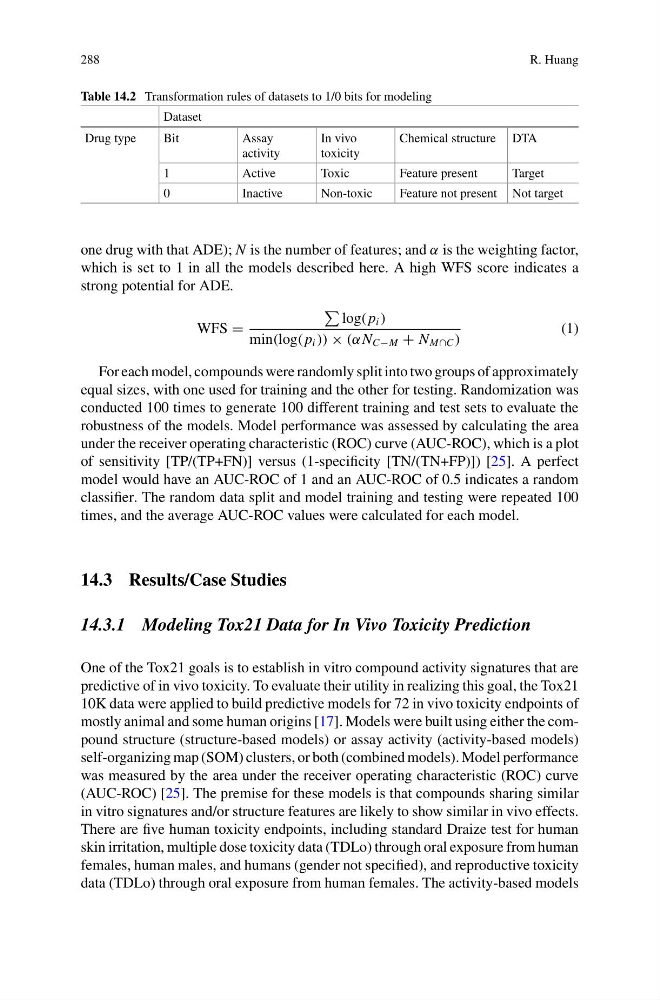
Table 14.2 Transformation rules of datasets to 1/0 bits for modeling
Dataset
Drug type
Bit
Assay
activity
In vivo
toxicity
Chemical structure DTA
1
Active
Toxic
Feature present
Target
0
Inactive
Non-toxic
Feature not present Not target
one drug with that ADE); N is the number of features; and α is the weighting factor,
which is set to 1 in all the models described here. A high WFS score indicates a
strong potential for ADE.
WFS =
log( p i )
min(log( p i )) × (α N C−M + N M∩C )
(1)
For each model, compounds were randomly split into two groups of approximately
equal sizes, with one used for training and the other for testing. Randomization was
conducted 100 times to generate 100 different training and test sets to evaluate the
robustness of the models. Model performance was assessed by calculating the area
under the receiver operating characteristic (ROC) curve (AUC-ROC), which is a plot
of sensitivity [TP/(TP+FN)] versus (1-specificity [TN/(TN+FP)]) [25]. A perfect
model would have an AUC-ROC of 1 and an AUC-ROC of 0.5 indicates a random
classifier. The random data split and model training and testing were repeated 100
times, and the average AUC-ROC values were calculated for each model.
14.3 Results/Case Studies
14.3.1 Modeling Tox21 Data for In Vivo Toxicity Prediction
One of the Tox21 goals is to establish in vitro compound activity signatures that are
predictive of in vivo toxicity. To evaluate their utility in realizing this goal, the Tox21
10K data were applied to build predictive models for 72 in vivo toxicity endpoints of
mostly animal and some human origins [17]. Models were built using either the compound structure (structure-based models) or assay activity (activity-based models)
self-organizing map (SOM) clusters, or both (combined models). Model performance
was measured by the area under the receiver operating characteristic (ROC) curve
(AUC-ROC) [25]. The premise for these models is that compounds sharing similar
in vitro signatures and/or structure features are likely to show similar in vivo effects.
There are five human toxicity endpoints, including standard Draize test for human
skin irritation, multiple dose toxicity data (TDLo) through oral exposure from human
females, human males, and humans (gender not specified), and reproductive toxicity
data (TDLo) through oral exposure from human females. The activity-based models
R. Huang
Table 14.2 Transformation rules of datasets to 1/0 bits for modeling
Dataset
Drug type
Bit
Assay
activity
In vivo
toxicity
Chemical structure DTA
1
Active
Toxic
Feature present
Target
0
Inactive
Non-toxic
Feature not present Not target
one drug with that ADE); N is the number of features; and α is the weighting factor,
which is set to 1 in all the models described here. A high WFS score indicates a
strong potential for ADE.
WFS =
log( p i )
min(log( p i )) × (α N C−M + N M∩C )
(1)
For each model, compounds were randomly split into two groups of approximately
equal sizes, with one used for training and the other for testing. Randomization was
conducted 100 times to generate 100 different training and test sets to evaluate the
robustness of the models. Model performance was assessed by calculating the area
under the receiver operating characteristic (ROC) curve (AUC-ROC), which is a plot
of sensitivity [TP/(TP+FN)] versus (1-specificity [TN/(TN+FP)]) [25]. A perfect
model would have an AUC-ROC of 1 and an AUC-ROC of 0.5 indicates a random
classifier. The random data split and model training and testing were repeated 100
times, and the average AUC-ROC values were calculated for each model.
14.3 Results/Case Studies
14.3.1 Modeling Tox21 Data for In Vivo Toxicity Prediction
One of the Tox21 goals is to establish in vitro compound activity signatures that are
predictive of in vivo toxicity. To evaluate their utility in realizing this goal, the Tox21
10K data were applied to build predictive models for 72 in vivo toxicity endpoints of
mostly animal and some human origins [17]. Models were built using either the compound structure (structure-based models) or assay activity (activity-based models)
self-organizing map (SOM) clusters, or both (combined models). Model performance
was measured by the area under the receiver operating characteristic (ROC) curve
(AUC-ROC) [25]. The premise for these models is that compounds sharing similar
in vitro signatures and/or structure features are likely to show similar in vivo effects.
There are five human toxicity endpoints, including standard Draize test for human
skin irritation, multiple dose toxicity data (TDLo) through oral exposure from human
females, human males, and humans (gender not specified), and reproductive toxicity
data (TDLo) through oral exposure from human females. The activity-based models