

286
R. Huang
from commercial sources. The main criteria for selection of the Tox21 compounds
included, but were not limited to, known or perceived environmental hazards or exposure concerns, physicochemical properties (molecular weight, volatility, solubility,
logP) suitability for qHTS, commercial availability, and cost. The types of compounds selected for constructing the library include pesticides, food additives, flame
retardants, industrial chemicals, drinking water disinfection by-products, preservatives, household cleaning agents, and drugs [20]. In addition, a set of 88 diverse
compounds was included as duplicates in every screening plate and designated as
internal controls for assay reproducibility [8]. All of the compounds in the Tox21
10K collection are currently going through analytical quality control (QC) testing
for purity and identity. The structures and annotations of the Tox21 10K library as
well as the QC results are publicly available [6, 7]. The compound library was plated
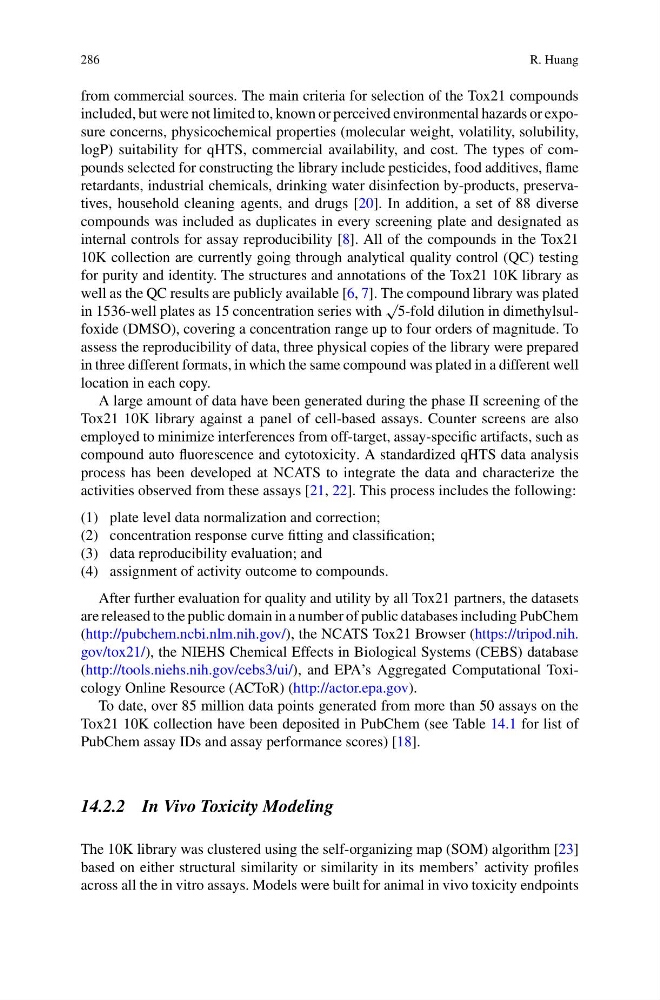
in 1536-well plates as 15 concentration series with
√
5-fold dilution in dimethylsulfoxide (DMSO), covering a concentration range up to four orders of magnitude. To
assess the reproducibility of data, three physical copies of the library were prepared
in three different formats, in which the same compound was plated in a different well
location in each copy.
A large amount of data have been generated during the phase II screening of the
Tox21 10K library against a panel of cell-based assays. Counter screens are also
employed to minimize interferences from off-target, assay-specific artifacts, such as
compound auto fluorescence and cytotoxicity. A standardized qHTS data analysis
process has been developed at NCATS to integrate the data and characterize the
activities observed from these assays [21, 22]. This process includes the following:
(1) plate level data normalization and correction;
(2) concentration response curve fitting and classification;
(3) data reproducibility evaluation; and
(4) assignment of activity outcome to compounds.
After further evaluation for quality and utility by all Tox21 partners, the datasets
are released to the public domain in a number of public databases including PubChem
(http://pubchem.ncbi.nlm.nih.gov/), the NCATS Tox21 Browser (https://tripod.nih.
gov/tox21/), the NIEHS Chemical Effects in Biological Systems (CEBS) database
(http://tools.niehs.nih.gov/cebs3/ui/), and EPA’s Aggregated Computational Toxicology Online Resource (ACToR) (http://actor.epa.gov).
To date, over 85 million data points generated from more than 50 assays on the
Tox21 10K collection have been deposited in PubChem (see Table 14.1 for list of
PubChem assay IDs and assay performance scores) [18].
14.2.2 In Vivo Toxicity Modeling
The 10K library was clustered using the self-organizing map (SOM) algorithm [23]
based on either structural similarity or similarity in its members’ activity profiles
across all the in vitro assays. Models were built for animal in vivo toxicity endpoints
R. Huang
from commercial sources. The main criteria for selection of the Tox21 compounds
included, but were not limited to, known or perceived environmental hazards or exposure concerns, physicochemical properties (molecular weight, volatility, solubility,
logP) suitability for qHTS, commercial availability, and cost. The types of compounds selected for constructing the library include pesticides, food additives, flame
retardants, industrial chemicals, drinking water disinfection by-products, preservatives, household cleaning agents, and drugs [20]. In addition, a set of 88 diverse
compounds was included as duplicates in every screening plate and designated as
internal controls for assay reproducibility [8]. All of the compounds in the Tox21
10K collection are currently going through analytical quality control (QC) testing
for purity and identity. The structures and annotations of the Tox21 10K library as
well as the QC results are publicly available [6, 7]. The compound library was plated
in 1536-well plates as 15 concentration series with
√
5-fold dilution in dimethylsulfoxide (DMSO), covering a concentration range up to four orders of magnitude. To
assess the reproducibility of data, three physical copies of the library were prepared
in three different formats, in which the same compound was plated in a different well
location in each copy.
A large amount of data have been generated during the phase II screening of the
Tox21 10K library against a panel of cell-based assays. Counter screens are also
employed to minimize interferences from off-target, assay-specific artifacts, such as
compound auto fluorescence and cytotoxicity. A standardized qHTS data analysis
process has been developed at NCATS to integrate the data and characterize the
activities observed from these assays [21, 22]. This process includes the following:
(1) plate level data normalization and correction;
(2) concentration response curve fitting and classification;
(3) data reproducibility evaluation; and
(4) assignment of activity outcome to compounds.
After further evaluation for quality and utility by all Tox21 partners, the datasets
are released to the public domain in a number of public databases including PubChem
(http://pubchem.ncbi.nlm.nih.gov/), the NCATS Tox21 Browser (https://tripod.nih.
gov/tox21/), the NIEHS Chemical Effects in Biological Systems (CEBS) database
(http://tools.niehs.nih.gov/cebs3/ui/), and EPA’s Aggregated Computational Toxicology Online Resource (ACToR) (http://actor.epa.gov).
To date, over 85 million data points generated from more than 50 assays on the
Tox21 10K collection have been deposited in PubChem (see Table 14.1 for list of
PubChem assay IDs and assay performance scores) [18].
14.2.2 In Vivo Toxicity Modeling
The 10K library was clustered using the self-organizing map (SOM) algorithm [23]
based on either structural similarity or similarity in its members’ activity profiles
across all the in vitro assays. Models were built for animal in vivo toxicity endpoints