

266
M. Chen et al.
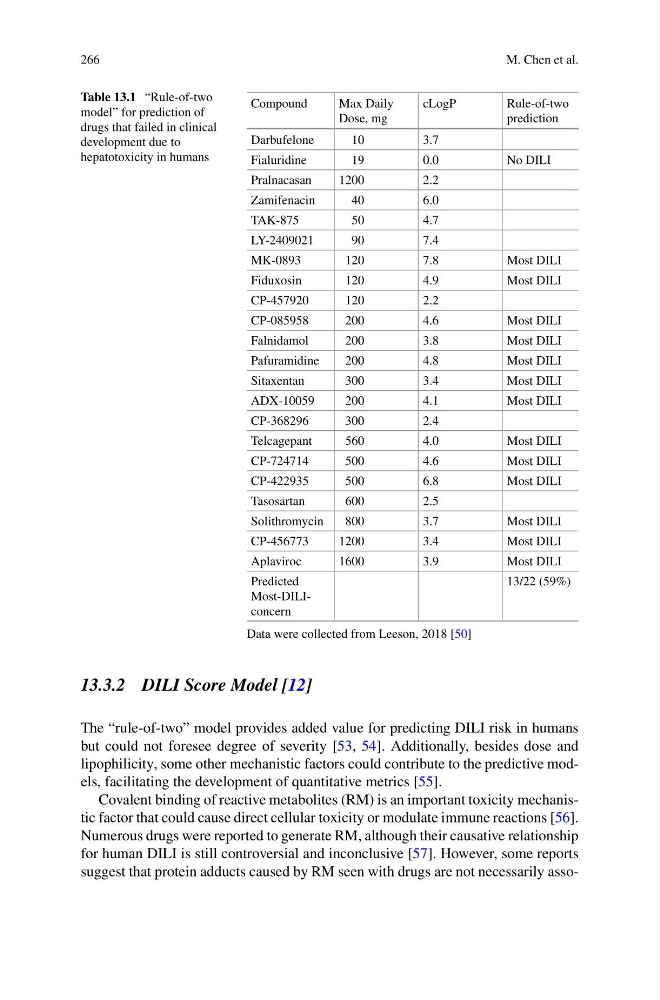
Table 13.1 “Rule-of-two
model” for prediction of
drugs that failed in clinical
development due to
hepatotoxicity in humans
Compound
Max Daily
Dose, mg
cLogP
Rule-of-two
prediction
Darbufelone
10
3.7
Fialuridine
19
0.0
No DILI
Pralnacasan
1200
2.2
Zamifenacin
40
6.0
TAK-875
50
4.7
LY-2409021
90
7.4
MK-0893
120
7.8
Most DILI
Fiduxosin
120
4.9
Most DILI
CP-457920
120
2.2
CP-085958
200
4.6
Most DILI
Falnidamol
200
3.8
Most DILI
Pafuramidine
200
4.8
Most DILI
Sitaxentan
300
3.4
Most DILI
ADX-10059
200
4.1
Most DILI
CP-368296
300
2.4
Telcagepant
560
4.0
Most DILI
CP-724714
500
4.6
Most DILI
CP-422935
500
6.8
Most DILI
Tasosartan
600
2.5
Solithromycin
800
3.7
Most DILI
CP-456773
1200
3.4
Most DILI
Aplaviroc
1600
3.9
Most DILI
Predicted
Most-DILIconcern
13/22 (59%)
Data were collected from Leeson, 2018 [50]
13.3.2 DILI Score Model [12]
The “rule-of-two” model provides added value for predicting DILI risk in humans
but could not foresee degree of severity [53, 54]. Additionally, besides dose and
lipophilicity, some other mechanistic factors could contribute to the predictive models, facilitating the development of quantitative metrics [55].
Covalent binding of reactive metabolites (RM) is an important toxicity mechanistic factor that could cause direct cellular toxicity or modulate immune reactions [56].
Numerous drugs were reported to generate RM, although their causative relationship
for human DILI is still controversial and inconclusive [57]. However, some reports
suggest that protein adducts caused by RM seen with drugs are not necessarily asso-
M. Chen et al.
Table 13.1 “Rule-of-two
model” for prediction of
drugs that failed in clinical
development due to
hepatotoxicity in humans
Compound
Max Daily
Dose, mg
cLogP
Rule-of-two
prediction
Darbufelone
10
3.7
Fialuridine
19
0.0
No DILI
Pralnacasan
1200
2.2
Zamifenacin
40
6.0
TAK-875
50
4.7
LY-2409021
90
7.4
MK-0893
120
7.8
Most DILI
Fiduxosin
120
4.9
Most DILI
CP-457920
120
2.2
CP-085958
200
4.6
Most DILI
Falnidamol
200
3.8
Most DILI
Pafuramidine
200
4.8
Most DILI
Sitaxentan
300
3.4
Most DILI
ADX-10059
200
4.1
Most DILI
CP-368296
300
2.4
Telcagepant
560
4.0
Most DILI
CP-724714
500
4.6
Most DILI
CP-422935
500
6.8
Most DILI
Tasosartan
600
2.5
Solithromycin
800
3.7
Most DILI
CP-456773
1200
3.4
Most DILI
Aplaviroc
1600
3.9
Most DILI
Predicted
Most-DILIconcern
13/22 (59%)
Data were collected from Leeson, 2018 [50]
13.3.2 DILI Score Model [12]
The “rule-of-two” model provides added value for predicting DILI risk in humans
but could not foresee degree of severity [53, 54]. Additionally, besides dose and
lipophilicity, some other mechanistic factors could contribute to the predictive models, facilitating the development of quantitative metrics [55].
Covalent binding of reactive metabolites (RM) is an important toxicity mechanistic factor that could cause direct cellular toxicity or modulate immune reactions [56].
Numerous drugs were reported to generate RM, although their causative relationship
for human DILI is still controversial and inconclusive [57]. However, some reports
suggest that protein adducts caused by RM seen with drugs are not necessarily asso-