

12 Application of Computational Methods for the Safety Assessment …
249
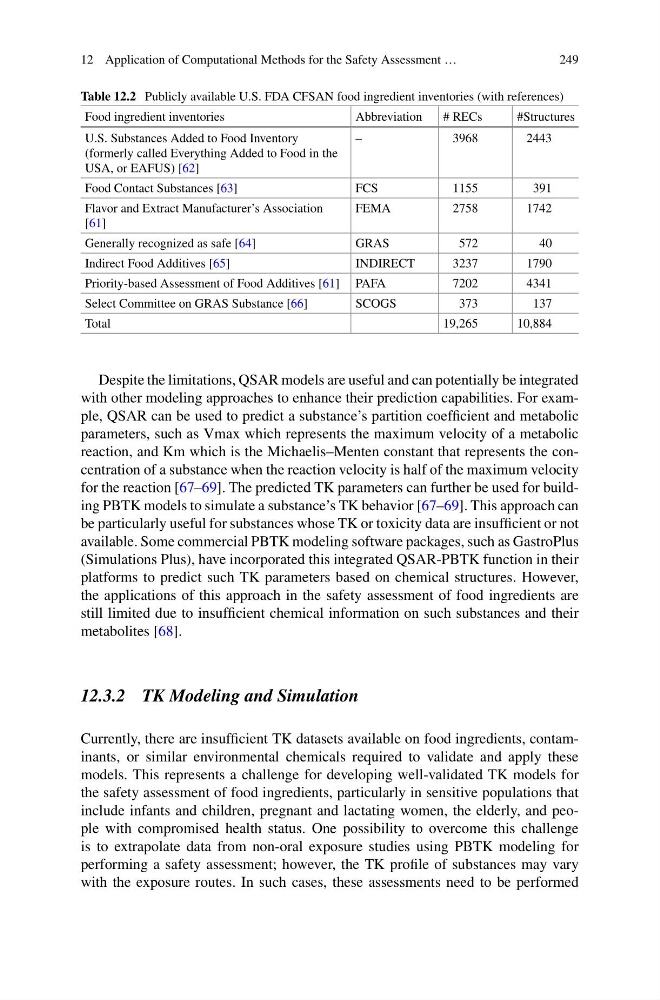
Table 12.2 Publicly available U.S. FDA CFSAN food ingredient inventories (with references)
Food ingredient inventories
Abbreviation
# RECs
#Structures
U.S. Substances Added to Food Inventory
(formerly called Everything Added to Food in the
USA, or EAFUS) [62]
–
3968
2443
Food Contact Substances [63]
FCS
1155
391
Flavor and Extract Manufacturer’s Association
[61]
FEMA
2758
1742
Generally recognized as safe [64]
GRAS
572
40
Indirect Food Additives [65]
INDIRECT
3237
1790
Priority-based Assessment of Food Additives [61] PAFA
7202
4341
Select Committee on GRAS Substance [66]
SCOGS
373
137
Total
19,265
10,884
Despite the limitations, QSAR models are useful and can potentially be integrated
with other modeling approaches to enhance their prediction capabilities. For example, QSAR can be used to predict a substance’s partition coefficient and metabolic
parameters, such as Vmax which represents the maximum velocity of a metabolic
reaction, and Km which is the Michaelis–Menten constant that represents the concentration of a substance when the reaction velocity is half of the maximum velocity
for the reaction [67–69]. The predicted TK parameters can further be used for building PBTK models to simulate a substance’s TK behavior [67–69]. This approach can
be particularly useful for substances whose TK or toxicity data are insufficient or not
available. Some commercial PBTK modeling software packages, such as GastroPlus
(Simulations Plus), have incorporated this integrated QSAR-PBTK function in their
platforms to predict such TK parameters based on chemical structures. However,
the applications of this approach in the safety assessment of food ingredients are
still limited due to insufficient chemical information on such substances and their
metabolites [68].
12.3.2 TK Modeling and Simulation
Currently, there are insufficient TK datasets available on food ingredients, contaminants, or similar environmental chemicals required to validate and apply these
models. This represents a challenge for developing well-validated TK models for
the safety assessment of food ingredients, particularly in sensitive populations that
include infants and children, pregnant and lactating women, the elderly, and people with compromised health status. One possibility to overcome this challenge
is to extrapolate data from non-oral exposure studies using PBTK modeling for
performing a safety assessment; however, the TK profile of substances may vary
with the exposure routes. In such cases, these assessments need to be performed
249
Table 12.2 Publicly available U.S. FDA CFSAN food ingredient inventories (with references)
Food ingredient inventories
Abbreviation
# RECs
#Structures
U.S. Substances Added to Food Inventory
(formerly called Everything Added to Food in the
USA, or EAFUS) [62]
–
3968
2443
Food Contact Substances [63]
FCS
1155
391
Flavor and Extract Manufacturer’s Association
[61]
FEMA
2758
1742
Generally recognized as safe [64]
GRAS
572
40
Indirect Food Additives [65]
INDIRECT
3237
1790
Priority-based Assessment of Food Additives [61] PAFA
7202
4341
Select Committee on GRAS Substance [66]
SCOGS
373
137
Total
19,265
10,884
Despite the limitations, QSAR models are useful and can potentially be integrated
with other modeling approaches to enhance their prediction capabilities. For example, QSAR can be used to predict a substance’s partition coefficient and metabolic
parameters, such as Vmax which represents the maximum velocity of a metabolic
reaction, and Km which is the Michaelis–Menten constant that represents the concentration of a substance when the reaction velocity is half of the maximum velocity
for the reaction [67–69]. The predicted TK parameters can further be used for building PBTK models to simulate a substance’s TK behavior [67–69]. This approach can
be particularly useful for substances whose TK or toxicity data are insufficient or not
available. Some commercial PBTK modeling software packages, such as GastroPlus
(Simulations Plus), have incorporated this integrated QSAR-PBTK function in their
platforms to predict such TK parameters based on chemical structures. However,
the applications of this approach in the safety assessment of food ingredients are
still limited due to insufficient chemical information on such substances and their
metabolites [68].
12.3.2 TK Modeling and Simulation
Currently, there are insufficient TK datasets available on food ingredients, contaminants, or similar environmental chemicals required to validate and apply these
models. This represents a challenge for developing well-validated TK models for
the safety assessment of food ingredients, particularly in sensitive populations that
include infants and children, pregnant and lactating women, the elderly, and people with compromised health status. One possibility to overcome this challenge
is to extrapolate data from non-oral exposure studies using PBTK modeling for
performing a safety assessment; however, the TK profile of substances may vary
with the exposure routes. In such cases, these assessments need to be performed