

12 Application of Computational Methods for the Safety Assessment …
239
(a)
(b)
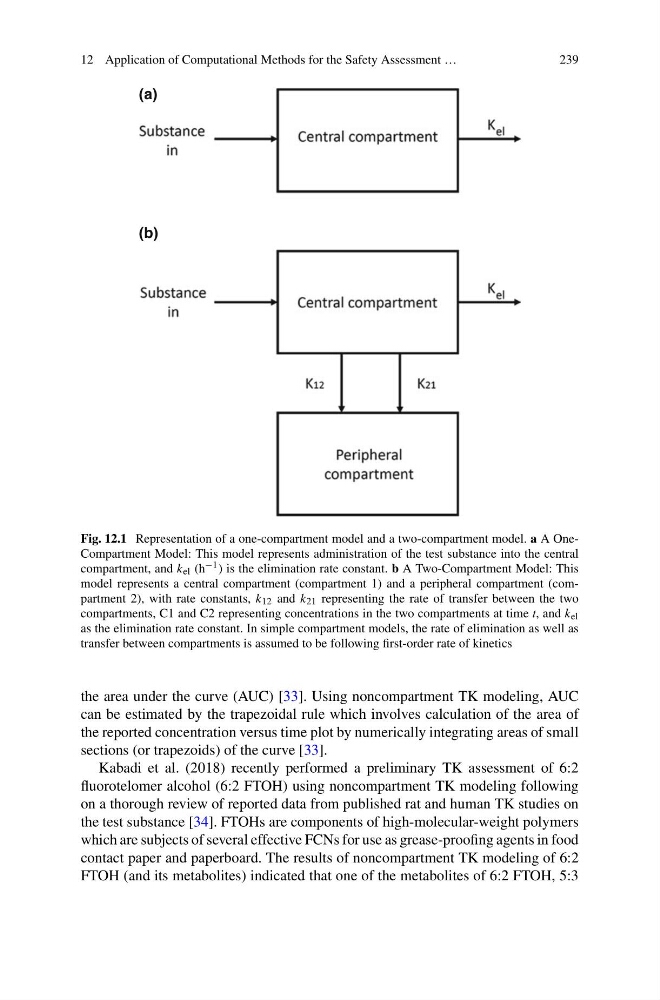
Fig. 12.1 Representation of a one-compartment model and a two-compartment model. a A OneCompartment Model: This model represents administration of the test substance into the central
compartment, and k el (h −1 ) is the elimination rate constant. b A Two-Compartment Model: This
model represents a central compartment (compartment 1) and a peripheral compartment (compartment 2), with rate constants, k 12 and k 21 representing the rate of transfer between the two
compartments, C1 and C2 representing concentrations in the two compartments at time t, and k el
as the elimination rate constant. In simple compartment models, the rate of elimination as well as
transfer between compartments is assumed to be following first-order rate of kinetics
the area under the curve (AUC) [33]. Using noncompartment TK modeling, AUC
can be estimated by the trapezoidal rule which involves calculation of the area of
the reported concentration versus time plot by numerically integrating areas of small
sections (or trapezoids) of the curve [33].
Kabadi et al. (2018) recently performed a preliminary TK assessment of 6:2
fluorotelomer alcohol (6:2 FTOH) using noncompartment TK modeling following
on a thorough review of reported data from published rat and human TK studies on
the test substance [34]. FTOHs are components of high-molecular-weight polymers
which are subjects of several effective FCNs for use as grease-proofing agents in food
contact paper and paperboard. The results of noncompartment TK modeling of 6:2
FTOH (and its metabolites) indicated that one of the metabolites of 6:2 FTOH, 5:3
239
(a)
(b)
Fig. 12.1 Representation of a one-compartment model and a two-compartment model. a A OneCompartment Model: This model represents administration of the test substance into the central
compartment, and k el (h −1 ) is the elimination rate constant. b A Two-Compartment Model: This
model represents a central compartment (compartment 1) and a peripheral compartment (compartment 2), with rate constants, k 12 and k 21 representing the rate of transfer between the two
compartments, C1 and C2 representing concentrations in the two compartments at time t, and k el
as the elimination rate constant. In simple compartment models, the rate of elimination as well as
transfer between compartments is assumed to be following first-order rate of kinetics
the area under the curve (AUC) [33]. Using noncompartment TK modeling, AUC
can be estimated by the trapezoidal rule which involves calculation of the area of
the reported concentration versus time plot by numerically integrating areas of small
sections (or trapezoids) of the curve [33].
Kabadi et al. (2018) recently performed a preliminary TK assessment of 6:2
fluorotelomer alcohol (6:2 FTOH) using noncompartment TK modeling following
on a thorough review of reported data from published rat and human TK studies on
the test substance [34]. FTOHs are components of high-molecular-weight polymers
which are subjects of several effective FCNs for use as grease-proofing agents in food
contact paper and paperboard. The results of noncompartment TK modeling of 6:2
FTOH (and its metabolites) indicated that one of the metabolites of 6:2 FTOH, 5:3