

12 Application of Computational Methods for the Safety Assessment …
237
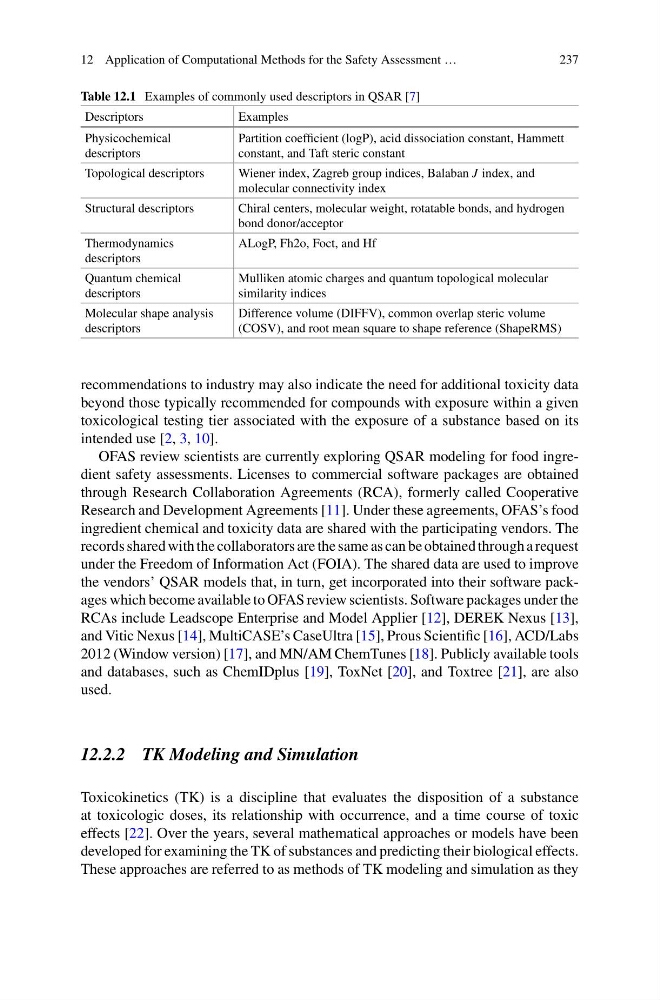
Table 12.1 Examples of commonly used descriptors in QSAR [7]
Descriptors
Examples
Physicochemical
descriptors
Partition coefficient (logP), acid dissociation constant, Hammett
constant, and Taft steric constant
Topological descriptors
Wiener index, Zagreb group indices, Balaban J index, and
molecular connectivity index
Structural descriptors
Chiral centers, molecular weight, rotatable bonds, and hydrogen
bond donor/acceptor
Thermodynamics
descriptors
ALogP, Fh2o, Foct, and Hf
Quantum chemical
descriptors
Mulliken atomic charges and quantum topological molecular
similarity indices
Molecular shape analysis
descriptors
Difference volume (DIFFV), common overlap steric volume
(COSV), and root mean square to shape reference (ShapeRMS)
recommendations to industry may also indicate the need for additional toxicity data
beyond those typically recommended for compounds with exposure within a given
toxicological testing tier associated with the exposure of a substance based on its
intended use [2, 3, 10].
OFAS review scientists are currently exploring QSAR modeling for food ingredient safety assessments. Licenses to commercial software packages are obtained
through Research Collaboration Agreements (RCA), formerly called Cooperative
Research and Development Agreements [11]. Under these agreements, OFAS’s food
ingredient chemical and toxicity data are shared with the participating vendors. The
records shared with the collaborators are the same as can be obtained through a request
under the Freedom of Information Act (FOIA). The shared data are used to improve
the vendors’ QSAR models that, in turn, get incorporated into their software packages which become available to OFAS review scientists. Software packages under the
RCAs include Leadscope Enterprise and Model Applier [12], DEREK Nexus [13],
and Vitic Nexus [14], MultiCASE’s CaseUltra [15], Prous Scientific [16], ACD/Labs
2012 (Window version) [17], and MN/AM ChemTunes [18]. Publicly available tools
and databases, such as ChemIDplus [19], ToxNet [20], and Toxtree [21], are also
used.
12.2.2 TK Modeling and Simulation
Toxicokinetics (TK) is a discipline that evaluates the disposition of a substance
at toxicologic doses, its relationship with occurrence, and a time course of toxic
effects [22]. Over the years, several mathematical approaches or models have been
developed for examining the TK of substances and predicting their biological effects.
These approaches are referred to as methods of TK modeling and simulation as they
237
Table 12.1 Examples of commonly used descriptors in QSAR [7]
Descriptors
Examples
Physicochemical
descriptors
Partition coefficient (logP), acid dissociation constant, Hammett
constant, and Taft steric constant
Topological descriptors
Wiener index, Zagreb group indices, Balaban J index, and
molecular connectivity index
Structural descriptors
Chiral centers, molecular weight, rotatable bonds, and hydrogen
bond donor/acceptor
Thermodynamics
descriptors
ALogP, Fh2o, Foct, and Hf
Quantum chemical
descriptors
Mulliken atomic charges and quantum topological molecular
similarity indices
Molecular shape analysis
descriptors
Difference volume (DIFFV), common overlap steric volume
(COSV), and root mean square to shape reference (ShapeRMS)
recommendations to industry may also indicate the need for additional toxicity data
beyond those typically recommended for compounds with exposure within a given
toxicological testing tier associated with the exposure of a substance based on its
intended use [2, 3, 10].
OFAS review scientists are currently exploring QSAR modeling for food ingredient safety assessments. Licenses to commercial software packages are obtained
through Research Collaboration Agreements (RCA), formerly called Cooperative
Research and Development Agreements [11]. Under these agreements, OFAS’s food
ingredient chemical and toxicity data are shared with the participating vendors. The
records shared with the collaborators are the same as can be obtained through a request
under the Freedom of Information Act (FOIA). The shared data are used to improve
the vendors’ QSAR models that, in turn, get incorporated into their software packages which become available to OFAS review scientists. Software packages under the
RCAs include Leadscope Enterprise and Model Applier [12], DEREK Nexus [13],
and Vitic Nexus [14], MultiCASE’s CaseUltra [15], Prous Scientific [16], ACD/Labs
2012 (Window version) [17], and MN/AM ChemTunes [18]. Publicly available tools
and databases, such as ChemIDplus [19], ToxNet [20], and Toxtree [21], are also
used.
12.2.2 TK Modeling and Simulation
Toxicokinetics (TK) is a discipline that evaluates the disposition of a substance
at toxicologic doses, its relationship with occurrence, and a time course of toxic
effects [22]. Over the years, several mathematical approaches or models have been
developed for examining the TK of substances and predicting their biological effects.
These approaches are referred to as methods of TK modeling and simulation as they