

174
Z. Liu et al.
9.5.4 Concordance Among TGx Assays is
Adverse-Outcome-Pathway-(AOP)-Specific
The concept of AOP is well established in risk assessment, which aims to provide
a structured representation of biological events and their causing adverse effects
[47]. An AOP usually includes a molecular initiating event (MIE), key events (KE),
and an adverse outcome (AO). The development of an AOP is very time-consuming
and domain-expert-knowledge-dependent. Some computational methodologies have
been developed to enrich conceptual AOP description to eliminate manual curation
[48, 49]. The AOP concept has been widely used to assess different toxicity endpoints and uncover their underlying mechanism [50, 51]. To understand the assay
transferability in different AOPs is of great importance to further implement the AOP
concept for the preclinical screening purpose.
We further studied the concordance when limiting the analysis to selecting genes
along specific AOPs. The gene-pathway associations from the Comparative Toxicogenomic Database (CTD) were used. The investigation eventually used 106 gene
sets from computational constructed AOPs, from which at least 200 genes for each
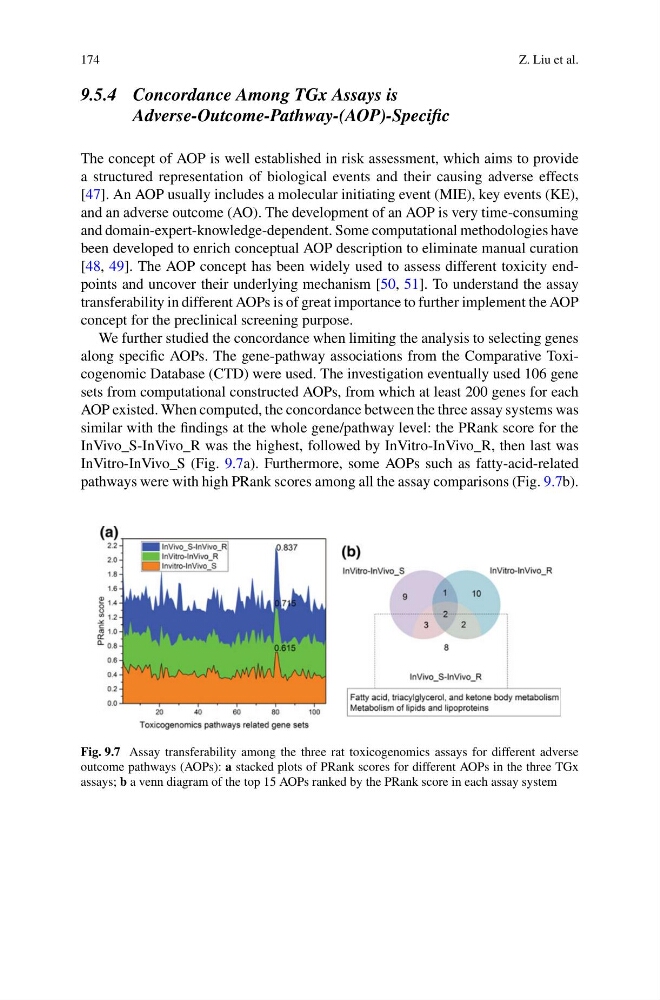
AOP existed. When computed, the concordance between the three assay systems was
similar with the findings at the whole gene/pathway level: the PRank score for the
InVivo_S-InVivo_R was the highest, followed by InVitro-InVivo_R, then last was
InVitro-InVivo_S (Fig. 9.7a). Furthermore, some AOPs such as fatty-acid-related
pathways were with high PRank scores among all the assay comparisons (Fig. 9.7b).
Fig. 9.7 Assay transferability among the three rat toxicogenomics assays for different adverse
outcome pathways (AOPs): a stacked plots of PRank scores for different AOPs in the three TGx
assays; b a venn diagram of the top 15 AOPs ranked by the PRank score in each assay system
Z. Liu et al.
9.5.4 Concordance Among TGx Assays is
Adverse-Outcome-Pathway-(AOP)-Specific
The concept of AOP is well established in risk assessment, which aims to provide
a structured representation of biological events and their causing adverse effects
[47]. An AOP usually includes a molecular initiating event (MIE), key events (KE),
and an adverse outcome (AO). The development of an AOP is very time-consuming
and domain-expert-knowledge-dependent. Some computational methodologies have
been developed to enrich conceptual AOP description to eliminate manual curation
[48, 49]. The AOP concept has been widely used to assess different toxicity endpoints and uncover their underlying mechanism [50, 51]. To understand the assay
transferability in different AOPs is of great importance to further implement the AOP
concept for the preclinical screening purpose.
We further studied the concordance when limiting the analysis to selecting genes
along specific AOPs. The gene-pathway associations from the Comparative Toxicogenomic Database (CTD) were used. The investigation eventually used 106 gene
sets from computational constructed AOPs, from which at least 200 genes for each
AOP existed. When computed, the concordance between the three assay systems was
similar with the findings at the whole gene/pathway level: the PRank score for the
InVivo_S-InVivo_R was the highest, followed by InVitro-InVivo_R, then last was
InVitro-InVivo_S (Fig. 9.7a). Furthermore, some AOPs such as fatty-acid-related
pathways were with high PRank scores among all the assay comparisons (Fig. 9.7b).
Fig. 9.7 Assay transferability among the three rat toxicogenomics assays for different adverse
outcome pathways (AOPs): a stacked plots of PRank scores for different AOPs in the three TGx
assays; b a venn diagram of the top 15 AOPs ranked by the PRank score in each assay system