

9 A Pair Ranking (PRank) Method for Assessing Assay …
167
Table 9.1 Open TG-GATEs data used to investigate assay transferability
Species
Human
Sprague–dawley rat (6 weeks old)
Experiment
In vitro
In vitro
In vivo
Tissues
Liver
Liver
Liver
#Compounds
170
Treatment
2, 8, 24 h (2 h is
omitted in some
cases)
2, 8, 24 h
• 3, 6, 9, and 24 h
after a single
administration
• 24 h after the last
dose of repeated
administration for
3, 7, 14 and 28 days
Dose
Low, middle, high
(1:5:25, low is
omitted in some
cases)
Low, middle, high
(1:5:25)
Low, middle, and
high (mainly 1:3:10)
Clinical information
Cell viability (LDH
release and DNA
contents)
Cell viability (LDH
release and DNA
contents)
Histopathology: liver
and kidney, body
weight, organ weight
(liver and kidney),
food consumption,
hematology, and
blood biochemistry
Toxicity Evaluation System. The Open TG-GATEs is an open TGx database led by
the Japanese Toxicogenomic Project consortium (TGP), which is accessed at http://
toxico.nibio.go.jp/english/index.html. The Open TG-GATEs database contains four
types of TGx assays including two in vitro assays (i.e., rat and human primary
hepatocytes) and two in vivo assays (i.e., rat liver single dose and repeated dose) that
have been exposed to 170 compounds at different dosages and time points.
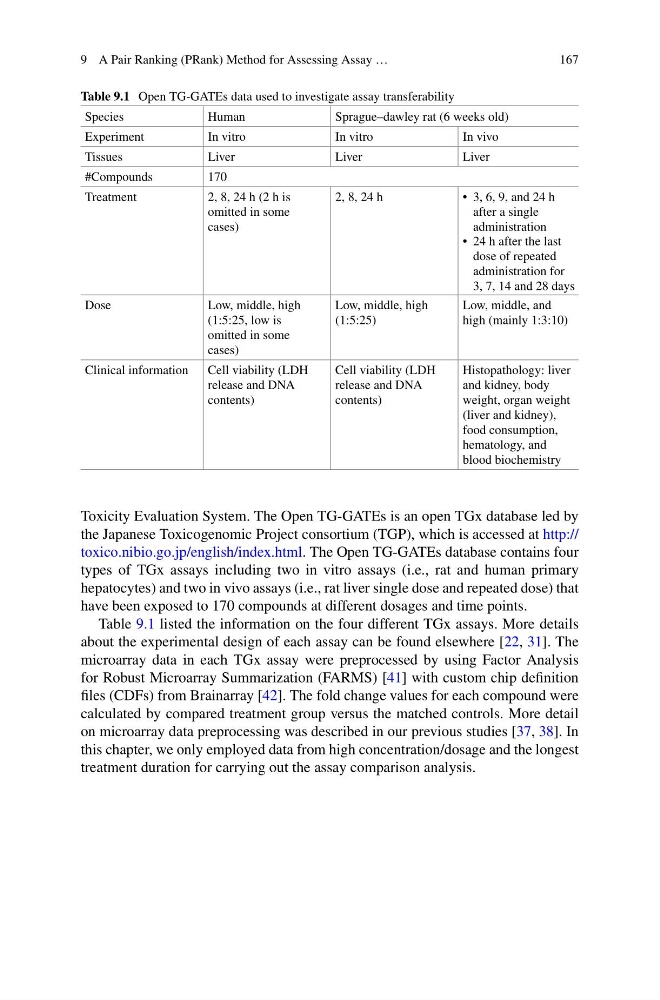
Table 9.1 listed the information on the four different TGx assays. More details
about the experimental design of each assay can be found elsewhere [22, 31]. The
microarray data in each TGx assay were preprocessed by using Factor Analysis
for Robust Microarray Summarization (FARMS) [41] with custom chip definition
files (CDFs) from Brainarray [42]. The fold change values for each compound were
calculated by compared treatment group versus the matched controls. More detail
on microarray data preprocessing was described in our previous studies [37, 38]. In
this chapter, we only employed data from high concentration/dosage and the longest
treatment duration for carrying out the assay comparison analysis.
167
Table 9.1 Open TG-GATEs data used to investigate assay transferability
Species
Human
Sprague–dawley rat (6 weeks old)
Experiment
In vitro
In vitro
In vivo
Tissues
Liver
Liver
Liver
#Compounds
170
Treatment
2, 8, 24 h (2 h is
omitted in some
cases)
2, 8, 24 h
• 3, 6, 9, and 24 h
after a single
administration
• 24 h after the last
dose of repeated
administration for
3, 7, 14 and 28 days
Dose
Low, middle, high
(1:5:25, low is
omitted in some
cases)
Low, middle, high
(1:5:25)
Low, middle, and
high (mainly 1:3:10)
Clinical information
Cell viability (LDH
release and DNA
contents)
Cell viability (LDH
release and DNA
contents)
Histopathology: liver
and kidney, body
weight, organ weight
(liver and kidney),
food consumption,
hematology, and
blood biochemistry
Toxicity Evaluation System. The Open TG-GATEs is an open TGx database led by
the Japanese Toxicogenomic Project consortium (TGP), which is accessed at http://
toxico.nibio.go.jp/english/index.html. The Open TG-GATEs database contains four
types of TGx assays including two in vitro assays (i.e., rat and human primary
hepatocytes) and two in vivo assays (i.e., rat liver single dose and repeated dose) that
have been exposed to 170 compounds at different dosages and time points.
Table 9.1 listed the information on the four different TGx assays. More details
about the experimental design of each assay can be found elsewhere [22, 31]. The
microarray data in each TGx assay were preprocessed by using Factor Analysis
for Robust Microarray Summarization (FARMS) [41] with custom chip definition
files (CDFs) from Brainarray [42]. The fold change values for each compound were
calculated by compared treatment group versus the matched controls. More detail
on microarray data preprocessing was described in our previous studies [37, 38]. In
this chapter, we only employed data from high concentration/dosage and the longest
treatment duration for carrying out the assay comparison analysis.