

110
P. Gong et al.
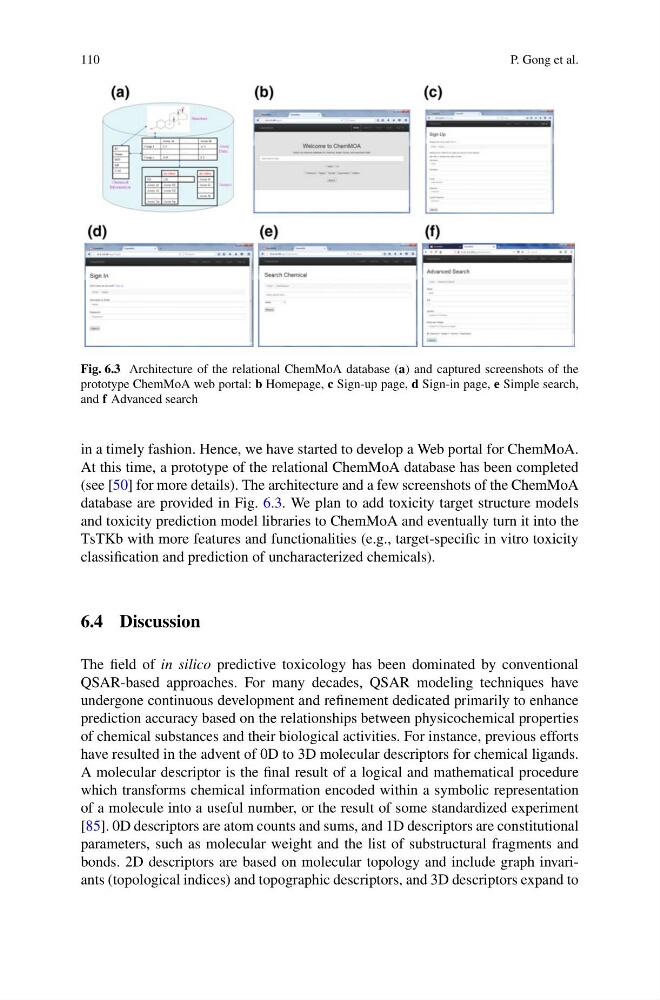
Fig. 6.3 Architecture of the relational ChemMoA database (a) and captured screenshots of the
prototype ChemMoA web portal: b Homepage, c Sign-up page, d Sign-in page, e Simple search,
and f Advanced search
in a timely fashion. Hence, we have started to develop a Web portal for ChemMoA.
At this time, a prototype of the relational ChemMoA database has been completed
(see [50] for more details). The architecture and a few screenshots of the ChemMoA
database are provided in Fig. 6.3. We plan to add toxicity target structure models
and toxicity prediction model libraries to ChemMoA and eventually turn it into the
TsTKb with more features and functionalities (e.g., target-specific in vitro toxicity
classification and prediction of uncharacterized chemicals).
6.4 Discussion
The field of in silico predictive toxicology has been dominated by conventional
QSAR-based approaches. For many decades, QSAR modeling techniques have
undergone continuous development and refinement dedicated primarily to enhance
prediction accuracy based on the relationships between physicochemical properties
of chemical substances and their biological activities. For instance, previous efforts
have resulted in the advent of 0D to 3D molecular descriptors for chemical ligands.
A molecular descriptor is the final result of a logical and mathematical procedure
which transforms chemical information encoded within a symbolic representation
of a molecule into a useful number, or the result of some standardized experiment
[85]. 0D descriptors are atom counts and sums, and 1D descriptors are constitutional
parameters, such as molecular weight and the list of substructural fragments and
bonds. 2D descriptors are based on molecular topology and include graph invariants (topological indices) and topographic descriptors, and 3D descriptors expand to
P. Gong et al.
Fig. 6.3 Architecture of the relational ChemMoA database (a) and captured screenshots of the
prototype ChemMoA web portal: b Homepage, c Sign-up page, d Sign-in page, e Simple search,
and f Advanced search
in a timely fashion. Hence, we have started to develop a Web portal for ChemMoA.
At this time, a prototype of the relational ChemMoA database has been completed
(see [50] for more details). The architecture and a few screenshots of the ChemMoA
database are provided in Fig. 6.3. We plan to add toxicity target structure models
and toxicity prediction model libraries to ChemMoA and eventually turn it into the
TsTKb with more features and functionalities (e.g., target-specific in vitro toxicity
classification and prediction of uncharacterized chemicals).
6.4 Discussion
The field of in silico predictive toxicology has been dominated by conventional
QSAR-based approaches. For many decades, QSAR modeling techniques have
undergone continuous development and refinement dedicated primarily to enhance
prediction accuracy based on the relationships between physicochemical properties
of chemical substances and their biological activities. For instance, previous efforts
have resulted in the advent of 0D to 3D molecular descriptors for chemical ligands.
A molecular descriptor is the final result of a logical and mathematical procedure
which transforms chemical information encoded within a symbolic representation
of a molecule into a useful number, or the result of some standardized experiment
[85]. 0D descriptors are atom counts and sums, and 1D descriptors are constitutional
parameters, such as molecular weight and the list of substructural fragments and
bonds. 2D descriptors are based on molecular topology and include graph invariants (topological indices) and topographic descriptors, and 3D descriptors expand to