

3 Study on Improving the Performance of Nitinol Cardiovascular Stent …
39
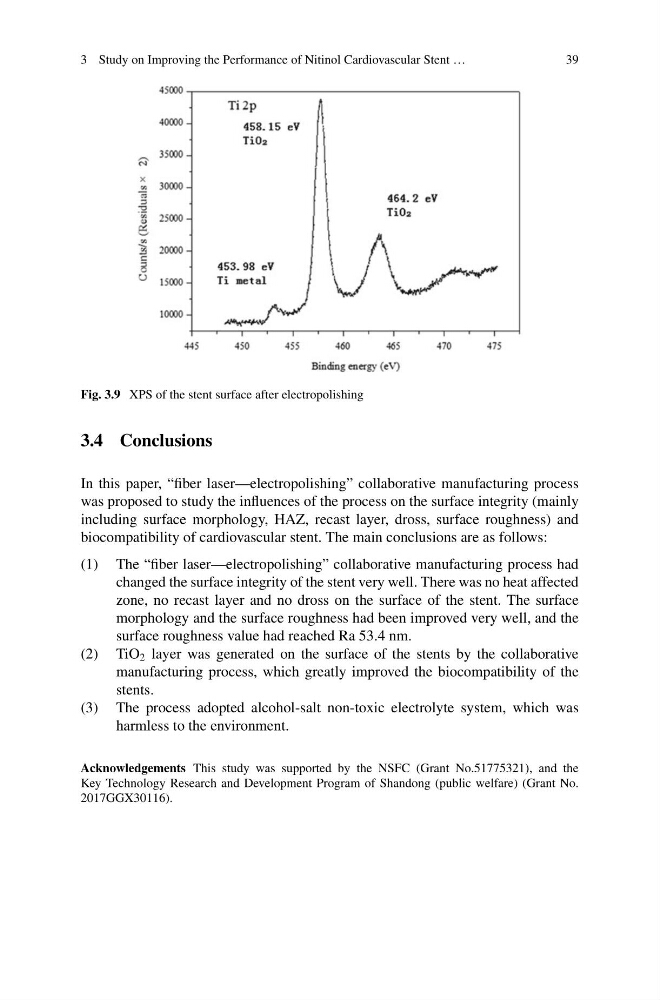
Fig. 3.9 XPS of the stent surface after electropolishing
3.4 Conclusions
In this paper, “fiber laser—electropolishing” collaborative manufacturing process
was proposed to study the influences of the process on the surface integrity (mainly
including surface morphology, HAZ, recast layer, dross, surface roughness) and
biocompatibility of cardiovascular stent. The main conclusions are as follows:
(1) The “fiber laser—electropolishing” collaborative manufacturing process had
changed the surface integrity of the stent very well. There was no heat affected
zone, no recast layer and no dross on the surface of the stent. The surface
morphology and the surface roughness had been improved very well, and the
surface roughness value had reached Ra 53.4 nm.
(2) TiO 2 layer was generated on the surface of the stents by the collaborative
manufacturing process, which greatly improved the biocompatibility of the
stents.
(3) The process adopted alcohol-salt non-toxic electrolyte system, which was
harmless to the environment.
Acknowledgements This study was supported by the NSFC (Grant No.51775321), and the
Key Technology Research and Development Program of Shandong (public welfare) (Grant No.
2017GGX30116).
39
Fig. 3.9 XPS of the stent surface after electropolishing
3.4 Conclusions
In this paper, “fiber laser—electropolishing” collaborative manufacturing process
was proposed to study the influences of the process on the surface integrity (mainly
including surface morphology, HAZ, recast layer, dross, surface roughness) and
biocompatibility of cardiovascular stent. The main conclusions are as follows:
(1) The “fiber laser—electropolishing” collaborative manufacturing process had
changed the surface integrity of the stent very well. There was no heat affected
zone, no recast layer and no dross on the surface of the stent. The surface
morphology and the surface roughness had been improved very well, and the
surface roughness value had reached Ra 53.4 nm.
(2) TiO 2 layer was generated on the surface of the stents by the collaborative
manufacturing process, which greatly improved the biocompatibility of the
stents.
(3) The process adopted alcohol-salt non-toxic electrolyte system, which was
harmless to the environment.
Acknowledgements This study was supported by the NSFC (Grant No.51775321), and the
Key Technology Research and Development Program of Shandong (public welfare) (Grant No.
2017GGX30116).