

266
L. Yang et al.
1750.0
2040.0
1800
1900
2000
Linear
s
0
700
100.0
200.0
300.0
400.0
500.0
600.0
50.0
150.0
250.0
350.0
450.0
550.0
650.0
Linear
Hz
1.26e-6
1.00
0.10
0.20
0.30
0.40
0.50
0.60
0.70
0.80
0.90
0.15
0.25
0.35
0.45
0.55
0.65
0.75
0.85
Amplitude
g
1750.0
2040.0
1800
1900
2000
Linear
s
0
700
100.0
200.0
300.0
400.0
500.0
600.0
50.0
150.0
250.0
350.0
450.0
550.0
650.0
Linear
Hz
1.26e-6
1.00
0.10
0.20
0.30
0.40
0.50
0.60
0.70
0.80
0.90
0.15
0.25
0.35
0.45
0.55
0.65
0.75
0.85
Amplitude
g
1750.0
2040.0
1800
1900
2000
1820 1840 1860 1880
1920 1940 1960 1980
1820 1840 1860 1880
1920 1940 1960 1980
1820 1840 1860 1880
1920 1940 1960 1980
Linear
s
0
700
100.0
200.0
300.0
400.0
500.0
600.0
50.0
150.0
250.0
350.0
450.0
550.0
650.0
Linear
Hz
1.26e-6
1.00
0.10
0.20
0.30
0.40
0.50
0.60
0.70
0.80
0.90
0.15
0.25
0.35
0.45
0.55
0.65
0.75
0.85
Amplitude
g
Axle box longitudinal
Axle box transverse
150Hz speed-related frequency
Axle box vertical
60-70Hz P2 force frequency
500 Hz natural frequency band
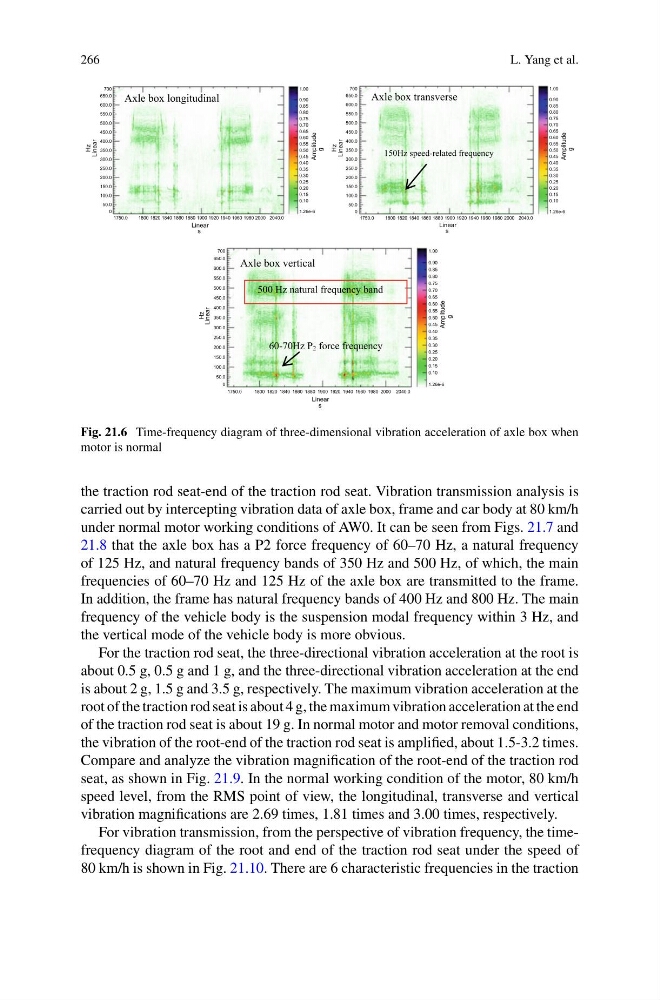
Fig. 21.6 Time-frequency diagram of three-dimensional vibration acceleration of axle box when
motor is normal
the traction rod seat-end of the traction rod seat. Vibration transmission analysis is
carried out by intercepting vibration data of axle box, frame and car body at 80 km/h
under normal motor working conditions of AW0. It can be seen from Figs. 21.7 and
21.8 that the axle box has a P2 force frequency of 60–70 Hz, a natural frequency
of 125 Hz, and natural frequency bands of 350 Hz and 500 Hz, of which, the main
frequencies of 60–70 Hz and 125 Hz of the axle box are transmitted to the frame.
In addition, the frame has natural frequency bands of 400 Hz and 800 Hz. The main
frequency of the vehicle body is the suspension modal frequency within 3 Hz, and
the vertical mode of the vehicle body is more obvious.
For the traction rod seat, the three-directional vibration acceleration at the root is
about 0.5 g, 0.5 g and 1 g, and the three-directional vibration acceleration at the end
is about 2 g, 1.5 g and 3.5 g, respectively. The maximum vibration acceleration at the
root of the traction rod seat is about 4 g, the maximum vibration acceleration at the end
of the traction rod seat is about 19 g. In normal motor and motor removal conditions,
the vibration of the root-end of the traction rod seat is amplified, about 1.5-3.2 times.
Compare and analyze the vibration magnification of the root-end of the traction rod
seat, as shown in Fig. 21.9. In the normal working condition of the motor, 80 km/h
speed level, from the RMS point of view, the longitudinal, transverse and vertical
vibration magnifications are 2.69 times, 1.81 times and 3.00 times, respectively.
For vibration transmission, from the perspective of vibration frequency, the timefrequency diagram of the root and end of the traction rod seat under the speed of
80 km/h is shown in Fig. 21.10. There are 6 characteristic frequencies in the traction
L. Yang et al.
1750.0
2040.0
1800
1900
2000
Linear
s
0
700
100.0
200.0
300.0
400.0
500.0
600.0
50.0
150.0
250.0
350.0
450.0
550.0
650.0
Linear
Hz
1.26e-6
1.00
0.10
0.20
0.30
0.40
0.50
0.60
0.70
0.80
0.90
0.15
0.25
0.35
0.45
0.55
0.65
0.75
0.85
Amplitude
g
1750.0
2040.0
1800
1900
2000
Linear
s
0
700
100.0
200.0
300.0
400.0
500.0
600.0
50.0
150.0
250.0
350.0
450.0
550.0
650.0
Linear
Hz
1.26e-6
1.00
0.10
0.20
0.30
0.40
0.50
0.60
0.70
0.80
0.90
0.15
0.25
0.35
0.45
0.55
0.65
0.75
0.85
Amplitude
g
1750.0
2040.0
1800
1900
2000
1820 1840 1860 1880
1920 1940 1960 1980
1820 1840 1860 1880
1920 1940 1960 1980
1820 1840 1860 1880
1920 1940 1960 1980
Linear
s
0
700
100.0
200.0
300.0
400.0
500.0
600.0
50.0
150.0
250.0
350.0
450.0
550.0
650.0
Linear
Hz
1.26e-6
1.00
0.10
0.20
0.30
0.40
0.50
0.60
0.70
0.80
0.90
0.15
0.25
0.35
0.45
0.55
0.65
0.75
0.85
Amplitude
g
Axle box longitudinal
Axle box transverse
150Hz speed-related frequency
Axle box vertical
60-70Hz P2 force frequency
500 Hz natural frequency band
Fig. 21.6 Time-frequency diagram of three-dimensional vibration acceleration of axle box when
motor is normal
the traction rod seat-end of the traction rod seat. Vibration transmission analysis is
carried out by intercepting vibration data of axle box, frame and car body at 80 km/h
under normal motor working conditions of AW0. It can be seen from Figs. 21.7 and
21.8 that the axle box has a P2 force frequency of 60–70 Hz, a natural frequency
of 125 Hz, and natural frequency bands of 350 Hz and 500 Hz, of which, the main
frequencies of 60–70 Hz and 125 Hz of the axle box are transmitted to the frame.
In addition, the frame has natural frequency bands of 400 Hz and 800 Hz. The main
frequency of the vehicle body is the suspension modal frequency within 3 Hz, and
the vertical mode of the vehicle body is more obvious.
For the traction rod seat, the three-directional vibration acceleration at the root is
about 0.5 g, 0.5 g and 1 g, and the three-directional vibration acceleration at the end
is about 2 g, 1.5 g and 3.5 g, respectively. The maximum vibration acceleration at the
root of the traction rod seat is about 4 g, the maximum vibration acceleration at the end
of the traction rod seat is about 19 g. In normal motor and motor removal conditions,
the vibration of the root-end of the traction rod seat is amplified, about 1.5-3.2 times.
Compare and analyze the vibration magnification of the root-end of the traction rod
seat, as shown in Fig. 21.9. In the normal working condition of the motor, 80 km/h
speed level, from the RMS point of view, the longitudinal, transverse and vertical
vibration magnifications are 2.69 times, 1.81 times and 3.00 times, respectively.
For vibration transmission, from the perspective of vibration frequency, the timefrequency diagram of the root and end of the traction rod seat under the speed of
80 km/h is shown in Fig. 21.10. There are 6 characteristic frequencies in the traction