

262
L. Yang et al.
[2]. It has become a new development direction for rail transit [3]. Zhang Jiang [4]
introduced the development of permanent magnet synchronous motor direct drive
technology at home and abroad. By analyzing many advantages of this technology,
it showed a broad prospect. The permanent magnet synchronous direct drive motor
bogie has always been the research focus of domestic and foreign scholars. Feng
Zunwei [5] studied a technical scheme of a flexible bogie directly driven by permanent magnet synchronous motor. By adjusting the structural parameters of the flexible
frame beam, a lower Y-direction torsional angle stiffness can be obtained, and it is
compared with the traditional B-type metro vehicle. Chu Yongping [6] studied a
permanent magnet direct-drive bogie using “cross-plate” flexible beams, which can
provide lower torsional stiffness and suitable diamond resistant rigidity. This has
changed the characteristics of traditional bogies with primary and secondary suspensions that adapt to track distortion. Zhang Zhihe [7] introduced the structural and
technical characteristics of the Locomotive Bogie with the permanent magnet motor
and direct drive mode, focusing on the technical features and research contents of
the key components using direct drive mode, the analysis shows that the Bogie using
this technology has obvious advantages. Lu Zhenggang [8] proposed a new solution
for directly driven wheel of disc permanent magnet synchronous motor (PMSM)
customized for low floor tramcar, the simulation shows that its dynamic performance
is excellent. Dong Shengmin [9] studied the suspension device of the motor of the
permanent magnet direct-drive electric locomotive, and analyzed the strength of the
motor suspension device using the finite element method, the calculation results meet
the design requirements. According to GB/T 5599-2019 “Specification for dynamic
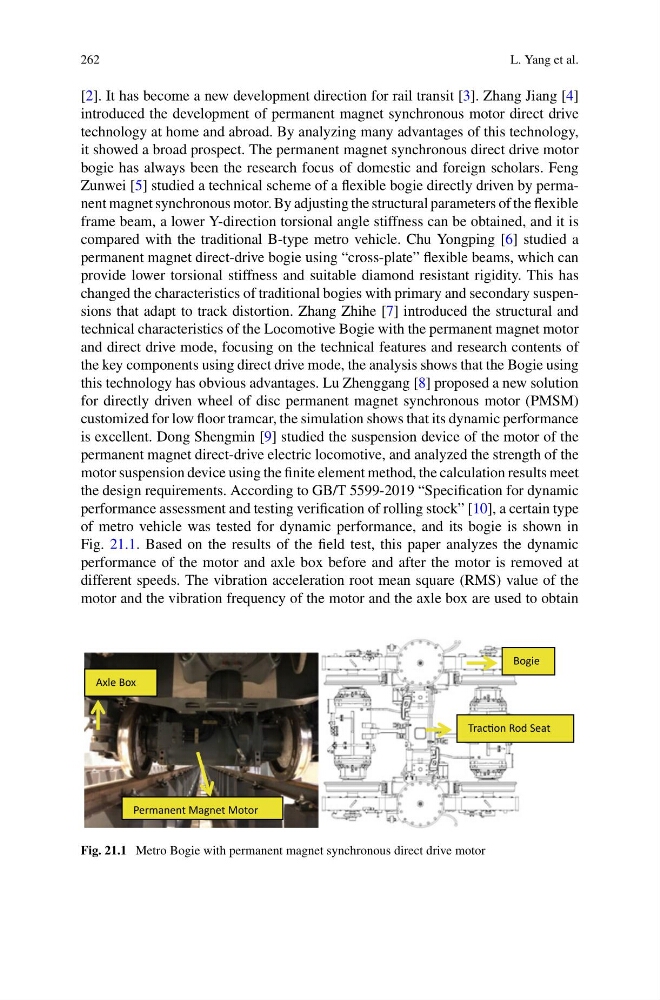
performance assessment and testing verification of rolling stock” [10], a certain type
of metro vehicle was tested for dynamic performance, and its bogie is shown in
Fig. 21.1. Based on the results of the field test, this paper analyzes the dynamic
performance of the motor and axle box before and after the motor is removed at
different speeds. The vibration acceleration root mean square (RMS) value of the
motor and the vibration frequency of the motor and the axle box are used to obtain
Bogie
TracƟon Rod Seat
Permanent Magnet Motor
Axle Box
Fig. 21.1 Metro Bogie with permanent magnet synchronous direct drive motor
L. Yang et al.
[2]. It has become a new development direction for rail transit [3]. Zhang Jiang [4]
introduced the development of permanent magnet synchronous motor direct drive
technology at home and abroad. By analyzing many advantages of this technology,
it showed a broad prospect. The permanent magnet synchronous direct drive motor
bogie has always been the research focus of domestic and foreign scholars. Feng
Zunwei [5] studied a technical scheme of a flexible bogie directly driven by permanent magnet synchronous motor. By adjusting the structural parameters of the flexible
frame beam, a lower Y-direction torsional angle stiffness can be obtained, and it is
compared with the traditional B-type metro vehicle. Chu Yongping [6] studied a
permanent magnet direct-drive bogie using “cross-plate” flexible beams, which can
provide lower torsional stiffness and suitable diamond resistant rigidity. This has
changed the characteristics of traditional bogies with primary and secondary suspensions that adapt to track distortion. Zhang Zhihe [7] introduced the structural and
technical characteristics of the Locomotive Bogie with the permanent magnet motor
and direct drive mode, focusing on the technical features and research contents of
the key components using direct drive mode, the analysis shows that the Bogie using
this technology has obvious advantages. Lu Zhenggang [8] proposed a new solution
for directly driven wheel of disc permanent magnet synchronous motor (PMSM)
customized for low floor tramcar, the simulation shows that its dynamic performance
is excellent. Dong Shengmin [9] studied the suspension device of the motor of the
permanent magnet direct-drive electric locomotive, and analyzed the strength of the
motor suspension device using the finite element method, the calculation results meet
the design requirements. According to GB/T 5599-2019 “Specification for dynamic
performance assessment and testing verification of rolling stock” [10], a certain type
of metro vehicle was tested for dynamic performance, and its bogie is shown in
Fig. 21.1. Based on the results of the field test, this paper analyzes the dynamic
performance of the motor and axle box before and after the motor is removed at
different speeds. The vibration acceleration root mean square (RMS) value of the
motor and the vibration frequency of the motor and the axle box are used to obtain
Bogie
TracƟon Rod Seat
Permanent Magnet Motor
Axle Box
Fig. 21.1 Metro Bogie with permanent magnet synchronous direct drive motor