

20 Multi-Objective Optimization of Automotive Front Rail …
257
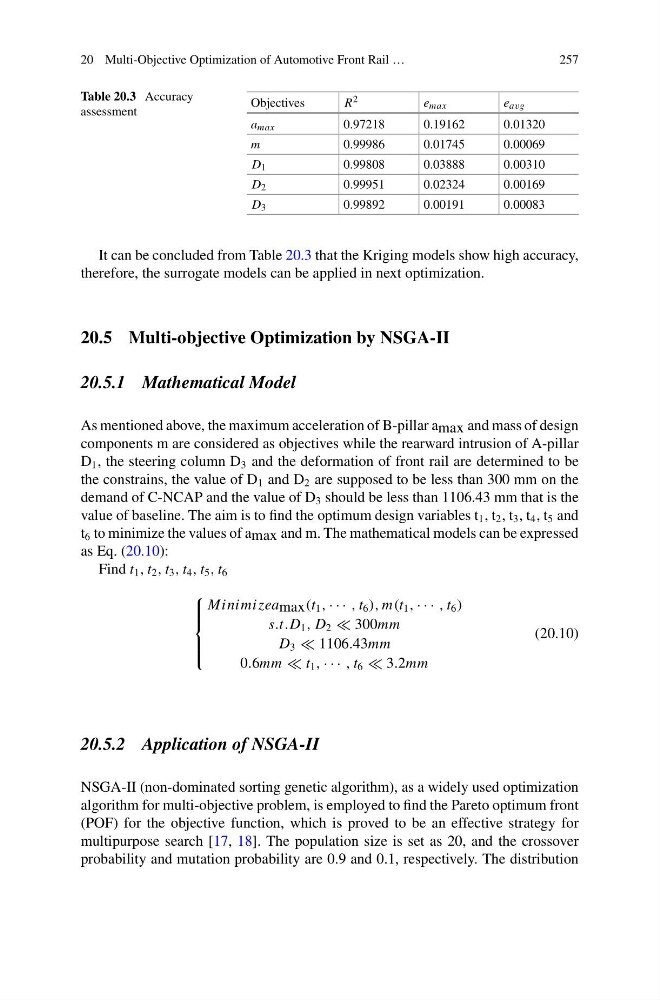
Table 20.3 Accuracy
assessment
Objectives
R 2
e max
e avg
a max
0.97218
0.19162
0.01320
m
0.99986
0.01745
0.00069
D 1
0.99808
0.03888
0.00310
D 2
0.99951
0.02324
0.00169
D 3
0.99892
0.00191
0.00083
It can be concluded from Table 20.3 that the Kriging models show high accuracy,
therefore, the surrogate models can be applied in next optimization.
20.5 Multi-objective Optimization by NSGA-II
20.5.1 Mathematical Model
As mentioned above, the maximum acceleration of B-pillar a max and mass of design
components m are considered as objectives while the rearward intrusion of A-pillar
D 1 , the steering column D 3 and the deformation of front rail are determined to be
the constrains, the value of D 1 and D 2 are supposed to be less than 300 mm on the
demand of C-NCAP and the value of D 3 should be less than 1106.43 mm that is the
value of baseline. The aim is to find the optimum design variables t 1 , t 2 , t 3 , t 4 , t 5 and
t 6 to minimize the values of a max and m. The mathematical models can be expressed
as Eq. (20.10):
Find t 1 , t 2 , t 3 , t 4 , t 5 , t 6
⎧
⎪ ⎪ ⎨
⎪ ⎪ ⎩
Minimi zea max (t 1 , · · · , t 6 ), m(t 1 , · · · , t 6 )
s.t.D 1 , D 2 300mm
D 3 1106.43mm
0.6mm t 1 , · · · , t 6 3.2mm
(20.10)
20.5.2 Application of NSGA-II
NSGA-II (non-dominated sorting genetic algorithm), as a widely used optimization
algorithm for multi-objective problem, is employed to find the Pareto optimum front
(POF) for the objective function, which is proved to be an effective strategy for
multipurpose search [17, 18]. The population size is set as 20, and the crossover
probability and mutation probability are 0.9 and 0.1, respectively. The distribution
257
Table 20.3 Accuracy
assessment
Objectives
R 2
e max
e avg
a max
0.97218
0.19162
0.01320
m
0.99986
0.01745
0.00069
D 1
0.99808
0.03888
0.00310
D 2
0.99951
0.02324
0.00169
D 3
0.99892
0.00191
0.00083
It can be concluded from Table 20.3 that the Kriging models show high accuracy,
therefore, the surrogate models can be applied in next optimization.
20.5 Multi-objective Optimization by NSGA-II
20.5.1 Mathematical Model
As mentioned above, the maximum acceleration of B-pillar a max and mass of design
components m are considered as objectives while the rearward intrusion of A-pillar
D 1 , the steering column D 3 and the deformation of front rail are determined to be
the constrains, the value of D 1 and D 2 are supposed to be less than 300 mm on the
demand of C-NCAP and the value of D 3 should be less than 1106.43 mm that is the
value of baseline. The aim is to find the optimum design variables t 1 , t 2 , t 3 , t 4 , t 5 and
t 6 to minimize the values of a max and m. The mathematical models can be expressed
as Eq. (20.10):
Find t 1 , t 2 , t 3 , t 4 , t 5 , t 6
⎧
⎪ ⎪ ⎨
⎪ ⎪ ⎩
Minimi zea max (t 1 , · · · , t 6 ), m(t 1 , · · · , t 6 )
s.t.D 1 , D 2 300mm
D 3 1106.43mm
0.6mm t 1 , · · · , t 6 3.2mm
(20.10)
20.5.2 Application of NSGA-II
NSGA-II (non-dominated sorting genetic algorithm), as a widely used optimization
algorithm for multi-objective problem, is employed to find the Pareto optimum front
(POF) for the objective function, which is proved to be an effective strategy for
multipurpose search [17, 18]. The population size is set as 20, and the crossover
probability and mutation probability are 0.9 and 0.1, respectively. The distribution