

236
Z. Wang et al.
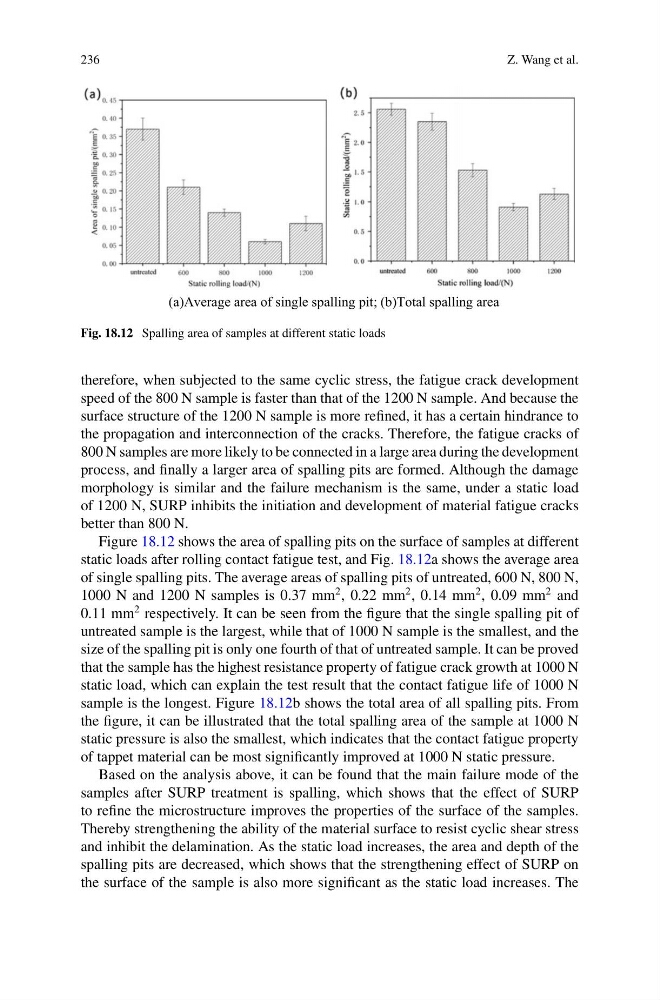
(a)Average area of single spalling pit; (b)Total spalling area
Fig. 18.12 Spalling area of samples at different static loads
therefore, when subjected to the same cyclic stress, the fatigue crack development
speed of the 800 N sample is faster than that of the 1200 N sample. And because the
surface structure of the 1200 N sample is more refined, it has a certain hindrance to
the propagation and interconnection of the cracks. Therefore, the fatigue cracks of
800 N samples are more likely to be connected in a large area during the development
process, and finally a larger area of spalling pits are formed. Although the damage
morphology is similar and the failure mechanism is the same, under a static load
of 1200 N, SURP inhibits the initiation and development of material fatigue cracks
better than 800 N.
Figure 18.12 shows the area of spalling pits on the surface of samples at different
static loads after rolling contact fatigue test, and Fig. 18.12a shows the average area
of single spalling pits. The average areas of spalling pits of untreated, 600 N, 800 N,
1000 N and 1200 N samples is 0.37 mm
2 , 0.22 mm
2 , 0.14 mm
2 , 0.09 mm
2 and
0.11 mm
2 respectively. It can be seen from the figure that the single spalling pit of
untreated sample is the largest, while that of 1000 N sample is the smallest, and the
size of the spalling pit is only one fourth of that of untreated sample. It can be proved
that the sample has the highest resistance property of fatigue crack growth at 1000 N
static load, which can explain the test result that the contact fatigue life of 1000 N
sample is the longest. Figure 18.12b shows the total area of all spalling pits. From
the figure, it can be illustrated that the total spalling area of the sample at 1000 N
static pressure is also the smallest, which indicates that the contact fatigue property
of tappet material can be most significantly improved at 1000 N static pressure.
Based on the analysis above, it can be found that the main failure mode of the
samples after SURP treatment is spalling, which shows that the effect of SURP
to refine the microstructure improves the properties of the surface of the samples.
Thereby strengthening the ability of the material surface to resist cyclic shear stress
and inhibit the delamination. As the static load increases, the area and depth of the
spalling pits are decreased, which shows that the strengthening effect of SURP on
the surface of the sample is also more significant as the static load increases. The
Z. Wang et al.
(a)Average area of single spalling pit; (b)Total spalling area
Fig. 18.12 Spalling area of samples at different static loads
therefore, when subjected to the same cyclic stress, the fatigue crack development
speed of the 800 N sample is faster than that of the 1200 N sample. And because the
surface structure of the 1200 N sample is more refined, it has a certain hindrance to
the propagation and interconnection of the cracks. Therefore, the fatigue cracks of
800 N samples are more likely to be connected in a large area during the development
process, and finally a larger area of spalling pits are formed. Although the damage
morphology is similar and the failure mechanism is the same, under a static load
of 1200 N, SURP inhibits the initiation and development of material fatigue cracks
better than 800 N.
Figure 18.12 shows the area of spalling pits on the surface of samples at different
static loads after rolling contact fatigue test, and Fig. 18.12a shows the average area
of single spalling pits. The average areas of spalling pits of untreated, 600 N, 800 N,
1000 N and 1200 N samples is 0.37 mm
2 , 0.22 mm
2 , 0.14 mm
2 , 0.09 mm
2 and
0.11 mm
2 respectively. It can be seen from the figure that the single spalling pit of
untreated sample is the largest, while that of 1000 N sample is the smallest, and the
size of the spalling pit is only one fourth of that of untreated sample. It can be proved
that the sample has the highest resistance property of fatigue crack growth at 1000 N
static load, which can explain the test result that the contact fatigue life of 1000 N
sample is the longest. Figure 18.12b shows the total area of all spalling pits. From
the figure, it can be illustrated that the total spalling area of the sample at 1000 N
static pressure is also the smallest, which indicates that the contact fatigue property
of tappet material can be most significantly improved at 1000 N static pressure.
Based on the analysis above, it can be found that the main failure mode of the
samples after SURP treatment is spalling, which shows that the effect of SURP
to refine the microstructure improves the properties of the surface of the samples.
Thereby strengthening the ability of the material surface to resist cyclic shear stress
and inhibit the delamination. As the static load increases, the area and depth of the
spalling pits are decreased, which shows that the strengthening effect of SURP on
the surface of the sample is also more significant as the static load increases. The