

18 The Effect of Surface Ultrasonic Rolling Processing …
231
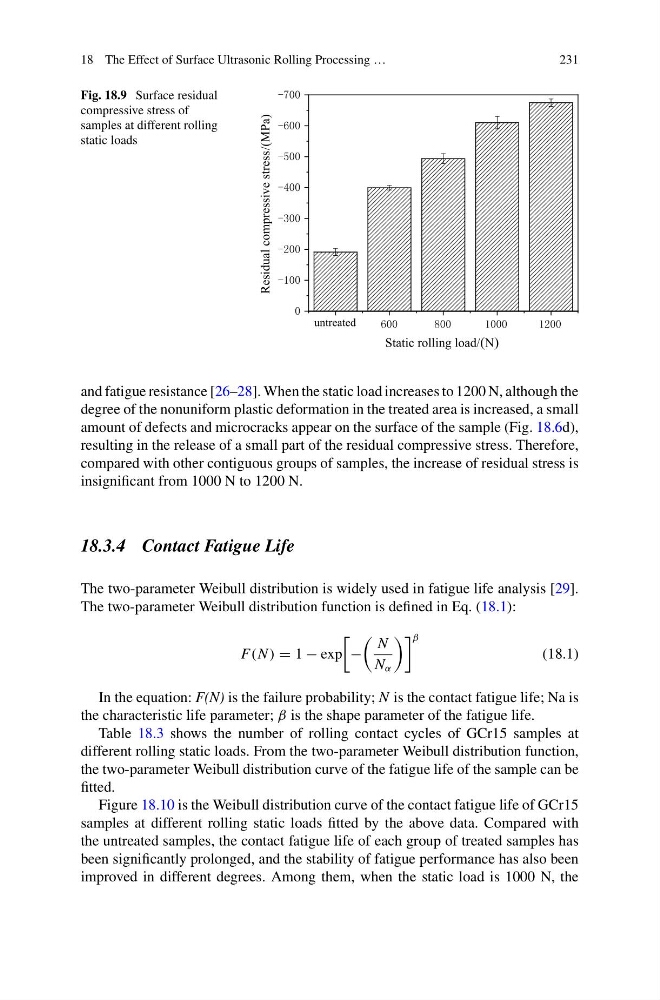
Fig. 18.9 Surface residual
compressive stress of
samples at different rolling
static loads
Residual compressive stress/(MPa)
Static rolling load/(N)
untreated
and fatigue resistance [26–28]. When the static load increases to 1200 N, although the
degree of the nonuniform plastic deformation in the treated area is increased, a small
amount of defects and microcracks appear on the surface of the sample (Fig. 18.6d),
resulting in the release of a small part of the residual compressive stress. Therefore,
compared with other contiguous groups of samples, the increase of residual stress is
insignificant from 1000 N to 1200 N.
18.3.4 Contact Fatigue Life
The two-parameter Weibull distribution is widely used in fatigue life analysis [29].
The two-parameter Weibull distribution function is defined in Eq. (18.1):
F(N ) = 1 − exp
−
N
N α
β
(18.1)
In the equation: F(N) is the failure probability; N is the contact fatigue life; Na is
the characteristic life parameter; β is the shape parameter of the fatigue life.
Table 18.3 shows the number of rolling contact cycles of GCr15 samples at
different rolling static loads. From the two-parameter Weibull distribution function,
the two-parameter Weibull distribution curve of the fatigue life of the sample can be
fitted.
Figure 18.10 is the Weibull distribution curve of the contact fatigue life of GCr15
samples at different rolling static loads fitted by the above data. Compared with
the untreated samples, the contact fatigue life of each group of treated samples has
been significantly prolonged, and the stability of fatigue performance has also been
improved in different degrees. Among them, when the static load is 1000 N, the
231
Fig. 18.9 Surface residual
compressive stress of
samples at different rolling
static loads
Residual compressive stress/(MPa)
Static rolling load/(N)
untreated
and fatigue resistance [26–28]. When the static load increases to 1200 N, although the
degree of the nonuniform plastic deformation in the treated area is increased, a small
amount of defects and microcracks appear on the surface of the sample (Fig. 18.6d),
resulting in the release of a small part of the residual compressive stress. Therefore,
compared with other contiguous groups of samples, the increase of residual stress is
insignificant from 1000 N to 1200 N.
18.3.4 Contact Fatigue Life
The two-parameter Weibull distribution is widely used in fatigue life analysis [29].
The two-parameter Weibull distribution function is defined in Eq. (18.1):
F(N ) = 1 − exp
−
N
N α
β
(18.1)
In the equation: F(N) is the failure probability; N is the contact fatigue life; Na is
the characteristic life parameter; β is the shape parameter of the fatigue life.
Table 18.3 shows the number of rolling contact cycles of GCr15 samples at
different rolling static loads. From the two-parameter Weibull distribution function,
the two-parameter Weibull distribution curve of the fatigue life of the sample can be
fitted.
Figure 18.10 is the Weibull distribution curve of the contact fatigue life of GCr15
samples at different rolling static loads fitted by the above data. Compared with
the untreated samples, the contact fatigue life of each group of treated samples has
been significantly prolonged, and the stability of fatigue performance has also been
improved in different degrees. Among them, when the static load is 1000 N, the