

204
S. Zhan et al.
deviation is 3.261%, and the vertical fit mean value is 87.44% and its standard
deviation is 3.629%. These are high fit percentage indicating the models can well
describe the system. In addition, the infinity norm of the residuals is small, indicating
good significance of the results.
16.4.2 Parameters Variation Law
In this system, its stiffness and damping will change with shaft positions. However,
this variation law is difficult to identify directly, so we will identify the equivalent stiffness and damping instead. The stiffness and damping are regarded as the
average value of the model parameter in this section, and then the average parameter
values of all the sections are fitted to obtain the variation law of the parameters.
These bearing-rotor model parameters are expected to depend continuously on the
horizontal position and vertical position. Each key parameter is therefore approximated onto a polynomial surface. Thereby the identified stiffness, damping matrix
coefficients are modelled as Eq. (16.5):
k(x, y) = k 0 + k 1 x + k 2 y + k 3 x y + k 4 y
2
+ k 5 x y
2
+ k 6 y
3
c(x, y) = c 0 + c 1 x + c 2 y + c 3 x y + c 4 y
2
+ c 5 x y
2
+ c 6 y
3
(16.5)
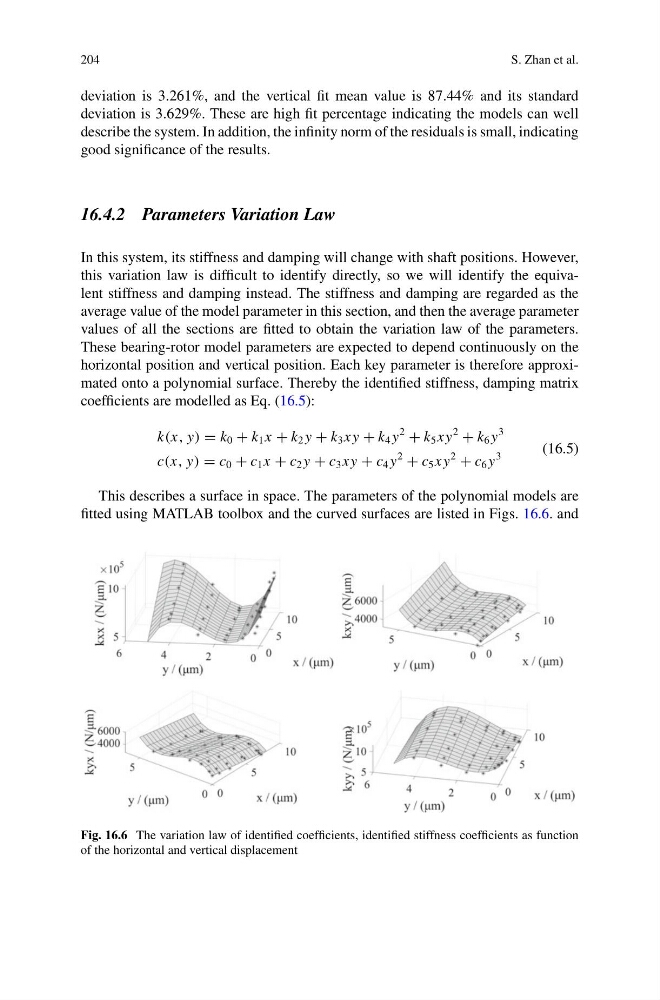
This describes a surface in space. The parameters of the polynomial models are
fitted using MATLAB toolbox and the curved surfaces are listed in Figs. 16.6. and
Fig. 16.6 The variation law of identified coefficients, identified stiffness coefficients as function
of the horizontal and vertical displacement
S. Zhan et al.
deviation is 3.261%, and the vertical fit mean value is 87.44% and its standard
deviation is 3.629%. These are high fit percentage indicating the models can well
describe the system. In addition, the infinity norm of the residuals is small, indicating
good significance of the results.
16.4.2 Parameters Variation Law
In this system, its stiffness and damping will change with shaft positions. However,
this variation law is difficult to identify directly, so we will identify the equivalent stiffness and damping instead. The stiffness and damping are regarded as the
average value of the model parameter in this section, and then the average parameter
values of all the sections are fitted to obtain the variation law of the parameters.
These bearing-rotor model parameters are expected to depend continuously on the
horizontal position and vertical position. Each key parameter is therefore approximated onto a polynomial surface. Thereby the identified stiffness, damping matrix
coefficients are modelled as Eq. (16.5):
k(x, y) = k 0 + k 1 x + k 2 y + k 3 x y + k 4 y
2
+ k 5 x y
2
+ k 6 y
3
c(x, y) = c 0 + c 1 x + c 2 y + c 3 x y + c 4 y
2
+ c 5 x y
2
+ c 6 y
3
(16.5)
This describes a surface in space. The parameters of the polynomial models are
fitted using MATLAB toolbox and the curved surfaces are listed in Figs. 16.6. and
Fig. 16.6 The variation law of identified coefficients, identified stiffness coefficients as function
of the horizontal and vertical displacement