

170
X. Bi et al.
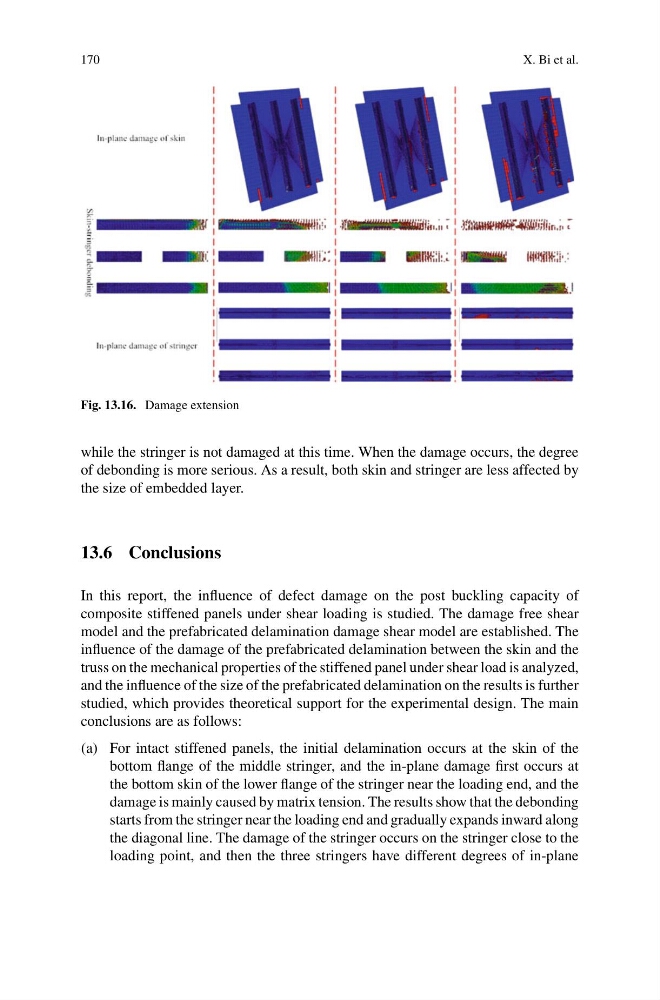
Fig. 13.16. Damage extension
while the stringer is not damaged at this time. When the damage occurs, the degree
of debonding is more serious. As a result, both skin and stringer are less affected by
the size of embedded layer.
13.6 Conclusions
In this report, the influence of defect damage on the post buckling capacity of
composite stiffened panels under shear loading is studied. The damage free shear
model and the prefabricated delamination damage shear model are established. The
influence of the damage of the prefabricated delamination between the skin and the
truss on the mechanical properties of the stiffened panel under shear load is analyzed,
and the influence of the size of the prefabricated delamination on the results is further
studied, which provides theoretical support for the experimental design. The main
conclusions are as follows:
(a) For intact stiffened panels, the initial delamination occurs at the skin of the
bottom flange of the middle stringer, and the in-plane damage first occurs at
the bottom skin of the lower flange of the stringer near the loading end, and the
damage is mainly caused by matrix tension. The results show that the debonding
starts from the stringer near the loading end and gradually expands inward along
the diagonal line. The damage of the stringer occurs on the stringer close to the
loading point, and then the three stringers have different degrees of in-plane
X. Bi et al.
Fig. 13.16. Damage extension
while the stringer is not damaged at this time. When the damage occurs, the degree
of debonding is more serious. As a result, both skin and stringer are less affected by
the size of embedded layer.
13.6 Conclusions
In this report, the influence of defect damage on the post buckling capacity of
composite stiffened panels under shear loading is studied. The damage free shear
model and the prefabricated delamination damage shear model are established. The
influence of the damage of the prefabricated delamination between the skin and the
truss on the mechanical properties of the stiffened panel under shear load is analyzed,
and the influence of the size of the prefabricated delamination on the results is further
studied, which provides theoretical support for the experimental design. The main
conclusions are as follows:
(a) For intact stiffened panels, the initial delamination occurs at the skin of the
bottom flange of the middle stringer, and the in-plane damage first occurs at
the bottom skin of the lower flange of the stringer near the loading end, and the
damage is mainly caused by matrix tension. The results show that the debonding
starts from the stringer near the loading end and gradually expands inward along
the diagonal line. The damage of the stringer occurs on the stringer close to the
loading point, and then the three stringers have different degrees of in-plane