

128
Y. Ge and Z. Ye
10.4 Case study
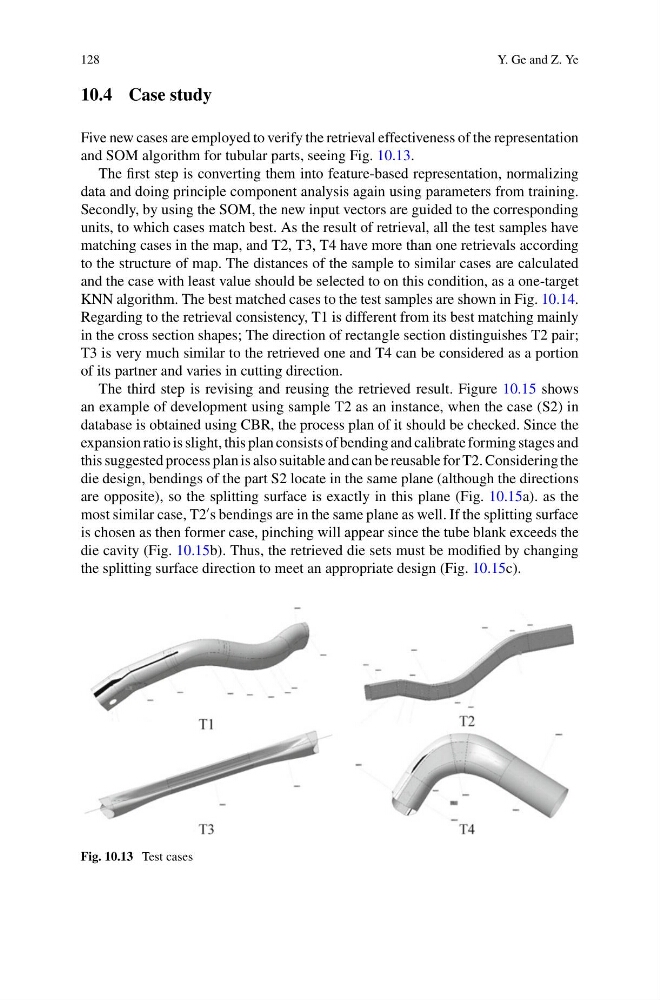
Five new cases are employed to verify the retrieval effectiveness of the representation
and SOM algorithm for tubular parts, seeing Fig. 10.13.
The first step is converting them into feature-based representation, normalizing
data and doing principle component analysis again using parameters from training.
Secondly, by using the SOM, the new input vectors are guided to the corresponding
units, to which cases match best. As the result of retrieval, all the test samples have
matching cases in the map, and T2, T3, T4 have more than one retrievals according
to the structure of map. The distances of the sample to similar cases are calculated
and the case with least value should be selected to on this condition, as a one-target
KNN algorithm. The best matched cases to the test samples are shown in Fig. 10.14.
Regarding to the retrieval consistency, T1 is different from its best matching mainly
in the cross section shapes; The direction of rectangle section distinguishes T2 pair;
T3 is very much similar to the retrieved one and T4 can be considered as a portion
of its partner and varies in cutting direction.
The third step is revising and reusing the retrieved result. Figure 10.15 shows
an example of development using sample T2 as an instance, when the case (S2) in
database is obtained using CBR, the process plan of it should be checked. Since the
expansion ratio is slight, this plan consists of bending and calibrate forming stages and
this suggested process plan is also suitable and can be reusable for T2. Considering the
die design, bendings of the part S2 locate in the same plane (although the directions
are opposite), so the splitting surface is exactly in this plane (Fig. 10.15a). as the
most similar case, T2
s bendings are in the same plane as well. If the splitting surface
is chosen as then former case, pinching will appear since the tube blank exceeds the
die cavity (Fig. 10.15b). Thus, the retrieved die sets must be modified by changing
the splitting surface direction to meet an appropriate design (Fig. 10.15c).
Fig. 10.13 Test cases
Y. Ge and Z. Ye
10.4 Case study
Five new cases are employed to verify the retrieval effectiveness of the representation
and SOM algorithm for tubular parts, seeing Fig. 10.13.
The first step is converting them into feature-based representation, normalizing
data and doing principle component analysis again using parameters from training.
Secondly, by using the SOM, the new input vectors are guided to the corresponding
units, to which cases match best. As the result of retrieval, all the test samples have
matching cases in the map, and T2, T3, T4 have more than one retrievals according
to the structure of map. The distances of the sample to similar cases are calculated
and the case with least value should be selected to on this condition, as a one-target
KNN algorithm. The best matched cases to the test samples are shown in Fig. 10.14.
Regarding to the retrieval consistency, T1 is different from its best matching mainly
in the cross section shapes; The direction of rectangle section distinguishes T2 pair;
T3 is very much similar to the retrieved one and T4 can be considered as a portion
of its partner and varies in cutting direction.
The third step is revising and reusing the retrieved result. Figure 10.15 shows
an example of development using sample T2 as an instance, when the case (S2) in
database is obtained using CBR, the process plan of it should be checked. Since the
expansion ratio is slight, this plan consists of bending and calibrate forming stages and
this suggested process plan is also suitable and can be reusable for T2. Considering the
die design, bendings of the part S2 locate in the same plane (although the directions
are opposite), so the splitting surface is exactly in this plane (Fig. 10.15a). as the
most similar case, T2
s bendings are in the same plane as well. If the splitting surface
is chosen as then former case, pinching will appear since the tube blank exceeds the
die cavity (Fig. 10.15b). Thus, the retrieved die sets must be modified by changing
the splitting surface direction to meet an appropriate design (Fig. 10.15c).
Fig. 10.13 Test cases