

8 Uncertainty Quantification of Spray Nozzle Fatigue …
93
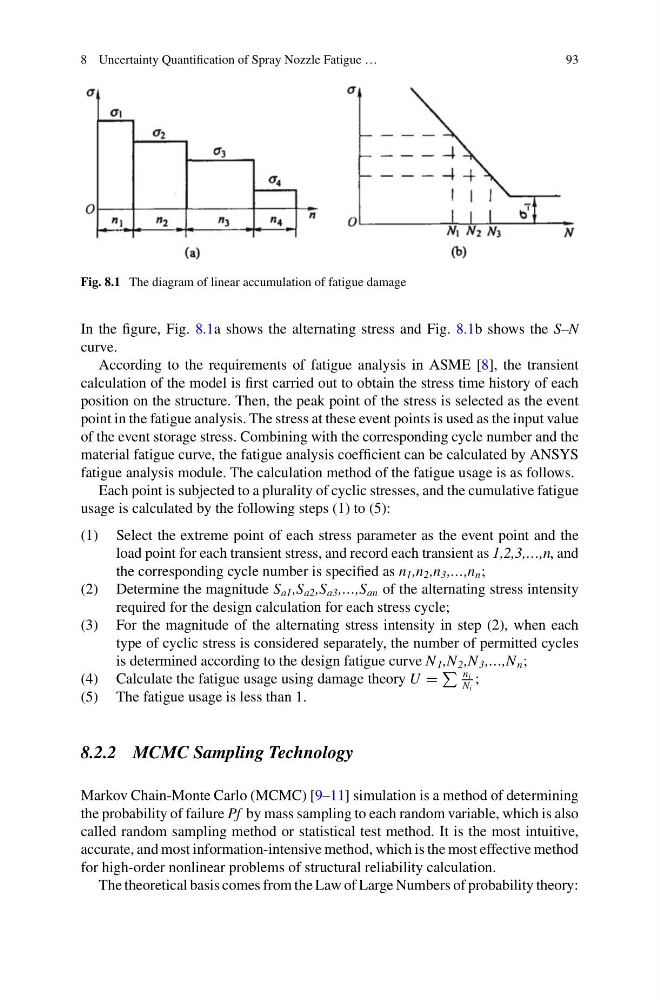
Fig. 8.1 The diagram of linear accumulation of fatigue damage
In the figure, Fig. 8.1a shows the alternating stress and Fig. 8.1b shows the S–N
curve.
According to the requirements of fatigue analysis in ASME [8], the transient
calculation of the model is first carried out to obtain the stress time history of each
position on the structure. Then, the peak point of the stress is selected as the event
point in the fatigue analysis. The stress at these event points is used as the input value
of the event storage stress. Combining with the corresponding cycle number and the
material fatigue curve, the fatigue analysis coefficient can be calculated by ANSYS
fatigue analysis module. The calculation method of the fatigue usage is as follows.
Each point is subjected to a plurality of cyclic stresses, and the cumulative fatigue
usage is calculated by the following steps (1) to (5):
(1) Select the extreme point of each stress parameter as the event point and the
load point for each transient stress, and record each transient as 1,2,3,…,n, and
the corresponding cycle number is specified as n 1 ,n 2 ,n 3 ,…,n n ;
(2) Determine the magnitude S a1 ,S a2 ,S a3 ,…,S an of the alternating stress intensity
required for the design calculation for each stress cycle;
(3) For the magnitude of the alternating stress intensity in step (2), when each
type of cyclic stress is considered separately, the number of permitted cycles
is determined according to the design fatigue curve N 1 ,N 2 ,N 3 ,…,N n ;
(4) Calculate the fatigue usage using damage theory U =
n i
N i
;
(5) The fatigue usage is less than 1.
8.2.2 MCMC Sampling Technology
Markov Chain-Monte Carlo (MCMC) [9–11] simulation is a method of determining
the probability of failure Pf by mass sampling to each random variable, which is also
called random sampling method or statistical test method. It is the most intuitive,
accurate, and most information-intensive method, which is the most effective method
for high-order nonlinear problems of structural reliability calculation.
The theoretical basis comes from the Law of Large Numbers of probability theory:
93
Fig. 8.1 The diagram of linear accumulation of fatigue damage
In the figure, Fig. 8.1a shows the alternating stress and Fig. 8.1b shows the S–N
curve.
According to the requirements of fatigue analysis in ASME [8], the transient
calculation of the model is first carried out to obtain the stress time history of each
position on the structure. Then, the peak point of the stress is selected as the event
point in the fatigue analysis. The stress at these event points is used as the input value
of the event storage stress. Combining with the corresponding cycle number and the
material fatigue curve, the fatigue analysis coefficient can be calculated by ANSYS
fatigue analysis module. The calculation method of the fatigue usage is as follows.
Each point is subjected to a plurality of cyclic stresses, and the cumulative fatigue
usage is calculated by the following steps (1) to (5):
(1) Select the extreme point of each stress parameter as the event point and the
load point for each transient stress, and record each transient as 1,2,3,…,n, and
the corresponding cycle number is specified as n 1 ,n 2 ,n 3 ,…,n n ;
(2) Determine the magnitude S a1 ,S a2 ,S a3 ,…,S an of the alternating stress intensity
required for the design calculation for each stress cycle;
(3) For the magnitude of the alternating stress intensity in step (2), when each
type of cyclic stress is considered separately, the number of permitted cycles
is determined according to the design fatigue curve N 1 ,N 2 ,N 3 ,…,N n ;
(4) Calculate the fatigue usage using damage theory U =
n i
N i
;
(5) The fatigue usage is less than 1.
8.2.2 MCMC Sampling Technology
Markov Chain-Monte Carlo (MCMC) [9–11] simulation is a method of determining
the probability of failure Pf by mass sampling to each random variable, which is also
called random sampling method or statistical test method. It is the most intuitive,
accurate, and most information-intensive method, which is the most effective method
for high-order nonlinear problems of structural reliability calculation.
The theoretical basis comes from the Law of Large Numbers of probability theory: