

3.4 Galileons
35
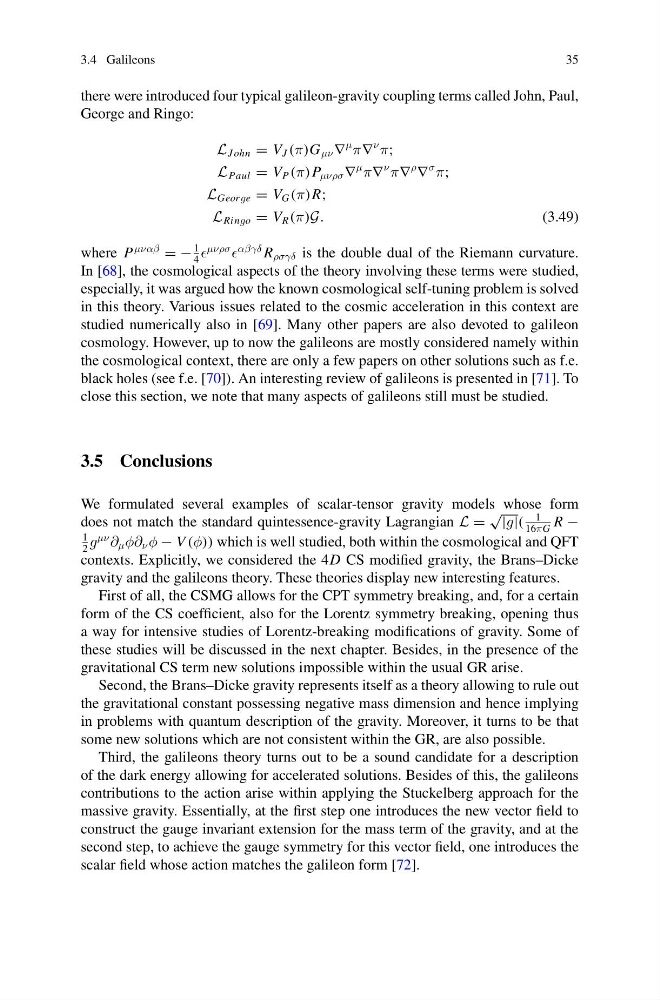
there were introduced four typical galileon-gravity coupling terms called John, Paul,
George and Ringo:
L J ohn = V J (π)G μν ∇
μ
π∇
ν
π;
L Paul = V P (π)P μνρσ ∇
μ
π∇
ν
π∇
ρ
∇
σ
π;
L George = V G (π)R;
L Ringo = V R (π)G.
(3.49)
where P
μναβ
= −
1
4
μνρσ
αβγδ R ρσγδ is the double dual of the Riemann curvature.
In [68], the cosmological aspects of the theory involving these terms were studied,
especially, it was argued how the known cosmological self-tuning problem is solved
in this theory. Various issues related to the cosmic acceleration in this context are
studied numerically also in [69]. Many other papers are also devoted to galileon
cosmology. However, up to now the galileons are mostly considered namely within
the cosmological context, there are only a few papers on other solutions such as f.e.
black holes (see f.e. [70]). An interesting review of galileons is presented in [71]. To
close this section, we note that many aspects of galileons still must be studied.
3.5 Conclusions
We formulated several examples of scalar-tensor gravity models whose form
does not match the standard quintessence-gravity Lagrangian L =
√
|g|(
1
16πG
R −
1
2
g
μν
∂ μ φ∂ ν φ − V (φ)) which is well studied, both within the cosmological and QFT
contexts. Explicitly, we considered the 4D CS modified gravity, the Brans–Dicke
gravity and the galileons theory. These theories display new interesting features.
First of all, the CSMG allows for the CPT symmetry breaking, and, for a certain
form of the CS coefficient, also for the Lorentz symmetry breaking, opening thus
a way for intensive studies of Lorentz-breaking modifications of gravity. Some of
these studies will be discussed in the next chapter. Besides, in the presence of the
gravitational CS term new solutions impossible within the usual GR arise.
Second, the Brans–Dicke gravity represents itself as a theory allowing to rule out
the gravitational constant possessing negative mass dimension and hence implying
in problems with quantum description of the gravity. Moreover, it turns to be that
some new solutions which are not consistent within the GR, are also possible.
Third, the galileons theory turns out to be a sound candidate for a description
of the dark energy allowing for accelerated solutions. Besides of this, the galileons
contributions to the action arise within applying the Stuckelberg approach for the
massive gravity. Essentially, at the first step one introduces the new vector field to
construct the gauge invariant extension for the mass term of the gravity, and at the
second step, to achieve the gauge symmetry for this vector field, one introduces the
scalar field whose action matches the galileon form [72].
35
there were introduced four typical galileon-gravity coupling terms called John, Paul,
George and Ringo:
L J ohn = V J (π)G μν ∇
μ
π∇
ν
π;
L Paul = V P (π)P μνρσ ∇
μ
π∇
ν
π∇
ρ
∇
σ
π;
L George = V G (π)R;
L Ringo = V R (π)G.
(3.49)
where P
μναβ
= −
1
4
μνρσ
αβγδ R ρσγδ is the double dual of the Riemann curvature.
In [68], the cosmological aspects of the theory involving these terms were studied,
especially, it was argued how the known cosmological self-tuning problem is solved
in this theory. Various issues related to the cosmic acceleration in this context are
studied numerically also in [69]. Many other papers are also devoted to galileon
cosmology. However, up to now the galileons are mostly considered namely within
the cosmological context, there are only a few papers on other solutions such as f.e.
black holes (see f.e. [70]). An interesting review of galileons is presented in [71]. To
close this section, we note that many aspects of galileons still must be studied.
3.5 Conclusions
We formulated several examples of scalar-tensor gravity models whose form
does not match the standard quintessence-gravity Lagrangian L =
√
|g|(
1
16πG
R −
1
2
g
μν
∂ μ φ∂ ν φ − V (φ)) which is well studied, both within the cosmological and QFT
contexts. Explicitly, we considered the 4D CS modified gravity, the Brans–Dicke
gravity and the galileons theory. These theories display new interesting features.
First of all, the CSMG allows for the CPT symmetry breaking, and, for a certain
form of the CS coefficient, also for the Lorentz symmetry breaking, opening thus
a way for intensive studies of Lorentz-breaking modifications of gravity. Some of
these studies will be discussed in the next chapter. Besides, in the presence of the
gravitational CS term new solutions impossible within the usual GR arise.
Second, the Brans–Dicke gravity represents itself as a theory allowing to rule out
the gravitational constant possessing negative mass dimension and hence implying
in problems with quantum description of the gravity. Moreover, it turns to be that
some new solutions which are not consistent within the GR, are also possible.
Third, the galileons theory turns out to be a sound candidate for a description
of the dark energy allowing for accelerated solutions. Besides of this, the galileons
contributions to the action arise within applying the Stuckelberg approach for the
massive gravity. Essentially, at the first step one introduces the new vector field to
construct the gauge invariant extension for the mass term of the gravity, and at the
second step, to achieve the gauge symmetry for this vector field, one introduces the
scalar field whose action matches the galileon form [72].