

28
3 Scalar-Tensor Gravities
2 ω
2
+ 2 bω(4 ω
2
− m
2
) =
1
2
e
2
+
1
2
ρ − +
3
2
p,
(3.27)
2 ω
2
− m
2
+ bω(4 ω
2
− m
2
) =
1
2
e
2
−
1
2
p + +
1
2
ρ,
0 = −
1
2
e
2
−
1
2
p + s
2
+ +
1
2
ρ.
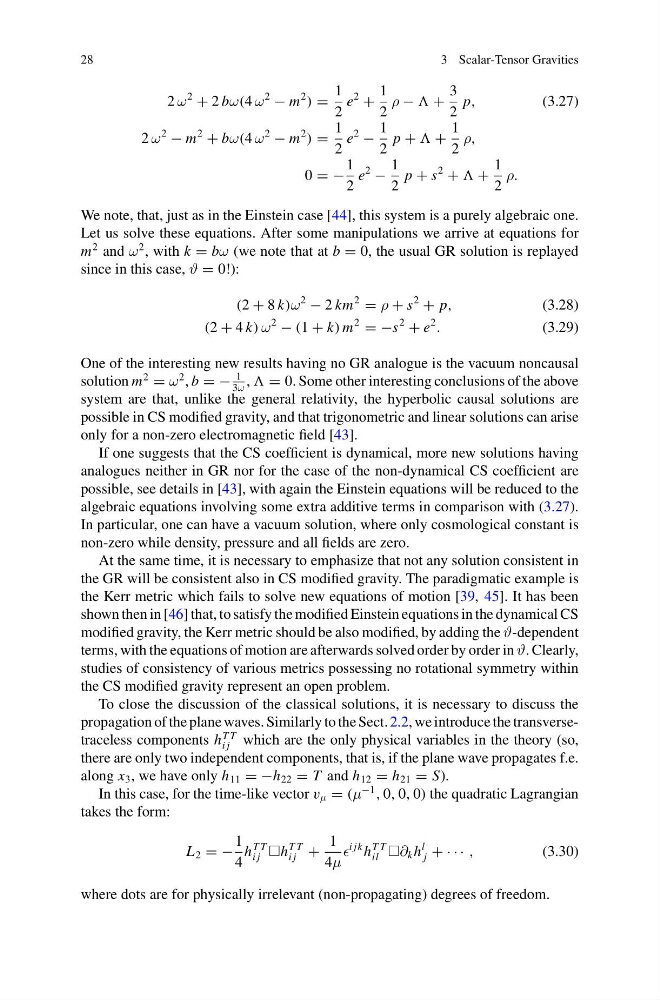
We note, that, just as in the Einstein case [44], this system is a purely algebraic one.
Let us solve these equations. After some manipulations we arrive at equations for
m
2 and ω
2 , with k = bω (we note that at b = 0, the usual GR solution is replayed
since in this case, ϑ = 0!):
(2 + 8 k)ω
2
− 2 km
2
= ρ + s
2
+ p,
(3.28)
(2 + 4 k) ω
2
− (1 + k) m
2
= −s
2
+ e
2
.
(3.29)
One of the interesting new results having no GR analogue is the vacuum noncausal
solution m
2
= ω
2 , b = −
1
3ω
, = 0. Some other interesting conclusions of the above
system are that, unlike the general relativity, the hyperbolic causal solutions are
possible in CS modified gravity, and that trigonometric and linear solutions can arise
only for a non-zero electromagnetic field [43].
If one suggests that the CS coefficient is dynamical, more new solutions having
analogues neither in GR nor for the case of the non-dynamical CS coefficient are
possible, see details in [43], with again the Einstein equations will be reduced to the
algebraic equations involving some extra additive terms in comparison with (3.27).
In particular, one can have a vacuum solution, where only cosmological constant is
non-zero while density, pressure and all fields are zero.
At the same time, it is necessary to emphasize that not any solution consistent in
the GR will be consistent also in CS modified gravity. The paradigmatic example is
the Kerr metric which fails to solve new equations of motion [39, 45]. It has been
shown then in [46] that, to satisfy the modified Einstein equations in the dynamical CS
modified gravity, the Kerr metric should be also modified, by adding the ϑ-dependent
terms, with the equations of motion are afterwards solved order by order in ϑ. Clearly,
studies of consistency of various metrics possessing no rotational symmetry within
the CS modified gravity represent an open problem.
To close the discussion of the classical solutions, it is necessary to discuss the
propagation of the plane waves. Similarly to the Sect. 2.2, we introduce the transversetraceless components h
T T
i j which are the only physical variables in the theory (so,
there are only two independent components, that is, if the plane wave propagates f.e.
along x 3 , we have only h 11 = −h 22 = T and h 12 = h 21 = S).
In this case, for the time-like vector v μ = (μ
−1
, 0, 0, 0) the quadratic Lagrangian
takes the form:
L 2 = −
1
4
h
T T
i j h
T T
i j +
1
4μ
i jk h
T T
il ∂ k h
l
j + · · · ,
(3.30)
where dots are for physically irrelevant (non-propagating) degrees of freedom.
3 Scalar-Tensor Gravities
2 ω
2
+ 2 bω(4 ω
2
− m
2
) =
1
2
e
2
+
1
2
ρ − +
3
2
p,
(3.27)
2 ω
2
− m
2
+ bω(4 ω
2
− m
2
) =
1
2
e
2
−
1
2
p + +
1
2
ρ,
0 = −
1
2
e
2
−
1
2
p + s
2
+ +
1
2
ρ.
We note, that, just as in the Einstein case [44], this system is a purely algebraic one.
Let us solve these equations. After some manipulations we arrive at equations for
m
2 and ω
2 , with k = bω (we note that at b = 0, the usual GR solution is replayed
since in this case, ϑ = 0!):
(2 + 8 k)ω
2
− 2 km
2
= ρ + s
2
+ p,
(3.28)
(2 + 4 k) ω
2
− (1 + k) m
2
= −s
2
+ e
2
.
(3.29)
One of the interesting new results having no GR analogue is the vacuum noncausal
solution m
2
= ω
2 , b = −
1
3ω
, = 0. Some other interesting conclusions of the above
system are that, unlike the general relativity, the hyperbolic causal solutions are
possible in CS modified gravity, and that trigonometric and linear solutions can arise
only for a non-zero electromagnetic field [43].
If one suggests that the CS coefficient is dynamical, more new solutions having
analogues neither in GR nor for the case of the non-dynamical CS coefficient are
possible, see details in [43], with again the Einstein equations will be reduced to the
algebraic equations involving some extra additive terms in comparison with (3.27).
In particular, one can have a vacuum solution, where only cosmological constant is
non-zero while density, pressure and all fields are zero.
At the same time, it is necessary to emphasize that not any solution consistent in
the GR will be consistent also in CS modified gravity. The paradigmatic example is
the Kerr metric which fails to solve new equations of motion [39, 45]. It has been
shown then in [46] that, to satisfy the modified Einstein equations in the dynamical CS
modified gravity, the Kerr metric should be also modified, by adding the ϑ-dependent
terms, with the equations of motion are afterwards solved order by order in ϑ. Clearly,
studies of consistency of various metrics possessing no rotational symmetry within
the CS modified gravity represent an open problem.
To close the discussion of the classical solutions, it is necessary to discuss the
propagation of the plane waves. Similarly to the Sect. 2.2, we introduce the transversetraceless components h
T T
i j which are the only physical variables in the theory (so,
there are only two independent components, that is, if the plane wave propagates f.e.
along x 3 , we have only h 11 = −h 22 = T and h 12 = h 21 = S).
In this case, for the time-like vector v μ = (μ
−1
, 0, 0, 0) the quadratic Lagrangian
takes the form:
L 2 = −
1
4
h
T T
i j h
T T
i j +
1
4μ
i jk h
T T
il ∂ k h
l
j + · · · ,
(3.30)
where dots are for physically irrelevant (non-propagating) degrees of freedom.