

22
3 Scalar-Tensor Gravities
allows to implement the CPT (and in certain cases Lorentz) symmetry breaking in
the gravity context. And actually, one more model is intensively discussed in this
context, that is the galileons model. Namely these theories will be considered in this
chapter.
3.2 Chern–Simons Modified Gravity
3.2.1 The 4 D Chern–Simons Modified Gravity Action
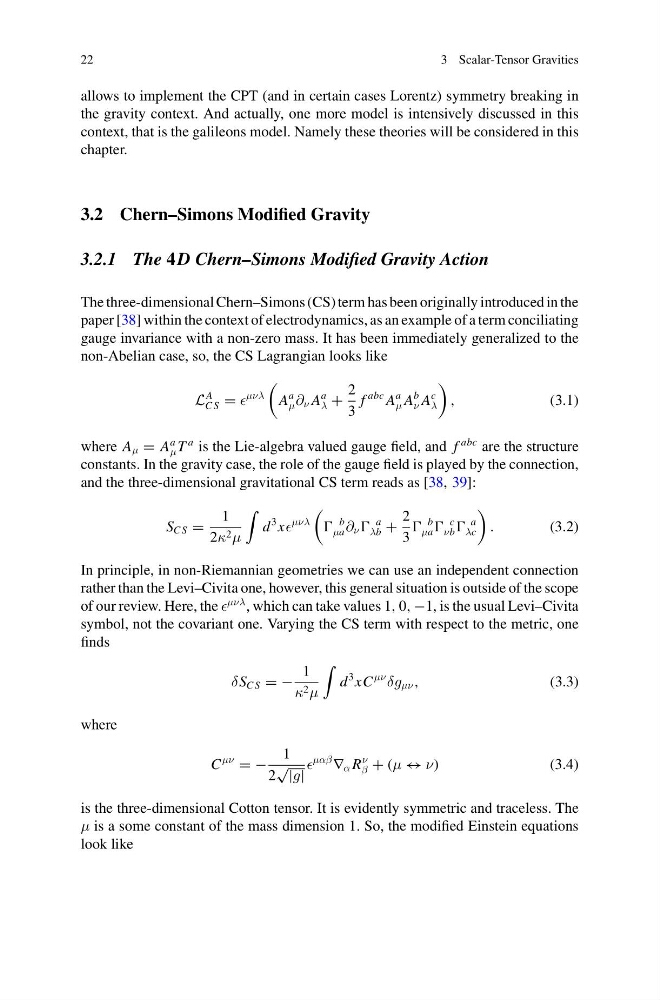
The three-dimensional Chern–Simons (CS) term has been originally introduced in the
paper [38] within the context of electrodynamics, as an example of a term conciliating
gauge invariance with a non-zero mass. It has been immediately generalized to the
non-Abelian case, so, the CS Lagrangian looks like
L
A
C S =
μνλ
A
a
μ ∂ ν A
a
λ +
2
3
f
abc A
a
μ A
b
ν A
c
λ
,
(3.1)
where A μ = A
a
μ T
a is the Lie-algebra valued gauge field, and f
abc are the structure
constants. In the gravity case, the role of the gauge field is played by the connection,
and the three-dimensional gravitational CS term reads as [38, 39]:
S C S =
1
2κ 2 μ
d
3 x
μνλ
b
μa ∂ ν
a
λb +
2
3
b
μa
c
νb
a
λc
.
(3.2)
In principle, in non-Riemannian geometries we can use an independent connection
rather than the Levi–Civita one, however, this general situation is outside of the scope
of our review. Here, the
μνλ , which can take values 1, 0, −1, is the usual Levi–Civita
symbol, not the covariant one. Varying the CS term with respect to the metric, one
finds
δS C S = −
1
κ 2 μ
d
3 xC
μν
δg μν ,
(3.3)
where
C
μν
= −
1
2
√ |g|
μαβ
∇ α R
ν
β + (μ ↔ ν)
(3.4)
is the three-dimensional Cotton tensor. It is evidently symmetric and traceless. The
μ is a some constant of the mass dimension 1. So, the modified Einstein equations
look like
3 Scalar-Tensor Gravities
allows to implement the CPT (and in certain cases Lorentz) symmetry breaking in
the gravity context. And actually, one more model is intensively discussed in this
context, that is the galileons model. Namely these theories will be considered in this
chapter.
3.2 Chern–Simons Modified Gravity
3.2.1 The 4 D Chern–Simons Modified Gravity Action
The three-dimensional Chern–Simons (CS) term has been originally introduced in the
paper [38] within the context of electrodynamics, as an example of a term conciliating
gauge invariance with a non-zero mass. It has been immediately generalized to the
non-Abelian case, so, the CS Lagrangian looks like
L
A
C S =
μνλ
A
a
μ ∂ ν A
a
λ +
2
3
f
abc A
a
μ A
b
ν A
c
λ
,
(3.1)
where A μ = A
a
μ T
a is the Lie-algebra valued gauge field, and f
abc are the structure
constants. In the gravity case, the role of the gauge field is played by the connection,
and the three-dimensional gravitational CS term reads as [38, 39]:
S C S =
1
2κ 2 μ
d
3 x
μνλ
b
μa ∂ ν
a
λb +
2
3
b
μa
c
νb
a
λc
.
(3.2)
In principle, in non-Riemannian geometries we can use an independent connection
rather than the Levi–Civita one, however, this general situation is outside of the scope
of our review. Here, the
μνλ , which can take values 1, 0, −1, is the usual Levi–Civita
symbol, not the covariant one. Varying the CS term with respect to the metric, one
finds
δS C S = −
1
κ 2 μ
d
3 xC
μν
δg μν ,
(3.3)
where
C
μν
= −
1
2
√ |g|
μαβ
∇ α R
ν
β + (μ ↔ ν)
(3.4)
is the three-dimensional Cotton tensor. It is evidently symmetric and traceless. The
μ is a some constant of the mass dimension 1. So, the modified Einstein equations
look like