

18
2 Modifications of the Pure Gravitational Sector
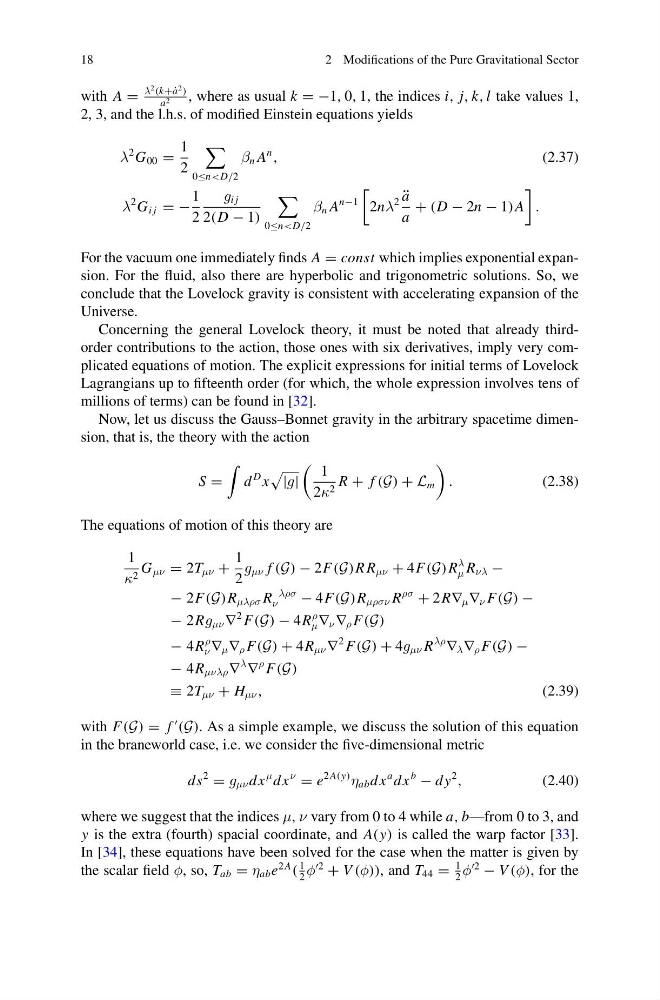
with A =
λ
2 (k+˙ a
2 )
a 2
, where as usual k = −1, 0, 1, the indices i, j, k, l take values 1,
2, 3, and the l.h.s. of modified Einstein equations yields
λ
2 G 00 =
1
2
0≤n
n
,
(2.37)
λ
2 G i j = −
1
2
g i j
2(D − 1)
0≤n
n−1
2nλ
2 ¨
a
a
+ (D − 2n − 1)A
.
For the vacuum one immediately finds A = const which implies exponential expansion. For the fluid, also there are hyperbolic and trigonometric solutions. So, we
conclude that the Lovelock gravity is consistent with accelerating expansion of the
Universe.
Concerning the general Lovelock theory, it must be noted that already thirdorder contributions to the action, those ones with six derivatives, imply very complicated equations of motion. The explicit expressions for initial terms of Lovelock
Lagrangians up to fifteenth order (for which, the whole expression involves tens of
millions of terms) can be found in [32].
Now, let us discuss the Gauss–Bonnet gravity in the arbitrary spacetime dimension, that is, the theory with the action
S =
d
D x
|g|
1
2κ 2 R + f (G) + L m
.
(2.38)
The equations of motion of this theory are
1
κ 2 G μν = 2T μν +
1
2
g μν f (G) − 2F(G)R R μν + 4F(G)R
λ
μ R νλ −
− 2F(G)R μλρσ R
λρσ
ν
− 4F(G)R μρσν R
ρσ
+ 2R∇ μ ∇ ν F(G) −
− 2Rg μν ∇
2 F(G) − 4R
ρ
μ ∇ ν ∇ ρ F(G)
− 4R
ρ
ν ∇ μ ∇ ρ F(G) + 4R μν ∇
2 F(G) + 4g μν R
λρ
∇ λ ∇ ρ F(G) −
− 4R μνλρ ∇
λ
∇
ρ F(G)
≡ 2T μν + H μν ,
(2.39)
with F(G) = f
(G). As a simple example, we discuss the solution of this equation
in the braneworld case, i.e. we consider the five-dimensional metric
ds
2
= g μν dx
μ dx
ν
= e
2 A(y)
η ab dx
a dx
b
− dy
2
,
(2.40)
where we suggest that the indices μ, ν vary from 0 to 4 while a, b—from 0 to 3, and
y is the extra (fourth) spacial coordinate, and A(y) is called the warp factor [33].
In [34], these equations have been solved for the case when the matter is given by
the scalar field φ, so, T ab = η ab e
2 A
(
1
2
φ
2
+ V (φ)), and T 44 =
1
2
φ
2
− V (φ), for the
2 Modifications of the Pure Gravitational Sector
with A =
λ
2 (k+˙ a
2 )
a 2
, where as usual k = −1, 0, 1, the indices i, j, k, l take values 1,
2, 3, and the l.h.s. of modified Einstein equations yields
λ
2 G 00 =
1
2
0≤n
n
,
(2.37)
λ
2 G i j = −
1
2
g i j
2(D − 1)
0≤n
n−1
2nλ
2 ¨
a
a
+ (D − 2n − 1)A
.
For the vacuum one immediately finds A = const which implies exponential expansion. For the fluid, also there are hyperbolic and trigonometric solutions. So, we
conclude that the Lovelock gravity is consistent with accelerating expansion of the
Universe.
Concerning the general Lovelock theory, it must be noted that already thirdorder contributions to the action, those ones with six derivatives, imply very complicated equations of motion. The explicit expressions for initial terms of Lovelock
Lagrangians up to fifteenth order (for which, the whole expression involves tens of
millions of terms) can be found in [32].
Now, let us discuss the Gauss–Bonnet gravity in the arbitrary spacetime dimension, that is, the theory with the action
S =
d
D x
|g|
1
2κ 2 R + f (G) + L m
.
(2.38)
The equations of motion of this theory are
1
κ 2 G μν = 2T μν +
1
2
g μν f (G) − 2F(G)R R μν + 4F(G)R
λ
μ R νλ −
− 2F(G)R μλρσ R
λρσ
ν
− 4F(G)R μρσν R
ρσ
+ 2R∇ μ ∇ ν F(G) −
− 2Rg μν ∇
2 F(G) − 4R
ρ
μ ∇ ν ∇ ρ F(G)
− 4R
ρ
ν ∇ μ ∇ ρ F(G) + 4R μν ∇
2 F(G) + 4g μν R
λρ
∇ λ ∇ ρ F(G) −
− 4R μνλρ ∇
λ
∇
ρ F(G)
≡ 2T μν + H μν ,
(2.39)
with F(G) = f
(G). As a simple example, we discuss the solution of this equation
in the braneworld case, i.e. we consider the five-dimensional metric
ds
2
= g μν dx
μ dx
ν
= e
2 A(y)
η ab dx
a dx
b
− dy
2
,
(2.40)
where we suggest that the indices μ, ν vary from 0 to 4 while a, b—from 0 to 3, and
y is the extra (fourth) spacial coordinate, and A(y) is called the warp factor [33].
In [34], these equations have been solved for the case when the matter is given by
the scalar field φ, so, T ab = η ab e
2 A
(
1
2
φ
2
+ V (φ)), and T 44 =
1
2
φ
2
− V (φ), for the