

2.2 R 2 -Gravity
11
a specific sign of the higher-derivative term. Therefore the higher-derivative models
including the R
2 -gravity are treated as effective theories aimed for description of the
low-energy dynamics of the theory (roughly speaking, for the square of momentum
much less than the characteristic mass M
2 ). However, it is necessary to note that
higher-derivative terms naturally emerge as quantum corrections after the integration
over some matter fields, see f.e. [16], so, the presence of higher-derivative terms
within the effective dynamics in many field theory models including gravity is natural.
Within our R
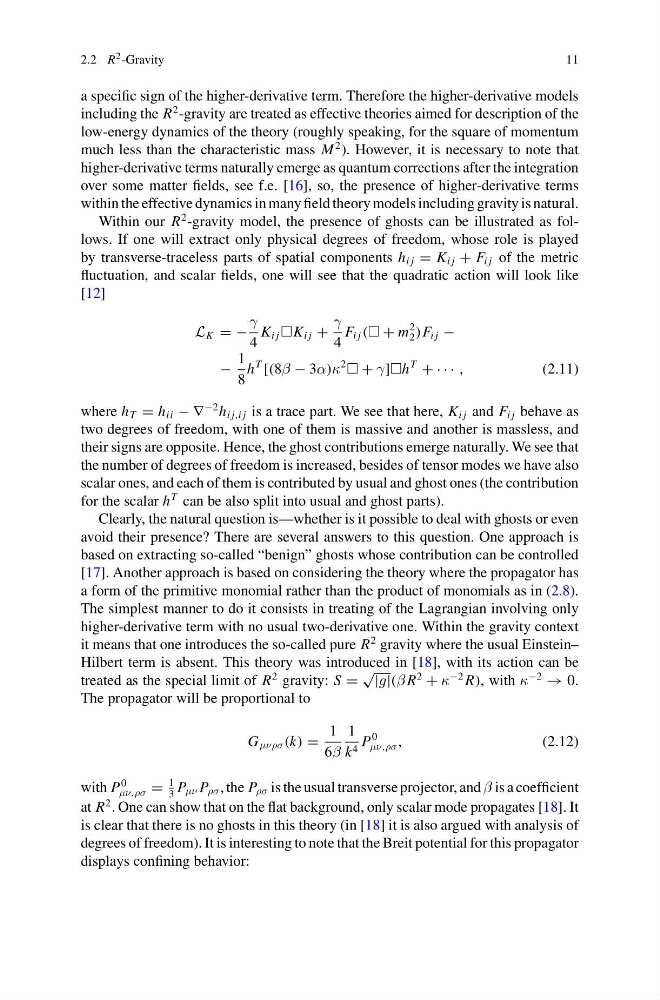
2 -gravity model, the presence of ghosts can be illustrated as follows. If one will extract only physical degrees of freedom, whose role is played
by transverse-traceless parts of spatial components h i j = K i j + F i j of the metric
fluctuation, and scalar fields, one will see that the quadratic action will look like
[12]
L K = −
γ
4
K i j K i j +
γ
4
F i j ( + m
2
2 )F i j −
−
1
8
h
T
[(8β − 3α)κ
2
+ γ]h
T
+ · · · ,
(2.11)
where h T = h ii − ∇
−2 h i j,i j is a trace part. We see that here, K i j and F i j behave as
two degrees of freedom, with one of them is massive and another is massless, and
their signs are opposite. Hence, the ghost contributions emerge naturally. We see that
the number of degrees of freedom is increased, besides of tensor modes we have also
scalar ones, and each of them is contributed by usual and ghost ones (the contribution
for the scalar h
T can be also split into usual and ghost parts).
Clearly, the natural question is—whether is it possible to deal with ghosts or even
avoid their presence? There are several answers to this question. One approach is
based on extracting so-called “benign” ghosts whose contribution can be controlled
[17]. Another approach is based on considering the theory where the propagator has
a form of the primitive monomial rather than the product of monomials as in (2.8).
The simplest manner to do it consists in treating of the Lagrangian involving only
higher-derivative term with no usual two-derivative one. Within the gravity context
it means that one introduces the so-called pure R
2 gravity where the usual Einstein–
Hilbert term is absent. This theory was introduced in [18], with its action can be
treated as the special limit of R
2 gravity: S =
√ |g|(β R
2
+ κ
−2 R), with κ
−2
→ 0.
The propagator will be proportional to
G μνρσ (k) =
1
6β
1
k 4 P
0
μν,ρσ ,
(2.12)
with P
0
μν,ρσ =
1
3
P μν P ρσ , the P ρσ is the usual transverse projector, and β is a coefficient
at R
2 . One can show that on the flat background, only scalar mode propagates [18]. It
is clear that there is no ghosts in this theory (in [18] it is also argued with analysis of
degrees of freedom). It is interesting to note that the Breit potential for this propagator
displays confining behavior:
11
a specific sign of the higher-derivative term. Therefore the higher-derivative models
including the R
2 -gravity are treated as effective theories aimed for description of the
low-energy dynamics of the theory (roughly speaking, for the square of momentum
much less than the characteristic mass M
2 ). However, it is necessary to note that
higher-derivative terms naturally emerge as quantum corrections after the integration
over some matter fields, see f.e. [16], so, the presence of higher-derivative terms
within the effective dynamics in many field theory models including gravity is natural.
Within our R
2 -gravity model, the presence of ghosts can be illustrated as follows. If one will extract only physical degrees of freedom, whose role is played
by transverse-traceless parts of spatial components h i j = K i j + F i j of the metric
fluctuation, and scalar fields, one will see that the quadratic action will look like
[12]
L K = −
γ
4
K i j K i j +
γ
4
F i j ( + m
2
2 )F i j −
−
1
8
h
T
[(8β − 3α)κ
2
+ γ]h
T
+ · · · ,
(2.11)
where h T = h ii − ∇
−2 h i j,i j is a trace part. We see that here, K i j and F i j behave as
two degrees of freedom, with one of them is massive and another is massless, and
their signs are opposite. Hence, the ghost contributions emerge naturally. We see that
the number of degrees of freedom is increased, besides of tensor modes we have also
scalar ones, and each of them is contributed by usual and ghost ones (the contribution
for the scalar h
T can be also split into usual and ghost parts).
Clearly, the natural question is—whether is it possible to deal with ghosts or even
avoid their presence? There are several answers to this question. One approach is
based on extracting so-called “benign” ghosts whose contribution can be controlled
[17]. Another approach is based on considering the theory where the propagator has
a form of the primitive monomial rather than the product of monomials as in (2.8).
The simplest manner to do it consists in treating of the Lagrangian involving only
higher-derivative term with no usual two-derivative one. Within the gravity context
it means that one introduces the so-called pure R
2 gravity where the usual Einstein–
Hilbert term is absent. This theory was introduced in [18], with its action can be
treated as the special limit of R
2 gravity: S =
√ |g|(β R
2
+ κ
−2 R), with κ
−2
→ 0.
The propagator will be proportional to
G μνρσ (k) =
1
6β
1
k 4 P
0
μν,ρσ ,
(2.12)
with P
0
μν,ρσ =
1
3
P μν P ρσ , the P ρσ is the usual transverse projector, and β is a coefficient
at R
2 . One can show that on the flat background, only scalar mode propagates [18]. It
is clear that there is no ghosts in this theory (in [18] it is also argued with analysis of
degrees of freedom). It is interesting to note that the Breit potential for this propagator
displays confining behavior: