

1 Einstein Gravity and the Need for Its Modification
5
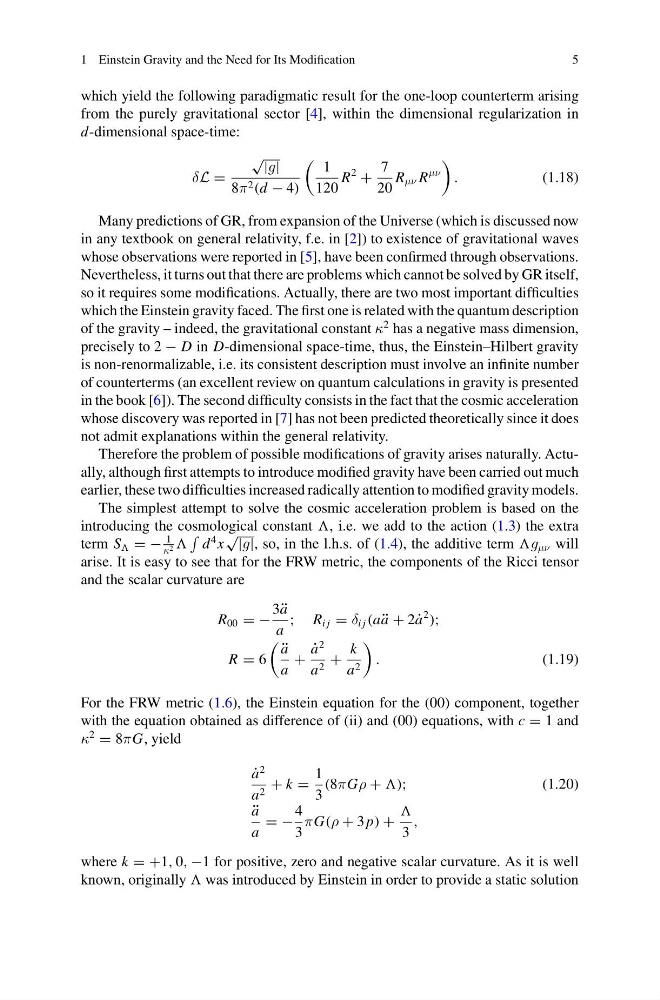
which yield the following paradigmatic result for the one-loop counterterm arising
from the purely gravitational sector [4], within the dimensional regularization in
d-dimensional space-time:
δL =
√
|g|
8π 2 (d − 4)
1
120
R
2
+
7
20
R μν R
μν
.
(1.18)
Many predictions of GR, from expansion of the Universe (which is discussed now
in any textbook on general relativity, f.e. in [2]) to existence of gravitational waves
whose observations were reported in [5], have been confirmed through observations.
Nevertheless, it turns out that there are problems which cannot be solved by GR itself,
so it requires some modifications. Actually, there are two most important difficulties
which the Einstein gravity faced. The first one is related with the quantum description
of the gravity – indeed, the gravitational constant κ
2 has a negative mass dimension,
precisely to 2 − D in D-dimensional space-time, thus, the Einstein–Hilbert gravity
is non-renormalizable, i.e. its consistent description must involve an infinite number
of counterterms (an excellent review on quantum calculations in gravity is presented
in the book [6]). The second difficulty consists in the fact that the cosmic acceleration
whose discovery was reported in [7] has not been predicted theoretically since it does
not admit explanations within the general relativity.
Therefore the problem of possible modifications of gravity arises naturally. Actually, although first attempts to introduce modified gravity have been carried out much
earlier, these two difficulties increased radically attention to modified gravity models.
The simplest attempt to solve the cosmic acceleration problem is based on the
introducing the cosmological constant , i.e. we add to the action (1.3) the extra
term S = −
1
κ 2
d
4 x
√ |g|, so, in the l.h.s. of (1.4), the additive term g μν will
arise. It is easy to see that for the FRW metric, the components of the Ricci tensor
and the scalar curvature are
R 00 = −
3 ¨
a
a
; R i j = δ i j (a ¨
a + 2 ˙
a
2
);
R = 6
¨
a
a
+
˙
a
2
a 2 +
k
a 2
.
(1.19)
For the FRW metric (1.6), the Einstein equation for the (00) component, together
with the equation obtained as difference of (ii) and (00) equations, with c = 1 and
κ
2
= 8πG, yield
˙
a
2
a 2 + k =
1
3
(8πGρ + );
(1.20)
¨
a
a
= −
4
3
πG(ρ + 3 p) +
3
,
where k = +1, 0, −1 for positive, zero and negative scalar curvature. As it is well
known, originally was introduced by Einstein in order to provide a static solution
5
which yield the following paradigmatic result for the one-loop counterterm arising
from the purely gravitational sector [4], within the dimensional regularization in
d-dimensional space-time:
δL =
√
|g|
8π 2 (d − 4)
1
120
R
2
+
7
20
R μν R
μν
.
(1.18)
Many predictions of GR, from expansion of the Universe (which is discussed now
in any textbook on general relativity, f.e. in [2]) to existence of gravitational waves
whose observations were reported in [5], have been confirmed through observations.
Nevertheless, it turns out that there are problems which cannot be solved by GR itself,
so it requires some modifications. Actually, there are two most important difficulties
which the Einstein gravity faced. The first one is related with the quantum description
of the gravity – indeed, the gravitational constant κ
2 has a negative mass dimension,
precisely to 2 − D in D-dimensional space-time, thus, the Einstein–Hilbert gravity
is non-renormalizable, i.e. its consistent description must involve an infinite number
of counterterms (an excellent review on quantum calculations in gravity is presented
in the book [6]). The second difficulty consists in the fact that the cosmic acceleration
whose discovery was reported in [7] has not been predicted theoretically since it does
not admit explanations within the general relativity.
Therefore the problem of possible modifications of gravity arises naturally. Actually, although first attempts to introduce modified gravity have been carried out much
earlier, these two difficulties increased radically attention to modified gravity models.
The simplest attempt to solve the cosmic acceleration problem is based on the
introducing the cosmological constant , i.e. we add to the action (1.3) the extra
term S = −
1
κ 2
d
4 x
√ |g|, so, in the l.h.s. of (1.4), the additive term g μν will
arise. It is easy to see that for the FRW metric, the components of the Ricci tensor
and the scalar curvature are
R 00 = −
3 ¨
a
a
; R i j = δ i j (a ¨
a + 2 ˙
a
2
);
R = 6
¨
a
a
+
˙
a
2
a 2 +
k
a 2
.
(1.19)
For the FRW metric (1.6), the Einstein equation for the (00) component, together
with the equation obtained as difference of (ii) and (00) equations, with c = 1 and
κ
2
= 8πG, yield
˙
a
2
a 2 + k =
1
3
(8πGρ + );
(1.20)
¨
a
a
= −
4
3
πG(ρ + 3 p) +
3
,
where k = +1, 0, −1 for positive, zero and negative scalar curvature. As it is well
known, originally was introduced by Einstein in order to provide a static solution