

of ammonia into nitrogen and hydrogen (the reverse reaction) is
endothermic hence according to Le Châtelier ammonia formation is
theoretically favoured by high pressure and low temperature. Simple?
Not quite, reaction rates are slower at lower temperatures and so it
would take longer to reach the equilibrium position. To achieve
reasonable conversions to ammonia we need to use high pressures,
reasonably high temperatures (with a catalyst to avoid too high
temperatures) and if we remove the ammonia as it is formed, the
reaction’s drive to maintain the equilibrium constant will result in
more nitrogen and hydrogen being used to replace the ammonia. For
gaseous reactions where no change in volume is achieved, pressure
simply affects reaction rates. High pressures mean faster reactions, low
pressures the opposite.
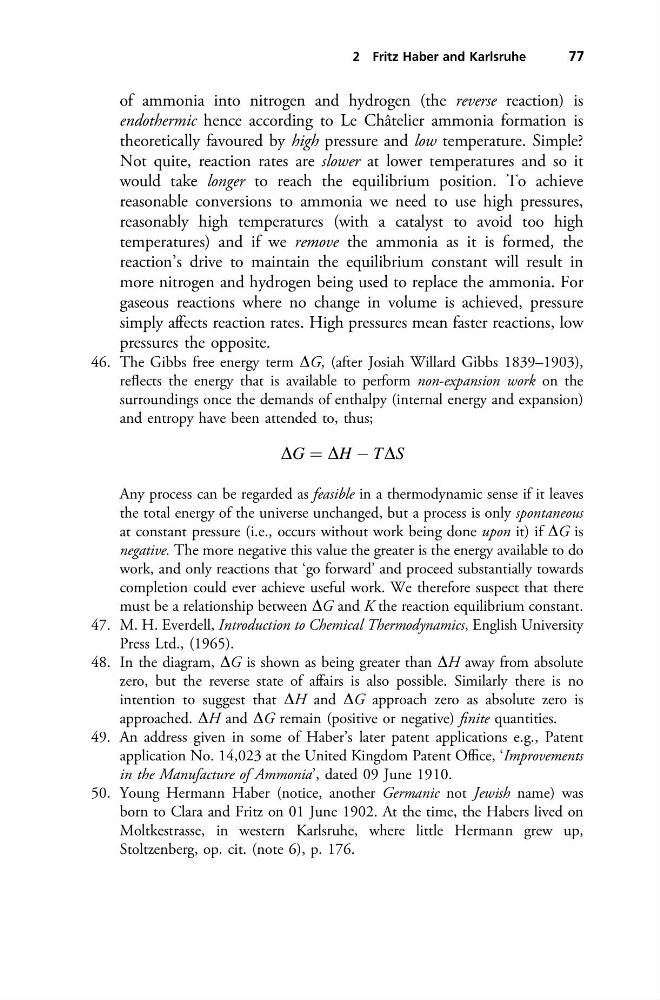
46. The Gibbs free energy term DG, (after Josiah Willard Gibbs 1839–1903),
reflects the energy that is available to perform non-expansion work on the
surroundings once the demands of enthalpy (internal energy and expansion)
and entropy have been attended to, thus;
DG ¼ DH À TDS
Any process can be regarded as feasible in a thermodynamic sense if it leaves
the total energy of the universe unchanged, but a process is only spontaneous
at constant pressure (i.e., occurs without work being done upon it) if DG is
negative. The more negative this value the greater is the energy available to do
work, and only reactions that ‘go forward’ and proceed substantially towards
completion could ever achieve useful work. We therefore suspect that there
must be a relationship between DG and K the reaction equilibrium constant.
47. M. H. Everdell, Introduction to Chemical Thermodynamics, English University
Press Ltd., (1965).
48. In the diagram, DG is shown as being greater than DH away from absolute
zero, but the reverse state of affairs is also possible. Similarly there is no
intention to suggest that DH and DG approach zero as absolute zero is
approached. DH and DG remain (positive or negative) finite quantities.
49. An address given in some of Haber’s later patent applications e.g., Patent
application No. 14,023 at the United Kingdom Patent Office, ‘Improvements
in the Manufacture of Ammonia’, dated 09 June 1910.
50. Young Hermann Haber (notice, another Germanic not Jewish name) was
born to Clara and Fritz on 01 June 1902. At the time, the Habers lived on
Moltkestrasse, in western Karlsruhe, where little Hermann grew up,
Stoltzenberg, op. cit. (note 6), p. 176.
2 Fritz Haber and Karlsruhe
77
endothermic hence according to Le Châtelier ammonia formation is
theoretically favoured by high pressure and low temperature. Simple?
Not quite, reaction rates are slower at lower temperatures and so it
would take longer to reach the equilibrium position. To achieve
reasonable conversions to ammonia we need to use high pressures,
reasonably high temperatures (with a catalyst to avoid too high
temperatures) and if we remove the ammonia as it is formed, the
reaction’s drive to maintain the equilibrium constant will result in
more nitrogen and hydrogen being used to replace the ammonia. For
gaseous reactions where no change in volume is achieved, pressure
simply affects reaction rates. High pressures mean faster reactions, low
pressures the opposite.
46. The Gibbs free energy term DG, (after Josiah Willard Gibbs 1839–1903),
reflects the energy that is available to perform non-expansion work on the
surroundings once the demands of enthalpy (internal energy and expansion)
and entropy have been attended to, thus;
DG ¼ DH À TDS
Any process can be regarded as feasible in a thermodynamic sense if it leaves
the total energy of the universe unchanged, but a process is only spontaneous
at constant pressure (i.e., occurs without work being done upon it) if DG is
negative. The more negative this value the greater is the energy available to do
work, and only reactions that ‘go forward’ and proceed substantially towards
completion could ever achieve useful work. We therefore suspect that there
must be a relationship between DG and K the reaction equilibrium constant.
47. M. H. Everdell, Introduction to Chemical Thermodynamics, English University
Press Ltd., (1965).
48. In the diagram, DG is shown as being greater than DH away from absolute
zero, but the reverse state of affairs is also possible. Similarly there is no
intention to suggest that DH and DG approach zero as absolute zero is
approached. DH and DG remain (positive or negative) finite quantities.
49. An address given in some of Haber’s later patent applications e.g., Patent
application No. 14,023 at the United Kingdom Patent Office, ‘Improvements
in the Manufacture of Ammonia’, dated 09 June 1910.
50. Young Hermann Haber (notice, another Germanic not Jewish name) was
born to Clara and Fritz on 01 June 1902. At the time, the Habers lived on
Moltkestrasse, in western Karlsruhe, where little Hermann grew up,
Stoltzenberg, op. cit. (note 6), p. 176.
2 Fritz Haber and Karlsruhe
77