

org. Nobel Media AB 2014. Web. 9 March 2016. http://www.nobelprize.
org/nobel_prizes/chemistry/laureates/1918/haber-lecture.html.
40. F. Haber, G. van Oordt, ‘Über Bildung von Ammoniak aus den Elementen’,
(Formation of Ammonia from the Elements), Z. Anorg. Chem., 44, 341–371,
(1905).
41. ‘… for various reasons …’ according to Coates, op. cit. (note 1), and also
Haber’s opinion that, ‘some discrepant values seemed to me to point to the upper
limit as the probable value’, Haber, op. cit. (note 39), p. 334.
42. Haber’s mastery of theory and his dislike of experimentation was to dictate
his working relationship with Le Rossignol, a point we return to in later
Chapters.
43. Arthur B. Lamb, at the time Assistant Professor and Director of the
Havemeyer Chemical Laboratory at New York University, USA. See the link;
https://www.harvardsquarelibrary.org/biographies/arthur-becket-lamb/.
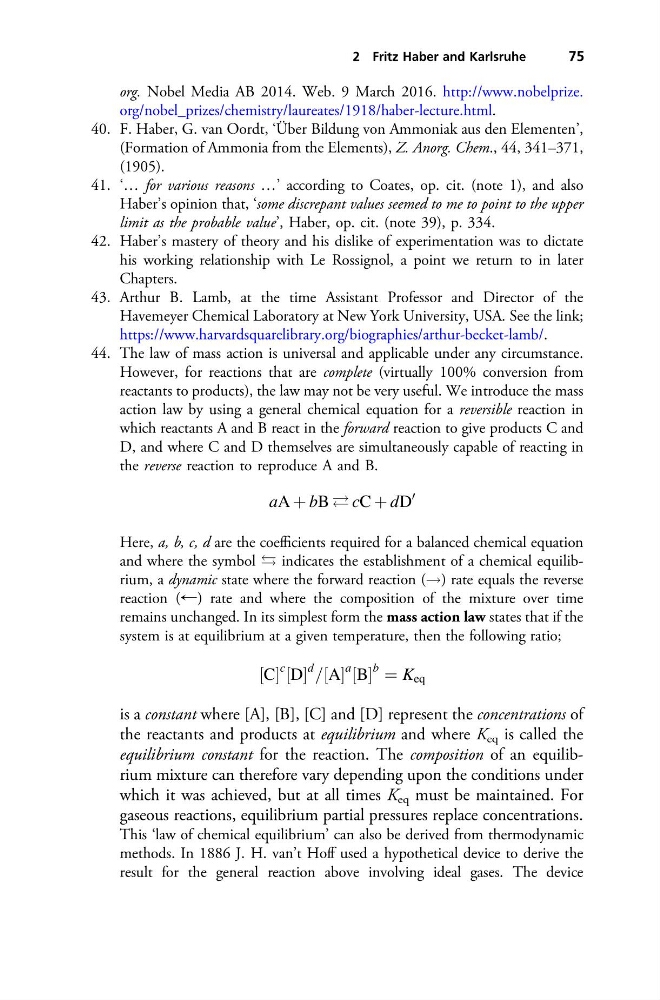
44. The law of mass action is universal and applicable under any circumstance.
However, for reactions that are complete (virtually 100% conversion from
reactants to products), the law may not be very useful. We introduce the mass
action law by using a general chemical equation for a reversible reaction in
which reactants A and B react in the forward reaction to give products C and
D, and where C and D themselves are simultaneously capable of reacting in
the reverse reaction to reproduce A and B.
aA þ bB cC þ dD
0
Here, a, b, c, d are the coefficients required for a balanced chemical equation
and where the symbol indicates the establishment of a chemical equilibrium, a dynamic state where the forward reaction (!) rate equals the reverse
reaction (←) rate and where the composition of the mixture over time
remains unchanged. In its simplest form the mass action law states that if the
system is at equilibrium at a given temperature, then the following ratio;
½C
c
½D
d
=½A
a
½B
b
¼ K eq
is a constant where [A], [B], [C] and [D] represent the concentrations of
the reactants and products at equilibrium and where K eq is called the
equilibrium constant for the reaction. The composition of an equilibrium mixture can therefore vary depending upon the conditions under
which it was achieved, but at all times K eq must be maintained. For
gaseous reactions, equilibrium partial pressures replace concentrations.
This ‘law of chemical equilibrium’ can also be derived from thermodynamic
methods. In 1886 J. H. van’t Hoff used a hypothetical device to derive the
result for the general reaction above involving ideal gases. The device
2 Fritz Haber and Karlsruhe
75
org/nobel_prizes/chemistry/laureates/1918/haber-lecture.html.
40. F. Haber, G. van Oordt, ‘Über Bildung von Ammoniak aus den Elementen’,
(Formation of Ammonia from the Elements), Z. Anorg. Chem., 44, 341–371,
(1905).
41. ‘… for various reasons …’ according to Coates, op. cit. (note 1), and also
Haber’s opinion that, ‘some discrepant values seemed to me to point to the upper
limit as the probable value’, Haber, op. cit. (note 39), p. 334.
42. Haber’s mastery of theory and his dislike of experimentation was to dictate
his working relationship with Le Rossignol, a point we return to in later
Chapters.
43. Arthur B. Lamb, at the time Assistant Professor and Director of the
Havemeyer Chemical Laboratory at New York University, USA. See the link;
https://www.harvardsquarelibrary.org/biographies/arthur-becket-lamb/.
44. The law of mass action is universal and applicable under any circumstance.
However, for reactions that are complete (virtually 100% conversion from
reactants to products), the law may not be very useful. We introduce the mass
action law by using a general chemical equation for a reversible reaction in
which reactants A and B react in the forward reaction to give products C and
D, and where C and D themselves are simultaneously capable of reacting in
the reverse reaction to reproduce A and B.
aA þ bB cC þ dD
0
Here, a, b, c, d are the coefficients required for a balanced chemical equation
and where the symbol indicates the establishment of a chemical equilibrium, a dynamic state where the forward reaction (!) rate equals the reverse
reaction (←) rate and where the composition of the mixture over time
remains unchanged. In its simplest form the mass action law states that if the
system is at equilibrium at a given temperature, then the following ratio;
½C
c
½D
d
=½A
a
½B
b
¼ K eq
is a constant where [A], [B], [C] and [D] represent the concentrations of
the reactants and products at equilibrium and where K eq is called the
equilibrium constant for the reaction. The composition of an equilibrium mixture can therefore vary depending upon the conditions under
which it was achieved, but at all times K eq must be maintained. For
gaseous reactions, equilibrium partial pressures replace concentrations.
This ‘law of chemical equilibrium’ can also be derived from thermodynamic
methods. In 1886 J. H. van’t Hoff used a hypothetical device to derive the
result for the general reaction above involving ideal gases. The device
2 Fritz Haber and Karlsruhe
75