

Clara converted to Christianity—probably for the same reasons as Fritz
Haber—and with little or no objection from her family. In 1899 Haber’s
good friend Richard Abegg was appointed as chemistry lecturer at Breslau and
he became Clara’s academic advisor. Clara’s progress towards her degree was
difficult in a world dominated by men. But supported by Abegg and just a
few days before Christmas in 1900, Clara defended her doctoral dissertation
in the Aula Leopoldina auditorium of Breslau university. Like Haber she was
sure-footed and quick-witted in support of her research and the packed
auditorium saw the dean of the faculty eventually present the first woman
from a German university with her magna cum laude
18 doctorate, (Charles
6
).
Dr. Clara Immerwahr remained at Breslau and became Abegg’s assistant,
but in the spring of 1901 Fritz Haber wrote to ‘two old friends and fellow
chemists, Prof. Dr Abegg and Frauleine Dr Assistant’, inviting the two to join
him at the next meeting of the German Electrochemical Society at Freiburg
just outside Karlsruhe. Soon after the invitation Fritz Haber confided in a
friend that he had spent the last decade ‘diligently but unsuccessfully’ trying
to forget about Clara. The invitation therefore had a hidden agenda and when
Clara travelled to Freiburg to meet Fritz he managed—over the course of a
few days—to convince her to spend the rest of her life with him and on 03
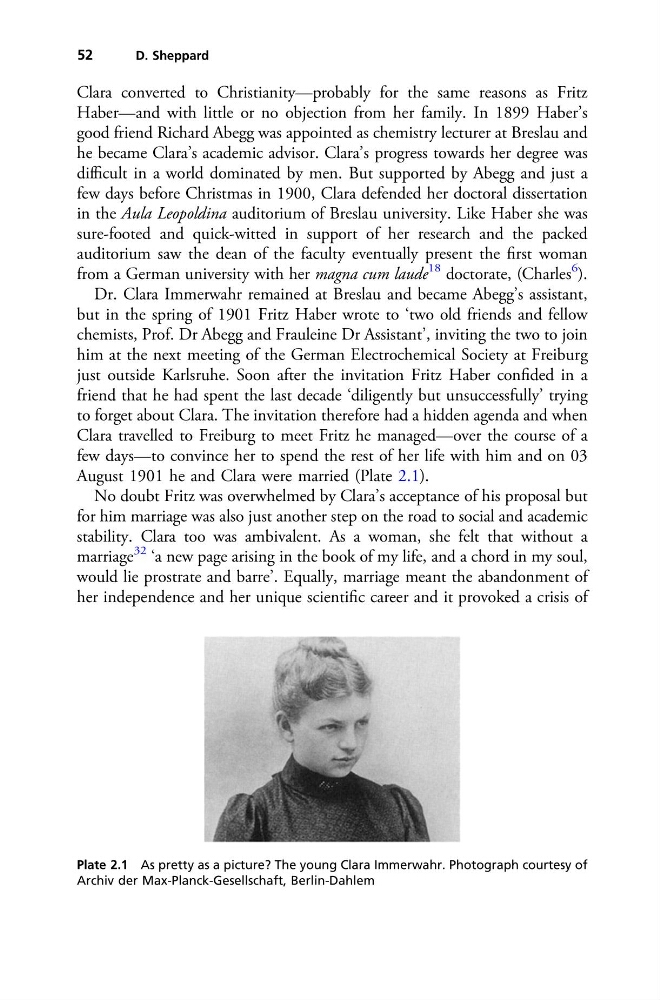
August 1901 he and Clara were married (Plate 2.1).
No doubt Fritz was overwhelmed by Clara’s acceptance of his proposal but
for him marriage was also just another step on the road to social and academic
stability. Clara too was ambivalent. As a woman, she felt that without a
marriage
32
‘a new page arising in the book of my life, and a chord in my soul,
would lie prostrate and barre’. Equally, marriage meant the abandonment of
her independence and her unique scientific career and it provoked a crisis of
Plate 2.1 As pretty as a picture? The young Clara Immerwahr. Photograph courtesy of
Archiv der Max-Planck-Gesellschaft, Berlin-Dahlem
52
D. Sheppard
Haber—and with little or no objection from her family. In 1899 Haber’s
good friend Richard Abegg was appointed as chemistry lecturer at Breslau and
he became Clara’s academic advisor. Clara’s progress towards her degree was
difficult in a world dominated by men. But supported by Abegg and just a
few days before Christmas in 1900, Clara defended her doctoral dissertation
in the Aula Leopoldina auditorium of Breslau university. Like Haber she was
sure-footed and quick-witted in support of her research and the packed
auditorium saw the dean of the faculty eventually present the first woman
from a German university with her magna cum laude
18 doctorate, (Charles
6
).
Dr. Clara Immerwahr remained at Breslau and became Abegg’s assistant,
but in the spring of 1901 Fritz Haber wrote to ‘two old friends and fellow
chemists, Prof. Dr Abegg and Frauleine Dr Assistant’, inviting the two to join
him at the next meeting of the German Electrochemical Society at Freiburg
just outside Karlsruhe. Soon after the invitation Fritz Haber confided in a
friend that he had spent the last decade ‘diligently but unsuccessfully’ trying
to forget about Clara. The invitation therefore had a hidden agenda and when
Clara travelled to Freiburg to meet Fritz he managed—over the course of a
few days—to convince her to spend the rest of her life with him and on 03
August 1901 he and Clara were married (Plate 2.1).
No doubt Fritz was overwhelmed by Clara’s acceptance of his proposal but
for him marriage was also just another step on the road to social and academic
stability. Clara too was ambivalent. As a woman, she felt that without a
marriage
32
‘a new page arising in the book of my life, and a chord in my soul,
would lie prostrate and barre’. Equally, marriage meant the abandonment of
her independence and her unique scientific career and it provoked a crisis of
Plate 2.1 As pretty as a picture? The young Clara Immerwahr. Photograph courtesy of
Archiv der Max-Planck-Gesellschaft, Berlin-Dahlem
52
D. Sheppard