

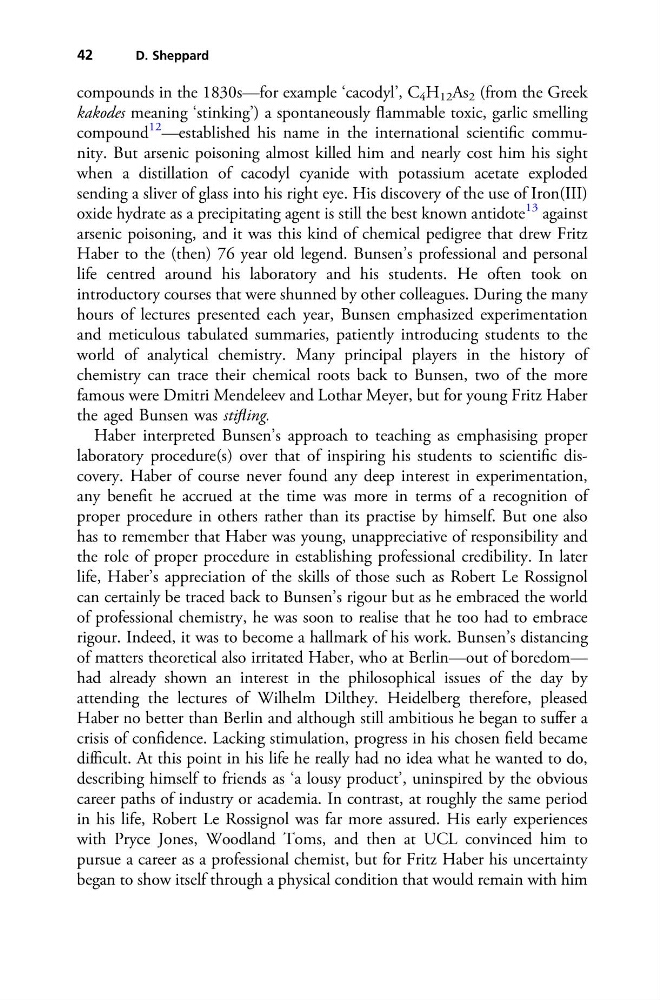
compounds in the 1830s—for example ‘cacodyl’, C 4 H 12 As 2 (from the Greek
kakodes meaning ‘stinking’) a spontaneously flammable toxic, garlic smelling
compound
12
—established his name in the international scientific community. But arsenic poisoning almost killed him and nearly cost him his sight
when a distillation of cacodyl cyanide with potassium acetate exploded
sending a sliver of glass into his right eye. His discovery of the use of Iron(III)
oxide hydrate as a precipitating agent is still the best known antidote
13 against
arsenic poisoning, and it was this kind of chemical pedigree that drew Fritz
Haber to the (then) 76 year old legend. Bunsen’s professional and personal
life centred around his laboratory and his students. He often took on
introductory courses that were shunned by other colleagues. During the many
hours of lectures presented each year, Bunsen emphasized experimentation
and meticulous tabulated summaries, patiently introducing students to the
world of analytical chemistry. Many principal players in the history of
chemistry can trace their chemical roots back to Bunsen, two of the more
famous were Dmitri Mendeleev and Lothar Meyer, but for young Fritz Haber
the aged Bunsen was stifling.
Haber interpreted Bunsen’s approach to teaching as emphasising proper
laboratory procedure(s) over that of inspiring his students to scientific discovery. Haber of course never found any deep interest in experimentation,
any benefit he accrued at the time was more in terms of a recognition of
proper procedure in others rather than its practise by himself. But one also
has to remember that Haber was young, unappreciative of responsibility and
the role of proper procedure in establishing professional credibility. In later
life, Haber’s appreciation of the skills of those such as Robert Le Rossignol
can certainly be traced back to Bunsen’s rigour but as he embraced the world
of professional chemistry, he was soon to realise that he too had to embrace
rigour. Indeed, it was to become a hallmark of his work. Bunsen’s distancing
of matters theoretical also irritated Haber, who at Berlin—out of boredom—
had already shown an interest in the philosophical issues of the day by
attending the lectures of Wilhelm Dilthey. Heidelberg therefore, pleased
Haber no better than Berlin and although still ambitious he began to suffer a
crisis of confidence. Lacking stimulation, progress in his chosen field became
difficult. At this point in his life he really had no idea what he wanted to do,
describing himself to friends as ‘a lousy product’, uninspired by the obvious
career paths of industry or academia. In contrast, at roughly the same period
in his life, Robert Le Rossignol was far more assured. His early experiences
with Pryce Jones, Woodland Toms, and then at UCL convinced him to
pursue a career as a professional chemist, but for Fritz Haber his uncertainty
began to show itself through a physical condition that would remain with him
42
D. Sheppard
kakodes meaning ‘stinking’) a spontaneously flammable toxic, garlic smelling
compound
12
—established his name in the international scientific community. But arsenic poisoning almost killed him and nearly cost him his sight
when a distillation of cacodyl cyanide with potassium acetate exploded
sending a sliver of glass into his right eye. His discovery of the use of Iron(III)
oxide hydrate as a precipitating agent is still the best known antidote
13 against
arsenic poisoning, and it was this kind of chemical pedigree that drew Fritz
Haber to the (then) 76 year old legend. Bunsen’s professional and personal
life centred around his laboratory and his students. He often took on
introductory courses that were shunned by other colleagues. During the many
hours of lectures presented each year, Bunsen emphasized experimentation
and meticulous tabulated summaries, patiently introducing students to the
world of analytical chemistry. Many principal players in the history of
chemistry can trace their chemical roots back to Bunsen, two of the more
famous were Dmitri Mendeleev and Lothar Meyer, but for young Fritz Haber
the aged Bunsen was stifling.
Haber interpreted Bunsen’s approach to teaching as emphasising proper
laboratory procedure(s) over that of inspiring his students to scientific discovery. Haber of course never found any deep interest in experimentation,
any benefit he accrued at the time was more in terms of a recognition of
proper procedure in others rather than its practise by himself. But one also
has to remember that Haber was young, unappreciative of responsibility and
the role of proper procedure in establishing professional credibility. In later
life, Haber’s appreciation of the skills of those such as Robert Le Rossignol
can certainly be traced back to Bunsen’s rigour but as he embraced the world
of professional chemistry, he was soon to realise that he too had to embrace
rigour. Indeed, it was to become a hallmark of his work. Bunsen’s distancing
of matters theoretical also irritated Haber, who at Berlin—out of boredom—
had already shown an interest in the philosophical issues of the day by
attending the lectures of Wilhelm Dilthey. Heidelberg therefore, pleased
Haber no better than Berlin and although still ambitious he began to suffer a
crisis of confidence. Lacking stimulation, progress in his chosen field became
difficult. At this point in his life he really had no idea what he wanted to do,
describing himself to friends as ‘a lousy product’, uninspired by the obvious
career paths of industry or academia. In contrast, at roughly the same period
in his life, Robert Le Rossignol was far more assured. His early experiences
with Pryce Jones, Woodland Toms, and then at UCL convinced him to
pursue a career as a professional chemist, but for Fritz Haber his uncertainty
began to show itself through a physical condition that would remain with him
42
D. Sheppard