

May I ask you to be kind enough to sign and return the
enclosed form for our record purposes?
Yours sincerely,
SHERWOOD TAYLOR,
Director.
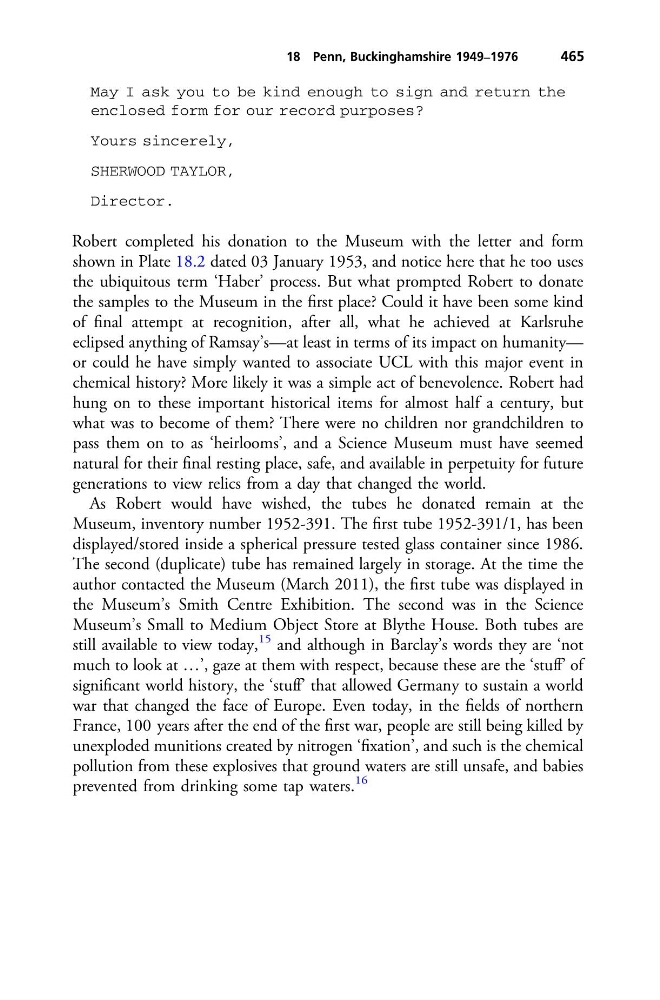
Robert completed his donation to the Museum with the letter and form
shown in Plate 18.2 dated 03 January 1953, and notice here that he too uses
the ubiquitous term ‘Haber’ process. But what prompted Robert to donate
the samples to the Museum in the first place? Could it have been some kind
of final attempt at recognition, after all, what he achieved at Karlsruhe
eclipsed anything of Ramsay’s—at least in terms of its impact on humanity—
or could he have simply wanted to associate UCL with this major event in
chemical history? More likely it was a simple act of benevolence. Robert had
hung on to these important historical items for almost half a century, but
what was to become of them? There were no children nor grandchildren to
pass them on to as ‘heirlooms’, and a Science Museum must have seemed
natural for their final resting place, safe, and available in perpetuity for future
generations to view relics from a day that changed the world.
As Robert would have wished, the tubes he donated remain at the
Museum, inventory number 1952-391. The first tube 1952-391/1, has been
displayed/stored inside a spherical pressure tested glass container since 1986.
The second (duplicate) tube has remained largely in storage. At the time the
author contacted the Museum (March 2011), the first tube was displayed in
the Museum’s Smith Centre Exhibition. The second was in the Science
Museum’s Small to Medium Object Store at Blythe House. Both tubes are
still available to view today,
15 and although in Barclay’s words they are ‘not
much to look at …’, gaze at them with respect, because these are the ‘stuff’ of
significant world history, the ‘stuff’ that allowed Germany to sustain a world
war that changed the face of Europe. Even today, in the fields of northern
France, 100 years after the end of the first war, people are still being killed by
unexploded munitions created by nitrogen ‘fixation’, and such is the chemical
pollution from these explosives that ground waters are still unsafe, and babies
prevented from drinking some tap waters.
16
18 Penn, Buckinghamshire 1949–1976
465
enclosed form for our record purposes?
Yours sincerely,
SHERWOOD TAYLOR,
Director.
Robert completed his donation to the Museum with the letter and form
shown in Plate 18.2 dated 03 January 1953, and notice here that he too uses
the ubiquitous term ‘Haber’ process. But what prompted Robert to donate
the samples to the Museum in the first place? Could it have been some kind
of final attempt at recognition, after all, what he achieved at Karlsruhe
eclipsed anything of Ramsay’s—at least in terms of its impact on humanity—
or could he have simply wanted to associate UCL with this major event in
chemical history? More likely it was a simple act of benevolence. Robert had
hung on to these important historical items for almost half a century, but
what was to become of them? There were no children nor grandchildren to
pass them on to as ‘heirlooms’, and a Science Museum must have seemed
natural for their final resting place, safe, and available in perpetuity for future
generations to view relics from a day that changed the world.
As Robert would have wished, the tubes he donated remain at the
Museum, inventory number 1952-391. The first tube 1952-391/1, has been
displayed/stored inside a spherical pressure tested glass container since 1986.
The second (duplicate) tube has remained largely in storage. At the time the
author contacted the Museum (March 2011), the first tube was displayed in
the Museum’s Smith Centre Exhibition. The second was in the Science
Museum’s Small to Medium Object Store at Blythe House. Both tubes are
still available to view today,
15 and although in Barclay’s words they are ‘not
much to look at …’, gaze at them with respect, because these are the ‘stuff’ of
significant world history, the ‘stuff’ that allowed Germany to sustain a world
war that changed the face of Europe. Even today, in the fields of northern
France, 100 years after the end of the first war, people are still being killed by
unexploded munitions created by nitrogen ‘fixation’, and such is the chemical
pollution from these explosives that ground waters are still unsafe, and babies
prevented from drinking some tap waters.
16
18 Penn, Buckinghamshire 1949–1976
465