

‘tympanums’ left in the country. The Church also contains reminders of the
influence of the landed families of the area. In the Lady Chapel, the Tudor and
Stuart brasses of the Penn’s can be seen, owners of large parts of the Parish and
the latest representatives of a family originating in the Welsh borders.
Throughout the church there are wall monuments dedicated to the 18th and
19th Century Curzons and Howes who followed on from the last of the Penns
through marriage. Six grandchildren of William Penn the Quaker are buried in
a family vault under the centre of the nave. In the churchyard the earliest
marked grave is that of William Penn, the local Lord of the Manor who died in
1693 but no relation to the Quaker Penns although throughout the 17th
an 18th centuries both families mistakenly thought they were related
4
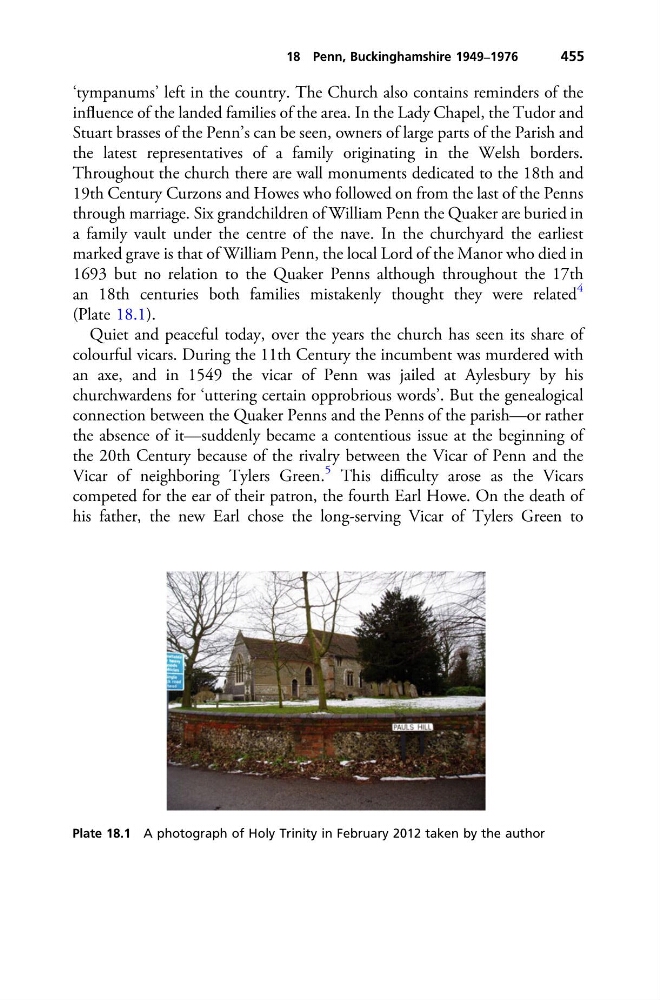
(Plate 18.1).
Quiet and peaceful today, over the years the church has seen its share of
colourful vicars. During the 11th Century the incumbent was murdered with
an axe, and in 1549 the vicar of Penn was jailed at Aylesbury by his
churchwardens for ‘uttering certain opprobrious words’. But the genealogical
connection between the Quaker Penns and the Penns of the parish—or rather
the absence of it—suddenly became a contentious issue at the beginning of
the 20th Century because of the rivalry between the Vicar of Penn and the
Vicar of neighboring Tylers Green.
5 This difficulty arose as the Vicars
competed for the ear of their patron, the fourth Earl Howe. On the death of
his father, the new Earl chose the long-serving Vicar of Tylers Green to
Plate 18.1 A photograph of Holy Trinity in February 2012 taken by the author
18 Penn, Buckinghamshire 1949–1976
455
influence of the landed families of the area. In the Lady Chapel, the Tudor and
Stuart brasses of the Penn’s can be seen, owners of large parts of the Parish and
the latest representatives of a family originating in the Welsh borders.
Throughout the church there are wall monuments dedicated to the 18th and
19th Century Curzons and Howes who followed on from the last of the Penns
through marriage. Six grandchildren of William Penn the Quaker are buried in
a family vault under the centre of the nave. In the churchyard the earliest
marked grave is that of William Penn, the local Lord of the Manor who died in
1693 but no relation to the Quaker Penns although throughout the 17th
an 18th centuries both families mistakenly thought they were related
4
(Plate 18.1).
Quiet and peaceful today, over the years the church has seen its share of
colourful vicars. During the 11th Century the incumbent was murdered with
an axe, and in 1549 the vicar of Penn was jailed at Aylesbury by his
churchwardens for ‘uttering certain opprobrious words’. But the genealogical
connection between the Quaker Penns and the Penns of the parish—or rather
the absence of it—suddenly became a contentious issue at the beginning of
the 20th Century because of the rivalry between the Vicar of Penn and the
Vicar of neighboring Tylers Green.
5 This difficulty arose as the Vicars
competed for the ear of their patron, the fourth Earl Howe. On the death of
his father, the new Earl chose the long-serving Vicar of Tylers Green to
Plate 18.1 A photograph of Holy Trinity in February 2012 taken by the author
18 Penn, Buckinghamshire 1949–1976
455