

Travers,
29 Ramsay’s own son ‘Willie’ was to eventually work with Haber, but
even so, Ramsay wanted Robert to study under Abegg.
23 Although
‘half-minded’ to do so, Robert had heard that ‘there were already too many
Englishmen there’
23 and together with what he later described as a developing
interest in ‘chemical technology’
23 he wrote instead to Haber seeking a
position at the Technische Hochschule—and was accepted. Now one would
have thought that it was Haber’s burgeoning international reputation at the
time that attracted Robert, for the fine group of physical chemists he had
collected at Karlsruhe produced an eclectic mix of work ranging from the
theoretically fundamental to the eminently practical. But it seems there were
other factors influencing his decision, factors which Robert revealed much
later in conversation
35 at his retirement home in Buckinghamshire with
Haber’s (then) biographer, Johannes Jaenicke. Certainly, Robert wished to
work in physical chemistry, but it was not Haber’s fame that attracted him. It
seems that after leaving UCL, Robert, his father Augustin and sister Elsie
Edith took a holiday in Switzerland. Here he met with a friend who described
Haber as ‘a very nice man’, and as Karlsruhe was close to the ‘Black Forest’
Robert found that ‘a great attraction too …!’ And so, it was, that he travelled
to Germany to spend ‘three glorious years’ with Haber, simply to be able to
take a walk in the Black Forest!
But Robert’s contact with German science was not as one-way as this
account may suggest. Although it was the ‘norm’ for British postgraduate
students to attend German universities, German students often travelled to
Britain—specially to improve their English—but equally influencing British
students to practise their German. Dr. Otto Hahn had joined Ramsay’s
Laboratory in 1904 for precisely this reason—the laboratory already
employing another very able young German chemist Otto Sakur—and these
two were Robert’s contemporaries at UCL. Hahn was put to work on radium
but soon discovered a highly radioactive ‘new metallic element’ indistinguishable from Thorium he called ‘radio thorium’, the half life of whose
‘emanation’ had already been established
29 by Robert and Gimingham when
working as a ‘research students’. ‘Radio thorium’ was later found to be an
isotope of thorium (
228
Th). Hahn also worked with Sakur to show that two
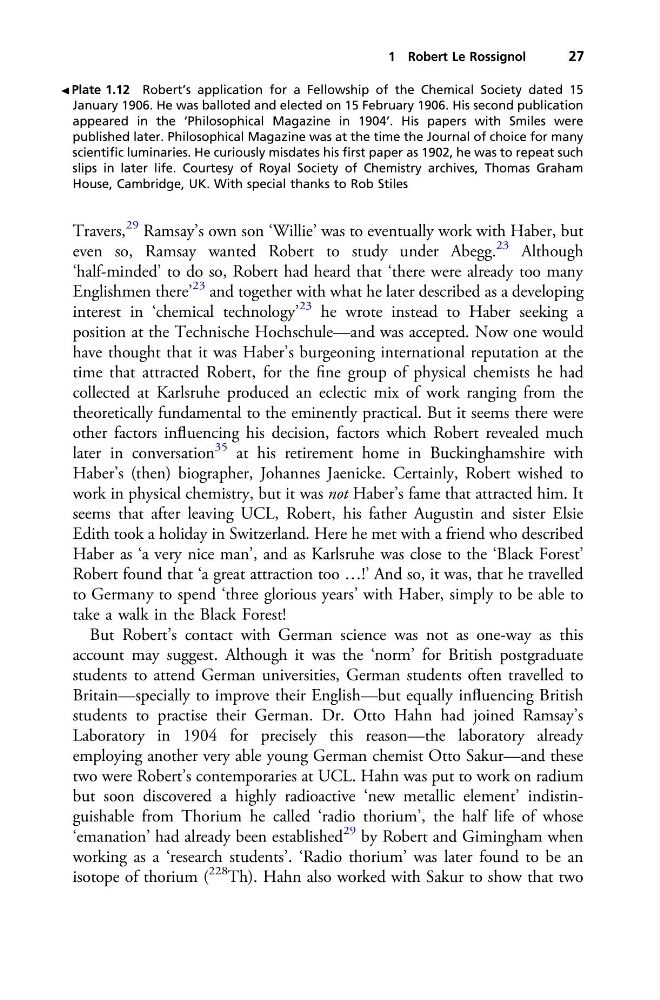
J Plate 1.12 Robert’s application for a Fellowship of the Chemical Society dated 15
January 1906. He was balloted and elected on 15 February 1906. His second publication
appeared in the ‘Philosophical Magazine in 1904’. His papers with Smiles were
published later. Philosophical Magazine was at the time the Journal of choice for many
scientific luminaries. He curiously misdates his first paper as 1902, he was to repeat such
slips in later life. Courtesy of Royal Society of Chemistry archives, Thomas Graham
House, Cambridge, UK. With special thanks to Rob Stiles
1 Robert Le Rossignol
27
29 Ramsay’s own son ‘Willie’ was to eventually work with Haber, but
even so, Ramsay wanted Robert to study under Abegg.
23 Although
‘half-minded’ to do so, Robert had heard that ‘there were already too many
Englishmen there’
23 and together with what he later described as a developing
interest in ‘chemical technology’
23 he wrote instead to Haber seeking a
position at the Technische Hochschule—and was accepted. Now one would
have thought that it was Haber’s burgeoning international reputation at the
time that attracted Robert, for the fine group of physical chemists he had
collected at Karlsruhe produced an eclectic mix of work ranging from the
theoretically fundamental to the eminently practical. But it seems there were
other factors influencing his decision, factors which Robert revealed much
later in conversation
35 at his retirement home in Buckinghamshire with
Haber’s (then) biographer, Johannes Jaenicke. Certainly, Robert wished to
work in physical chemistry, but it was not Haber’s fame that attracted him. It
seems that after leaving UCL, Robert, his father Augustin and sister Elsie
Edith took a holiday in Switzerland. Here he met with a friend who described
Haber as ‘a very nice man’, and as Karlsruhe was close to the ‘Black Forest’
Robert found that ‘a great attraction too …!’ And so, it was, that he travelled
to Germany to spend ‘three glorious years’ with Haber, simply to be able to
take a walk in the Black Forest!
But Robert’s contact with German science was not as one-way as this
account may suggest. Although it was the ‘norm’ for British postgraduate
students to attend German universities, German students often travelled to
Britain—specially to improve their English—but equally influencing British
students to practise their German. Dr. Otto Hahn had joined Ramsay’s
Laboratory in 1904 for precisely this reason—the laboratory already
employing another very able young German chemist Otto Sakur—and these
two were Robert’s contemporaries at UCL. Hahn was put to work on radium
but soon discovered a highly radioactive ‘new metallic element’ indistinguishable from Thorium he called ‘radio thorium’, the half life of whose
‘emanation’ had already been established
29 by Robert and Gimingham when
working as a ‘research students’. ‘Radio thorium’ was later found to be an
isotope of thorium (
228
Th). Hahn also worked with Sakur to show that two
J Plate 1.12 Robert’s application for a Fellowship of the Chemical Society dated 15
January 1906. He was balloted and elected on 15 February 1906. His second publication
appeared in the ‘Philosophical Magazine in 1904’. His papers with Smiles were
published later. Philosophical Magazine was at the time the Journal of choice for many
scientific luminaries. He curiously misdates his first paper as 1902, he was to repeat such
slips in later life. Courtesy of Royal Society of Chemistry archives, Thomas Graham
House, Cambridge, UK. With special thanks to Rob Stiles
1 Robert Le Rossignol
27