

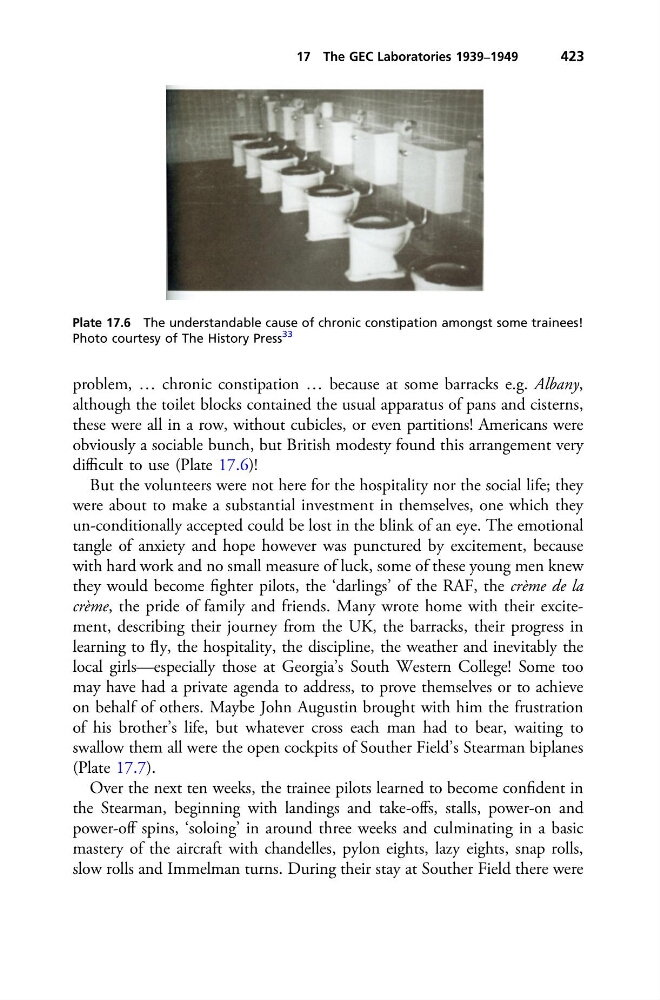
problem, … chronic constipation … because at some barracks e.g. Albany,
although the toilet blocks contained the usual apparatus of pans and cisterns,
these were all in a row, without cubicles, or even partitions! Americans were
obviously a sociable bunch, but British modesty found this arrangement very
difficult to use (Plate 17.6)!
But the volunteers were not here for the hospitality nor the social life; they
were about to make a substantial investment in themselves, one which they
un-conditionally accepted could be lost in the blink of an eye. The emotional
tangle of anxiety and hope however was punctured by excitement, because
with hard work and no small measure of luck, some of these young men knew
they would become fighter pilots, the ‘darlings’ of the RAF, the crème de la
crème, the pride of family and friends. Many wrote home with their excitement, describing their journey from the UK, the barracks, their progress in
learning to fly, the hospitality, the discipline, the weather and inevitably the
local girls—especially those at Georgia’s South Western College! Some too
may have had a private agenda to address, to prove themselves or to achieve
on behalf of others. Maybe John Augustin brought with him the frustration
of his brother’s life, but whatever cross each man had to bear, waiting to
swallow them all were the open cockpits of Souther Field’s Stearman biplanes
(Plate 17.7).
Over the next ten weeks, the trainee pilots learned to become confident in
the Stearman, beginning with landings and take-offs, stalls, power-on and
power-off spins, ‘soloing’ in around three weeks and culminating in a basic
mastery of the aircraft with chandelles, pylon eights, lazy eights, snap rolls,
slow rolls and Immelman turns. During their stay at Souther Field there were
Plate 17.6 The understandable cause of chronic constipation amongst some trainees!
Photo courtesy of The History Press
33
17 The GEC Laboratories 1939–1949
423
although the toilet blocks contained the usual apparatus of pans and cisterns,
these were all in a row, without cubicles, or even partitions! Americans were
obviously a sociable bunch, but British modesty found this arrangement very
difficult to use (Plate 17.6)!
But the volunteers were not here for the hospitality nor the social life; they
were about to make a substantial investment in themselves, one which they
un-conditionally accepted could be lost in the blink of an eye. The emotional
tangle of anxiety and hope however was punctured by excitement, because
with hard work and no small measure of luck, some of these young men knew
they would become fighter pilots, the ‘darlings’ of the RAF, the crème de la
crème, the pride of family and friends. Many wrote home with their excitement, describing their journey from the UK, the barracks, their progress in
learning to fly, the hospitality, the discipline, the weather and inevitably the
local girls—especially those at Georgia’s South Western College! Some too
may have had a private agenda to address, to prove themselves or to achieve
on behalf of others. Maybe John Augustin brought with him the frustration
of his brother’s life, but whatever cross each man had to bear, waiting to
swallow them all were the open cockpits of Souther Field’s Stearman biplanes
(Plate 17.7).
Over the next ten weeks, the trainee pilots learned to become confident in
the Stearman, beginning with landings and take-offs, stalls, power-on and
power-off spins, ‘soloing’ in around three weeks and culminating in a basic
mastery of the aircraft with chandelles, pylon eights, lazy eights, snap rolls,
slow rolls and Immelman turns. During their stay at Souther Field there were
Plate 17.6 The understandable cause of chronic constipation amongst some trainees!
Photo courtesy of The History Press
33
17 The GEC Laboratories 1939–1949
423