

series-modulation arose concerning the grid and filament circuits at the
high-tension end of the circuit, but as the visitor book shows, interest in
Droitwich continued throughout the world.
Over the next few years however, an interesting phenomenon that the local
householders became used to, especially those living adjacent to the transmitter site, was the sound of programmes mysteriously emanating from
objects such as electric cookers and iron ranges, such was the power of the
new transmitter. This was due to long lengths of house wiring and large metal
objects acting as receivers and picking up energy from the powerful transmitting aerials. This gave rise to an audible, but rather ‘tinny’, signal. One
lady claimed to be able to hear a programme every time she touched the
poker on the firebars of her metal fireplace! In later years, an attraction that
appealed to visitors, especially the children, was the pond. It was part of the
cooling system for the large transmitting valves, holding 300,000 gallons of
water containing thousands of goldfish to keep the water free from algae. In
time, the fish learned that when the metal guard rail was tapped, food was
about to appear. The canteen kept a supply of stale bread and visitors were
able to command shoals of fish to appear in response to the signal. It was
against regulations to remove fish from the reservoir but over the years many a
local ornamental garden pond was stocked from this source! Even so, one
cannot help feeling that the pond should ideally have contained some
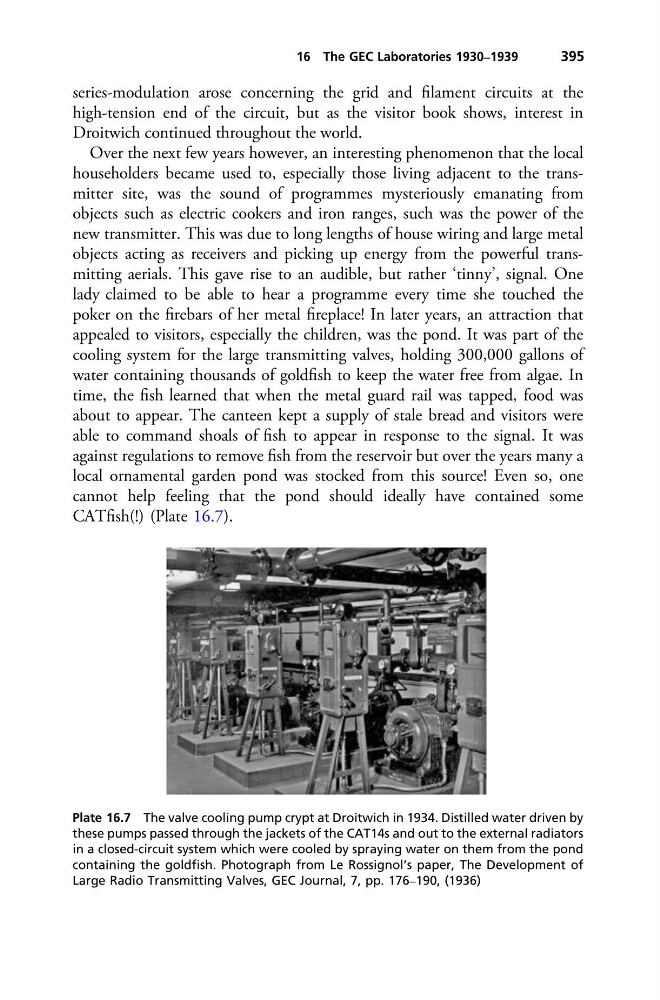
CATfish(!) (Plate 16.7).
Plate 16.7 The valve cooling pump crypt at Droitwich in 1934. Distilled water driven by
these pumps passed through the jackets of the CAT14s and out to the external radiators
in a closed-circuit system which were cooled by spraying water on them from the pond
containing the goldfish. Photograph from Le Rossignol’s paper, The Development of
Large Radio Transmitting Valves, GEC Journal, 7, pp. 176–190, (1936)
16 The GEC Laboratories 1930–1939
395
high-tension end of the circuit, but as the visitor book shows, interest in
Droitwich continued throughout the world.
Over the next few years however, an interesting phenomenon that the local
householders became used to, especially those living adjacent to the transmitter site, was the sound of programmes mysteriously emanating from
objects such as electric cookers and iron ranges, such was the power of the
new transmitter. This was due to long lengths of house wiring and large metal
objects acting as receivers and picking up energy from the powerful transmitting aerials. This gave rise to an audible, but rather ‘tinny’, signal. One
lady claimed to be able to hear a programme every time she touched the
poker on the firebars of her metal fireplace! In later years, an attraction that
appealed to visitors, especially the children, was the pond. It was part of the
cooling system for the large transmitting valves, holding 300,000 gallons of
water containing thousands of goldfish to keep the water free from algae. In
time, the fish learned that when the metal guard rail was tapped, food was
about to appear. The canteen kept a supply of stale bread and visitors were
able to command shoals of fish to appear in response to the signal. It was
against regulations to remove fish from the reservoir but over the years many a
local ornamental garden pond was stocked from this source! Even so, one
cannot help feeling that the pond should ideally have contained some
CATfish(!) (Plate 16.7).
Plate 16.7 The valve cooling pump crypt at Droitwich in 1934. Distilled water driven by
these pumps passed through the jackets of the CAT14s and out to the external radiators
in a closed-circuit system which were cooled by spraying water on them from the pond
containing the goldfish. Photograph from Le Rossignol’s paper, The Development of
Large Radio Transmitting Valves, GEC Journal, 7, pp. 176–190, (1936)
16 The GEC Laboratories 1930–1939
395