

reproduction of Karlsruhe’s larger, more advanced model. Now, however,
[with] my farewell at the end of this month, I have had … reason to
reproduce the larger Karlsruhe apparatus. If the Deutsches Museum
wishes to accept it as a gift, the master mechanic of my institute, [Hermann]
Lütge, will effect the transfer to Munich on my behalf and [ensure its] proper
installation there, without any costs for the Deutsches Museum. It only
requires his immediate assignment to the task, so that the [transfer] can [be]
done this month. during my time of service.
Respectfully F. Haber.
The museum inventory records show that the apparatus Haber originally sent
to the museum in 1922 was that produced by the BASF in 1910 and shown
in Plates (11.1) and (11.2), (Chap. 11). This apparatus had been used at
Karlsruhe for teaching/demonstration purposes. But as the original Haber-Le
Rossignol apparatus had been ‘lost’ after Haber’s departure from Karlsruhe,
he instructed his master mechanic to produce a faithful re-construction for
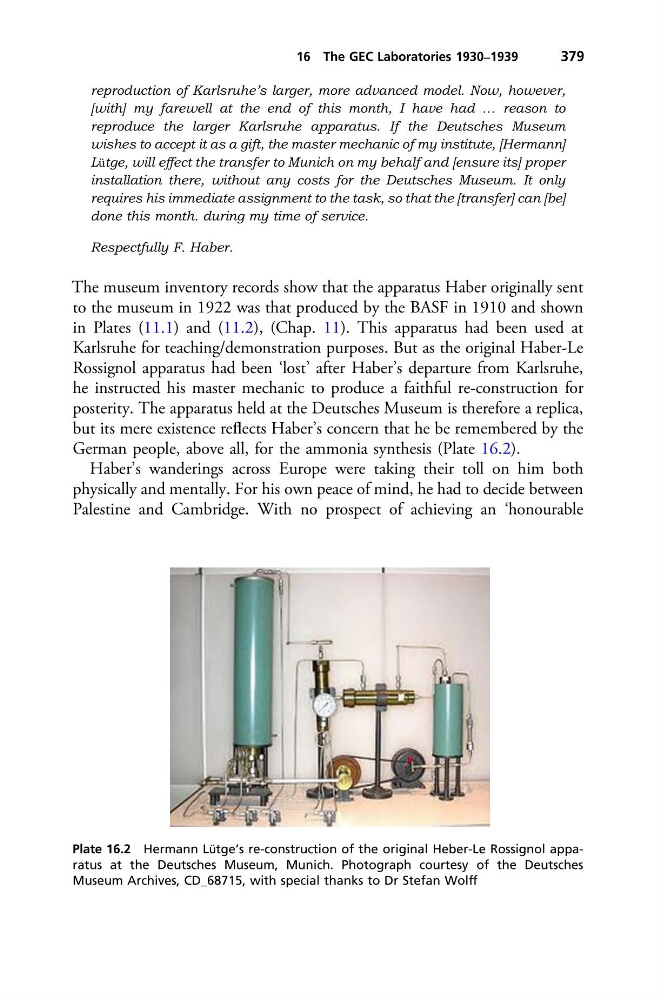
posterity. The apparatus held at the Deutsches Museum is therefore a replica,
but its mere existence reflects Haber’s concern that he be remembered by the
German people, above all, for the ammonia synthesis (Plate 16.2).
Haber’s wanderings across Europe were taking their toll on him both
physically and mentally. For his own peace of mind, he had to decide between
Palestine and Cambridge. With no prospect of achieving an ‘honourable
Plate 16.2 Hermann Lütge’s re-construction of the original Heber-Le Rossignol apparatus at the Deutsches Museum, Munich. Photograph courtesy of the Deutsches
Museum Archives, CD_68715, with special thanks to Dr Stefan Wolff
16 The GEC Laboratories 1930–1939
379
[with] my farewell at the end of this month, I have had … reason to
reproduce the larger Karlsruhe apparatus. If the Deutsches Museum
wishes to accept it as a gift, the master mechanic of my institute, [Hermann]
Lütge, will effect the transfer to Munich on my behalf and [ensure its] proper
installation there, without any costs for the Deutsches Museum. It only
requires his immediate assignment to the task, so that the [transfer] can [be]
done this month. during my time of service.
Respectfully F. Haber.
The museum inventory records show that the apparatus Haber originally sent
to the museum in 1922 was that produced by the BASF in 1910 and shown
in Plates (11.1) and (11.2), (Chap. 11). This apparatus had been used at
Karlsruhe for teaching/demonstration purposes. But as the original Haber-Le
Rossignol apparatus had been ‘lost’ after Haber’s departure from Karlsruhe,
he instructed his master mechanic to produce a faithful re-construction for
posterity. The apparatus held at the Deutsches Museum is therefore a replica,
but its mere existence reflects Haber’s concern that he be remembered by the
German people, above all, for the ammonia synthesis (Plate 16.2).
Haber’s wanderings across Europe were taking their toll on him both
physically and mentally. For his own peace of mind, he had to decide between
Palestine and Cambridge. With no prospect of achieving an ‘honourable
Plate 16.2 Hermann Lütge’s re-construction of the original Heber-Le Rossignol apparatus at the Deutsches Museum, Munich. Photograph courtesy of the Deutsches
Museum Archives, CD_68715, with special thanks to Dr Stefan Wolff
16 The GEC Laboratories 1930–1939
379