

expensive items, costing many hundreds of pounds. They were also fragile
and precautions were taken to prevent damage during handling. Marconi
therefore designed special trolleys to move the valves from the valve store to
the transmitter hall and then lift them into position, not only to prevent
damage but also to avoid undue delay in the event of a valve failure. To make
doubly sure, spare valves were already kept mounted in position. The life of
these valves was only measured in thousands of hours, they were therefore
always run under optimal conditions and constantly monitored.
16 As an
example of the dependability of CAT valves, in 1932 the BBC’s transmissions
amounted to 58,163 h. Breakdowns amounted to 0.023%, just half a second
per hour.
10 The design of a broadcasting station was therefore complex, a
‘many splendid thing’, but by September 1934 when BBC Droitwich began
broadcasting with the debut of the awesome CAT14, GEC and Marconi had
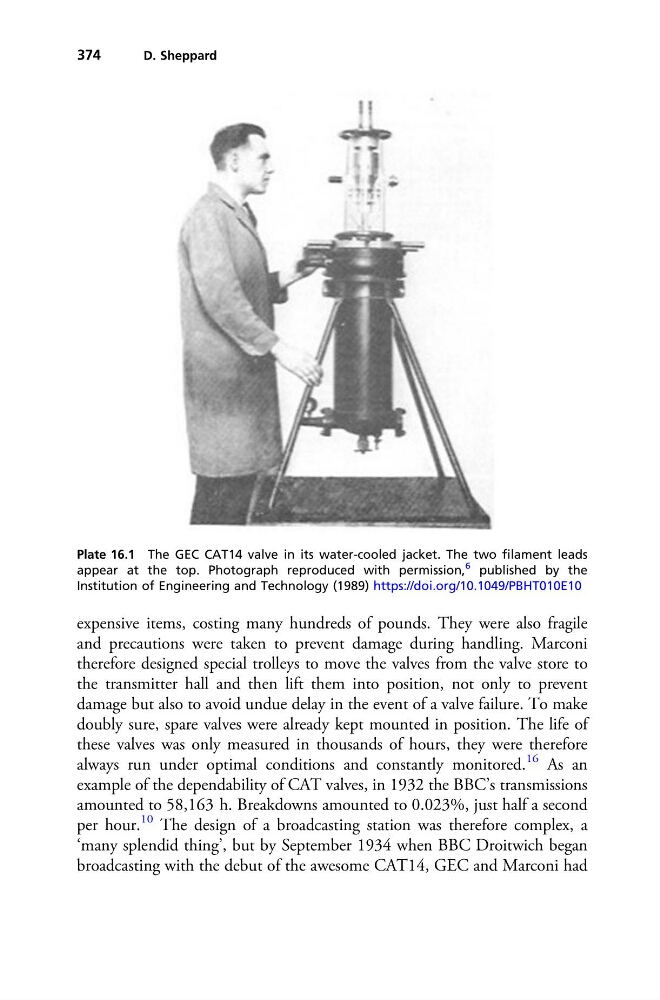
Plate 16.1 The GEC CAT14 valve in its water-cooled jacket. The two filament leads
appear at the top. Photograph reproduced with permission,
6 published by the
Institution of Engineering and Technology (1989) https://doi.org/10.1049/PBHT010E10
374
D. Sheppard
and precautions were taken to prevent damage during handling. Marconi
therefore designed special trolleys to move the valves from the valve store to
the transmitter hall and then lift them into position, not only to prevent
damage but also to avoid undue delay in the event of a valve failure. To make
doubly sure, spare valves were already kept mounted in position. The life of
these valves was only measured in thousands of hours, they were therefore
always run under optimal conditions and constantly monitored.
16 As an
example of the dependability of CAT valves, in 1932 the BBC’s transmissions
amounted to 58,163 h. Breakdowns amounted to 0.023%, just half a second
per hour.
10 The design of a broadcasting station was therefore complex, a
‘many splendid thing’, but by September 1934 when BBC Droitwich began
broadcasting with the debut of the awesome CAT14, GEC and Marconi had
Plate 16.1 The GEC CAT14 valve in its water-cooled jacket. The two filament leads
appear at the top. Photograph reproduced with permission,
6 published by the
Institution of Engineering and Technology (1989) https://doi.org/10.1049/PBHT010E10
374
D. Sheppard