

that Austen was successful in the Biology component of the preliminary
science examination at the University of London, probably a condition laid
down by Exeter prior to ‘going up’, as Victoria College had no track record in
the sciences. Robert’s father Augustin had of course studied at the London
Hospital in the 1860s and Austen was shortly to become a houseman there.
But according to Chirnside,
23 it was Woodland Toms’ connections with a
member of staff at UCL (one, ‘Dunlop’, who later left for Chile) that was the
deciding factor. Fortuitous though Robert’s choice may have been, it turned
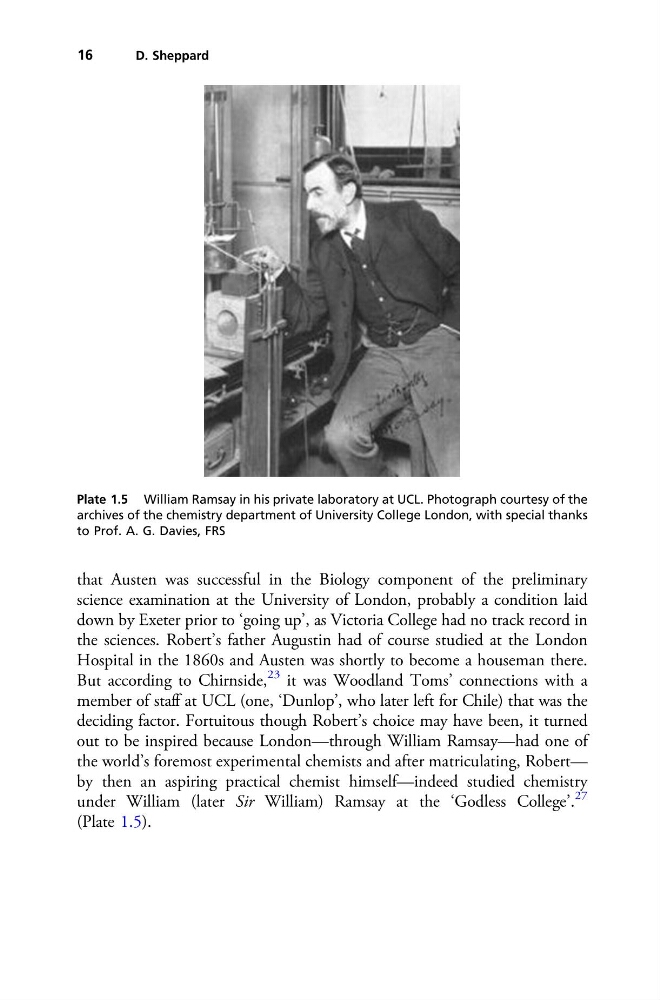
out to be inspired because London—through William Ramsay—had one of
the world’s foremost experimental chemists and after matriculating, Robert—
by then an aspiring practical chemist himself—indeed studied chemistry
under William (later Sir William) Ramsay at the ‘Godless College’.
27
(Plate 1.5).
Plate 1.5 William Ramsay in his private laboratory at UCL. Photograph courtesy of the
archives of the chemistry department of University College London, with special thanks
to Prof. A. G. Davies, FRS
16
D. Sheppard
science examination at the University of London, probably a condition laid
down by Exeter prior to ‘going up’, as Victoria College had no track record in
the sciences. Robert’s father Augustin had of course studied at the London
Hospital in the 1860s and Austen was shortly to become a houseman there.
But according to Chirnside,
23 it was Woodland Toms’ connections with a
member of staff at UCL (one, ‘Dunlop’, who later left for Chile) that was the
deciding factor. Fortuitous though Robert’s choice may have been, it turned
out to be inspired because London—through William Ramsay—had one of
the world’s foremost experimental chemists and after matriculating, Robert—
by then an aspiring practical chemist himself—indeed studied chemistry
under William (later Sir William) Ramsay at the ‘Godless College’.
27
(Plate 1.5).
Plate 1.5 William Ramsay in his private laboratory at UCL. Photograph courtesy of the
archives of the chemistry department of University College London, with special thanks
to Prof. A. G. Davies, FRS
16
D. Sheppard