

the period 1909–1915. Throughout his professional life, Robert it seems
studied the scientific literature meticulously, keeping hand-written records of
papers and patents of interest in ‘filofax’ style. One such filofax—addressed ‘7
St Johns Road’—remains within the family, mainly relating to references for
articles written in the 1930s and ‘40s, and including formulae and topics such
as refrigerators, centrifuges and atomic clocks. Several pages covering the
period from the late 1940s to the early 1950s are devoted to refrigeration
which seems to have been a life-long interest for him, and early refrigeration
engineering, comprising compressors, and circulating pumps moving heat
transfer agents such as ammonia through heat exchangers, may well have
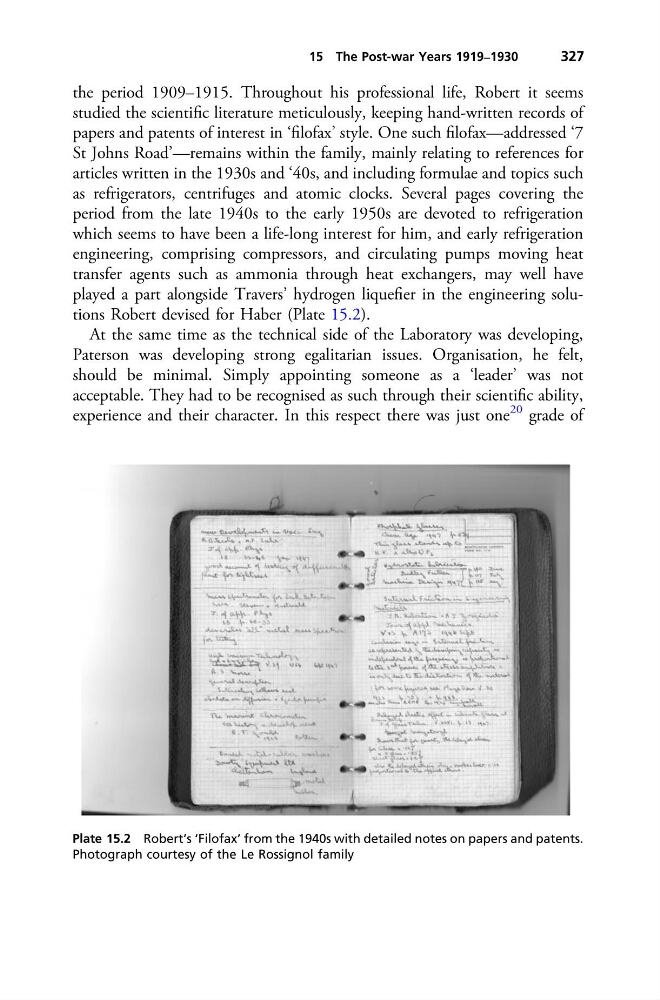
played a part alongside Travers’ hydrogen liquefier in the engineering solutions Robert devised for Haber (Plate 15.2).
At the same time as the technical side of the Laboratory was developing,
Paterson was developing strong egalitarian issues. Organisation, he felt,
should be minimal. Simply appointing someone as a ‘leader’ was not
acceptable. They had to be recognised as such through their scientific ability,
experience and their character. In this respect there was just one
20 grade of
Plate 15.2 Robert’s ‘Filofax’ from the 1940s with detailed notes on papers and patents.
Photograph courtesy of the Le Rossignol family
15 The Post-war Years 1919–1930
327
studied the scientific literature meticulously, keeping hand-written records of
papers and patents of interest in ‘filofax’ style. One such filofax—addressed ‘7
St Johns Road’—remains within the family, mainly relating to references for
articles written in the 1930s and ‘40s, and including formulae and topics such
as refrigerators, centrifuges and atomic clocks. Several pages covering the
period from the late 1940s to the early 1950s are devoted to refrigeration
which seems to have been a life-long interest for him, and early refrigeration
engineering, comprising compressors, and circulating pumps moving heat
transfer agents such as ammonia through heat exchangers, may well have
played a part alongside Travers’ hydrogen liquefier in the engineering solutions Robert devised for Haber (Plate 15.2).
At the same time as the technical side of the Laboratory was developing,
Paterson was developing strong egalitarian issues. Organisation, he felt,
should be minimal. Simply appointing someone as a ‘leader’ was not
acceptable. They had to be recognised as such through their scientific ability,
experience and their character. In this respect there was just one
20 grade of
Plate 15.2 Robert’s ‘Filofax’ from the 1940s with detailed notes on papers and patents.
Photograph courtesy of the Le Rossignol family
15 The Post-war Years 1919–1930
327