

Manager, visited the National Physical Laboratories to speak to Clifford
Paterson, Principal Assistant in charge of Electrotechnics and Photometry.
Paterson was approached because he had substantial contact with the
Hammersmith Works and he was asked to recommend a man who could
organise a research department along the lines envisaged by Hirst. Paterson’s
original reaction was that he felt GEC were doing the right thing, rather than
being reliant on University departments to advise them. He suggested two or
three people who might be interested, discussed with the visitors the type of
organization they ought to consider, and as industrial research institutions
those days were very rare, advised them that to some extent they were
embarking on the unknown. But the next day, Wilson asked to see Paterson
again having detected that he may not be averse to taking on the job himself.
Paterson’s initial response however was hesitant; no-one would support the
kind of freedoms he would want in such an organization; freedom to pick the
problems to be investigated, to choose the staff, to set their remuneration,
conditions of service and to demand the space and apparatus he felt was
necessary to do their job. But he had misjudged his visitors, they agreed
wholeheartedly with his vision and asked him to join them as soon as hostilities ceased.
Almost three years elapsed before the idea was considered again, but with
the Armistice of November 1918 Paterson approached the Osram management and asked them if they wished to reconsider the project before he and
others ‘took the plunge’ and resigned from the NPL. Amazingly, Wilson told
Paterson that far from their resolve weakening, an even larger scheme was
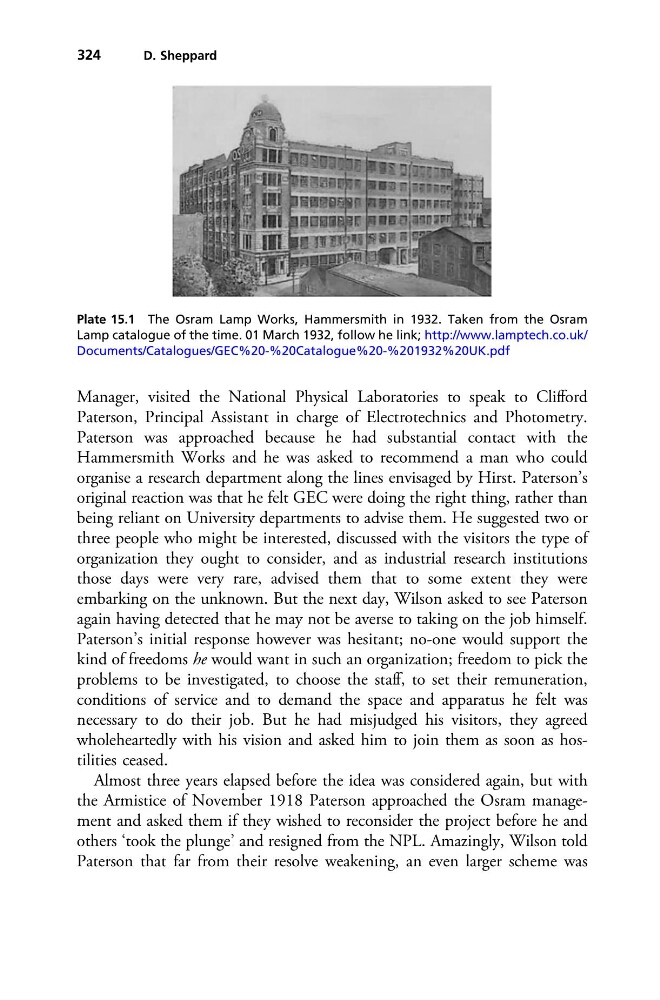
Plate 15.1 The Osram Lamp Works, Hammersmith in 1932. Taken from the Osram
Lamp catalogue of the time. 01 March 1932, follow he link; http://www.lamptech.co.uk/
Documents/Catalogues/GEC%20-%20Catalogue%20-%201932%20UK.pdf
324
D. Sheppard
Paterson, Principal Assistant in charge of Electrotechnics and Photometry.
Paterson was approached because he had substantial contact with the
Hammersmith Works and he was asked to recommend a man who could
organise a research department along the lines envisaged by Hirst. Paterson’s
original reaction was that he felt GEC were doing the right thing, rather than
being reliant on University departments to advise them. He suggested two or
three people who might be interested, discussed with the visitors the type of
organization they ought to consider, and as industrial research institutions
those days were very rare, advised them that to some extent they were
embarking on the unknown. But the next day, Wilson asked to see Paterson
again having detected that he may not be averse to taking on the job himself.
Paterson’s initial response however was hesitant; no-one would support the
kind of freedoms he would want in such an organization; freedom to pick the
problems to be investigated, to choose the staff, to set their remuneration,
conditions of service and to demand the space and apparatus he felt was
necessary to do their job. But he had misjudged his visitors, they agreed
wholeheartedly with his vision and asked him to join them as soon as hostilities ceased.
Almost three years elapsed before the idea was considered again, but with
the Armistice of November 1918 Paterson approached the Osram management and asked them if they wished to reconsider the project before he and
others ‘took the plunge’ and resigned from the NPL. Amazingly, Wilson told
Paterson that far from their resolve weakening, an even larger scheme was
Plate 15.1 The Osram Lamp Works, Hammersmith in 1932. Taken from the Osram
Lamp catalogue of the time. 01 March 1932, follow he link; http://www.lamptech.co.uk/
Documents/Catalogues/GEC%20-%20Catalogue%20-%201932%20UK.pdf
324
D. Sheppard